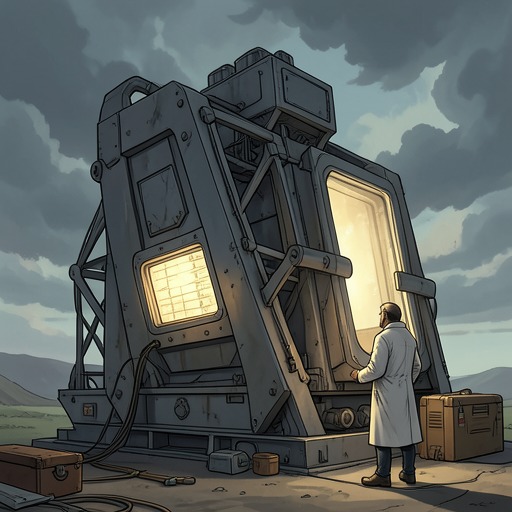
St. Ives's spacecraft
HomunculusSt. Ives's spacecraft is Langdon St. Ives’s experimental vehicle, a carefully prepared iron craft whose brief, unintended flight turns years of technical work into a hazardous public spectacle. Designed to rise from a silo atop a rocket, it combines a sealed cabin, an aerating device, and a Keeble box; its launch instead goes awry when Billy Deener interferes with the apparatus. The ship’s passage from engineered project to uncontrolled object makes its material details central to the story: it is not merely a means of travel, but a fragile assembly whose fate depends on people, mechanisms, and the conditions of its launch.
Design and Preparation
Langdon St. Ives spends a day testing the aerating device and preparing the vessel in the silo. The spacecraft is a spherical iron shell, its surface crosshatched with rows of rivets. It sits atop what resembles an enormous Chinese rocket, pointed toward the silo’s domed roof. Pulleys and chains are meant to draw the dome back and allow the craft to issue from the enclosure. Close to the hull are arched, batlike wings; exhaust and motivator tubes project from their bases. Heavy-glass windows ring the vessel beneath the conical locking mechanism of its hatch. The design is presented as a complete, purpose-built machine, but its planned passage through the silo depends on an exposed sequence of structures and controls.
The interior preparation reveals how much the vessel relies on a functioning life-support arrangement. St. Ives climbs the wooden stairway spiraling to the hatch and checks the cabin’s contents, including potted orchids and begonias intended to assist the Keeble box in supplying oxygen. He tests the sensing device by breathing onto it, then watches the gas-detection gauge respond. The trial is brief, but it gives him a measurable indication that the cabin’s atmosphere can register changes. He considers the test flight a serious risk: an unmanned craft might be lost at sea or come down in the suburbs. Nevertheless, sending it without a person aboard seems preferable to risking a passenger in an untested machine.
A Keeble box is anchored firmly inside the cabin. Its rosewood top, carved with hippos and apes, carries William Keeble’s distinctive handiwork into the spacecraft’s otherwise industrial interior. When St. Ives presses its tester button, it releases green chlorophyll dust in a mixture of helium and oxygen. The gauge jumps and then settles as the oxygen disperses through the cabin. The scene links the ship’s survival system to an object that also matters beyond the technical test: the box is a piece of equipment, but its identity and contents make it a source of danger and conflict elsewhere in the plot.
An Unintended Launch
The craft’s intended launch is disrupted by Billy Deener, who reaches the silo while St. Ives is away from it. Deener sees the rocket and spacecraft as something worth damaging, and he wants the box for Kelso Drake. After opening the hatch, he removes the box and places it on the landing outside. He then attacks the plants in the cabin, cutting and trampling the orchid and begonia growth that had been part of the oxygen-supply arrangement. His actions undo elements of the careful preparation St. Ives had completed only shortly before.
Deener next reaches a bank of levers on the rocket’s side and wrenches them about. One lever breaks off in his hand; he throws it against the others and then hurls it into the silo’s clapboard wall. A blast follows and throws him onto the grass. The domed roof bursts outward, scattering shingles and wooden fragments, and the rocket rises amid sparks. Its ascent is uneven: it appears to make little progress, and its nose threatens to dip toward the ground. The spacecraft’s departure is therefore not a controlled demonstration of St. Ives’s design. It begins amid damage, broken controls, and the destruction of the structure meant to contain and release it.
From beyond the willows, St. Ives watches the rocket edge above the trees. For a moment, the craft seems about to continue skyward, but the rocket hangs almost stationary before its nose dips and it falls lifeless into the meadow. The spacecraft separates from it, leaping from the rocket as if propelled from a toy pop gun, and arcs over the observers. Its cabin gaslamps are lit, while the hatch hangs open on its hinges. These details make the separation a startling reversal: the rocket fails to carry the vehicle onward, yet the spacecraft itself continues through the air, no longer as the controlled payload of the launch system but as an independent, uncontrolled object.
Damage and Consequences
The launch costs Langdon St. Ives more than the loss of a machine. An old man, Binger, later illustrates the destruction of Lord Kelvin’s barn with an oar, a whistled arc, and an abrupt gesture. St. Ives recognizes that Willis Pule has reduced both his spacecraft and his reputation to rubble with a single pull of a lever. The account connects the physical consequences of the launch to professional standing: the vehicle’s failure is also a public and personal setback, especially in the context of the Royal Academy’s interest and the effort invested in the project.
The episode also exposes how little control St. Ives has over the machine once it leaves the conditions for which it was designed. The craft’s careful shell, sensors, plants, and oxygen equipment cannot guarantee a safe voyage when the launching mechanism is interfered with and the hatch is left open. Its technical sophistication is real, but it remains vulnerable to rough handling and to failures in the larger system around it. In that sense, the spacecraft’s story is not a simple contrast between clever invention and ignorant destruction: its operation depends on the cooperation of several components, and their failure changes what the whole assembly can do.
The Ship’s Place in the Story
The spacecraft brings together different kinds of value. To Langdon St. Ives it is the product of years of work and the means by which he hopes to test a journey beyond ordinary travel. To Deener it is a target to meddle with, and the box inside it is something to steal for Drake. To the observers, its departure is an alarming event whose trajectory cannot be confidently predicted. These competing uses and expectations make the vehicle a contested object rather than a neutral tool: it carries scientific ambition, criminal intent, and the physical risk created when the two collide.
The later image of the open Keeble box containing a tremendous emerald, held before Dorothy Keeble and Jack by Captain Powers, gives the box a separate resolution, but not the spacecraft. The vehicle’s own ending is loss. Langdon St. Ives does not regret that loss, however; he has had his voyage and is certain that the future holds the promise of more. The statement grants the failed craft a double significance. It has not completed the reliable journey its preparation implied, yet its brief passage through the air has made the attempt itself consequential. The spacecraft remains an unfinished instrument of travel, but not, for St. Ives, the end of the possibility it embodied.