The Birth of Wainamoinen's Second Harp
KalevalaThe Birth of Wainamoinen's Second Harp is the making of a new instrument after a storm sweeps the minstrel’s fish-bone harp from his ship. Wainamoinen turns his own grief into a musical response to the lament of a birch tree: he makes the tree’s wood the body of a sacred harp, gathers tuning pins from an oak, and seeks golden ringlets from a maiden as he completes the work. The episode replaces a lost instrument not with an exact copy, but through a sequence of exchanges between the singer and the living landscape.
From loss to a new beginning
The new harp follows the destruction of Wainamoinen’s first one. During a storm, winds roar and the waters lash the vessel; the waves toss the war-ship high and cast away the fish-bone harp. The loss brings an abrupt interruption to the minstrel’s music. He laments that his songs will no longer echo over the hills of Kalevala, then wanders through the forest.
That movement away from the sea and into the woods changes the scene’s terms. The earlier harp was lost amid violent weather and a ship at risk; the next is made through attention to trees and the materials they can provide. Wainamoinen’s response is not to abandon music, but to find another way to give it form. The episode makes recovery a process of listening, asking, and crafting rather than a reversal of the storm itself: the fish-bone instrument is gone, and a different harp must be made.
The birch answers the minstrel
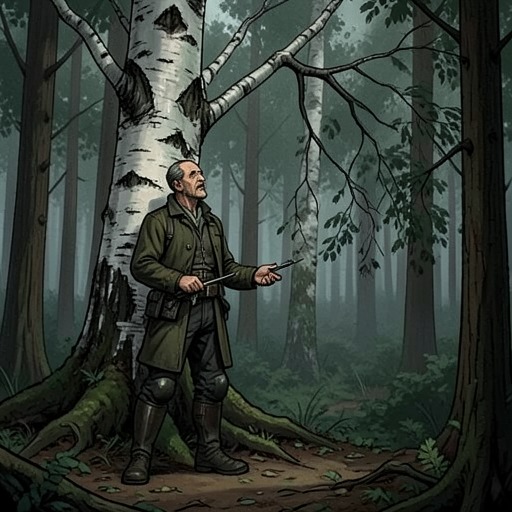
As he passes through the forest, Wainamoinen hears a juniper complaining and draws near to listen. He then addresses a birch tree, treating it as a companion rather than inert timber. The birch’s lament describes it as left naked on the mountain, lonely, helpless, and disheartened. Wainamoinen answers by promising to turn its grief to joy and to make it laugh and sing.
The promise becomes an action: he fashions a harp from sacred birch-wood, made in the days of summer. The scene links the tree’s voiced sorrow to the instrument’s eventual music. The birch is not simply cut down to serve the minstrel’s craft; the poem first gives it a complaint, lets Wainamoinen hear it, and makes the making of the harp an answer to that complaint. His words to the tree as a friend and brother establish a relation of kinship that the finished instrument carries into the song-making that follows.
Materials and completion
The birch supplies the harp’s body, but Wainamoinen must find the smaller parts needed to make it playable. He asks where the hooks and tuning pins can be found so that the harp may sing in concord. Nearby stands an oak with evenly spreading branches and an acorn on each twig. Wainamoinen takes the merry harp-pins from it, a practical use of the oak’s growth in service of the instrument’s ordered sound.
Even after completing the pins, he recognizes that the harp remains unfinished. He hastens to a maiden and asks her for her golden ringlets. The episode thus assembles the instrument through successive encounters: the birch offers its wood after its sorrow has been heard, the oak supplies pins for tuning, and the maiden is asked for her ringlets. The text identifies the request and then announces the harp’s completion; it does not dwell on the intervening workmanship. The resulting harp is presented as a made object whose materials have been gathered from distinct relationships and acts of address, not as a ready-made treasure discovered by chance.
Music restored to Wainola
Once the sacred harp is finished, Wainamoinen sits upon the rock of joyance. The instrument’s stated consequence reaches beyond the maker: it becomes a source of lasting pleasure for the people of Wainola. The ending therefore resolves the episode not merely by replacing an object, but by returning the possibility of shared music after the storm had seemed to silence the minstrel’s songs.
The second harp also forms a deliberate counterpoint to the first. The fish-bone instrument was carried away by forces beyond Wainamoinen’s control; the birch-wood harp emerges from a measured sequence of listening and making. Earlier harp episodes associate performance with gladness and with Wainamoinen’s tears, so the renewed instrument belongs to a recurring pattern in which music can gather pleasure and sorrow together. Here, however, the emphasis falls on recovery: a tree’s grief is answered with a promise of song, and the finished harp restores music to Wainola without undoing the loss that made its creation necessary.