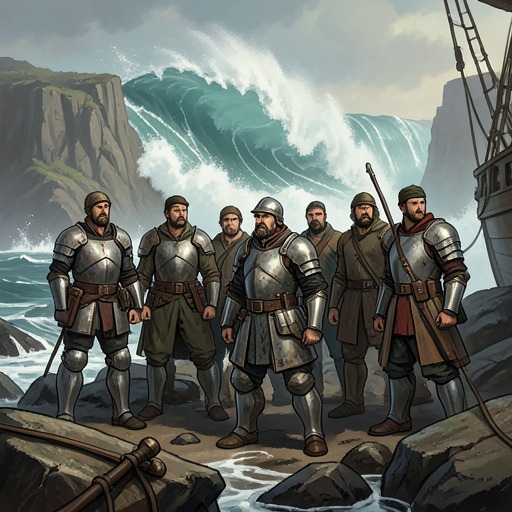
Wainamoinen's Expedition for the Sampo
KalevalaWainamoinen's Expedition for the Sampo is the northward undertaking through which Wainamoinen gathers companions and sets out toward Pohyola in pursuit of the Sampo. The episode makes the expedition’s formation part of its significance: Wainamoinen first addresses Ilmarinen as a brother and wonder-worker, while Lemminkainen later asks to join the journey. The poem thus presents the venture not as a solitary quest but as an alliance taking shape on the road to the Northland.
A Journey Proposed
The expedition takes form in Rune XXXIX, identified as Wainamoinen's Sailing. Wainamoinen, described as old and faithful, speaks to Ilmarinen and proposes that they go to Sariola. The appeal joins a personal bond to a practical undertaking: he addresses Ilmarinen as his brother and acknowledges him as a wonder-worker before inviting him north. The wording establishes cooperation as the journey’s starting point, even though these lines do not detail how the companions prepare or what terms they agree upon.
The destination and purpose acquire sharper definition as the passage proceeds. Wainamoinen calls the Northland unpleasant, and the expedition is identified as a journey for the Sampo. The poem first names Sariola in the invitation and later refers to Pohyola and the Northland. Those place-names anchor the movement northward, while the Sampo gives the voyage its objective. The distinction between the initial invitation and the later departure also gives the episode a measured beginning: proposal comes before the declared moment to journey.
Departure and Readiness
Before that moment, the text stresses the value of protection. It observes that a man is stronger in armor and safer in copper mail. The lines present readiness as a condition of the Northland journey, not as a report of a particular battle or a description of a specific attack. The emphasis is on the danger implied by the destination: the party is going somewhere against which armor and mail matter.
The narrative then makes departure explicit, announcing that the time has come to journey to the never-pleasant Northland. Wainamoinen is again called ancient, connecting the expedition’s forward motion to the veteran figure who initiated it. The sequence moves from brotherly proposal, through counsel about protection, to an announced journey. It supplies a clear threshold into the adventure without detailing the route or the travelers’ equipment beyond the reference to armor and copper mail.
Lemminkainen Joins the Venture
As the party approaches the Northland, the scene shifts to a jutting promontory where a Northland village appears. Lemminkainen stands there, presented by several names and descriptions: Kaukomieli, black magician, and Ahti, wizard of Wainola. His placement at this point in the journey makes him a figure encountered at the edge of the destination rather than one introduced in Wainamoinen’s initial invitation to Ilmarinen.
Lemminkainen asks Wainamoinen to take him to Pohyola, referring to the stone-berg and copper-bearing mountain. The request turns the expedition from the undertaking of the original pair into a venture that includes a third named companion. It also gives the approach a social encounter: as the Northland village comes into view, Lemminkainen openly seeks a place in the journey. The passage establishes his wish to accompany Wainamoinen, but does not, in these lines, describe a debate over his admission or specify what role he will play afterward.
The Expedition's Narrative Place
The episode’s structure emphasizes assembly and approach rather than a continuous account of every stage of travel. Its key turns are compact: Wainamoinen proposes the journey to Ilmarinen, the text marks the need for protection and the time of departure, and Lemminkainen asks to join near a Northland village. Together, these moments show how the expedition’s company forms as its destination draws closer.
The rune sequence places the sailing before the later rune titled Capture of the Sampo. That transition connects the northward venture to its stated object and to the poem’s subsequent Sampo episode, without making the surviving expedition details a full account of the capture itself. Within the evidence presented here, the expedition’s decisive development is therefore its movement from proposal to departure and the enlargement of its company on the way to Pohyola.