Wainamoinen's Sowing of Barley
KalevalaWainamoinen's Sowing of Barley recounts how Wainamoinen establishes a barley crop where vegetation has appeared but barley will not grow. The episode makes cultivation a hard-won beginning: seeds must be found, the forest prepared, and the grain entrusted to the ground through both human work and an appeal to Ukko. Its clearing of the land is not absolute, however. A birch remains for the birds, and the resulting crop marks the transformation of a wild, unproductive place into a source of food.
The Need for a Crop
The episode begins with a problem rather than a harvest. Many kinds of vegetation are present, but barley is not growing. Wainamoinen, described as old and trusty, goes away to consider what must be done. The poem thus distinguishes the abundance of untended plant life from the particular success of a cultivated grain: the presence of vegetation alone does not provide the crop he seeks.
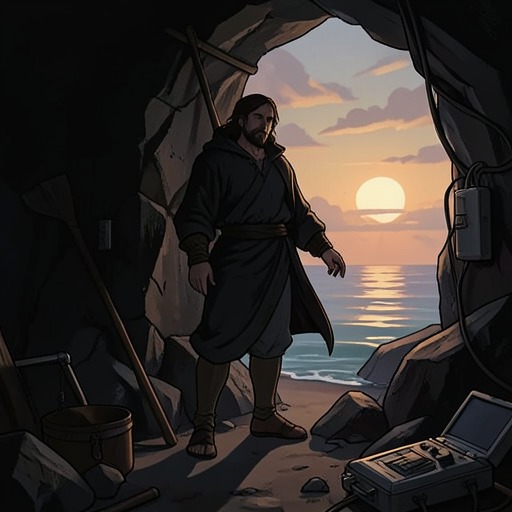
His search brings him to the borders of the waters and the ocean's sandy margin. There he finds six seeds of golden barley, then specifies seven ripened kernels on the shore of upper Northland. The verse preserves both numbers in its account, presenting the discovery as a small, precious stock of seed rather than an already flourishing supply. The shoreline is where the means of cultivation become available, but finding grain does not yet make the land ready to receive it.
Preparing the Forest
Wainamoinen's next task is to clear the ground. He considers the need for the forest to be levelled and its branches burned to ashes, makes himself an axe, and begins felling trees. The work is described broadly: he cuts trees of different kinds, making human labor the immediate means by which a field can be opened. The axe is a practical tool, and its appearance marks the shift from deliberation to sustained physical action.
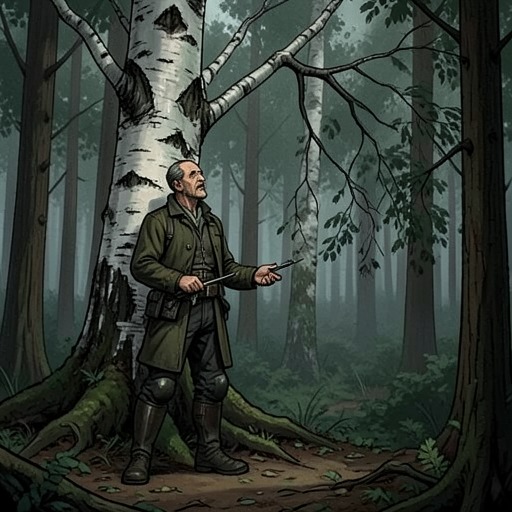
The clearing has a limit. Wainamoinen leaves the birch standing so that birds will have a place to rest and sing. In the poem's sequence, this exception is a concrete feature of the new field's preparation, not an incidental detail: the work of making space for barley does not require removing every tree. The Cuckoo's song is associated with the birch as a place of rest, giving the spared tree a continuing use amid the cleared ground.
A bird from heaven then kindles fire among the branches, and north winds fan the flames. The fire burns the cut wood to dust and ashes, while the birch remains standing. The sequence joins Wainamoinen's axe-work to fire and wind: clearing is accomplished through a combination of his deliberate preparation and forces that carry it further. At the end of the burning, the land is not wholly bare; the single spared tree remains the visible exception to the destruction of the branches.
Sowing and Appeal to Ukko
With the ground prepared, Wainamoinen brings out his magic grains of barley and scatters the seed. He calls them seeds of life and describes sowing through his open fingers, connecting the act to the hand of his Creator. The image makes planting both a bodily action and an act placed within a larger sacred order. The grains are handled and dispersed by Wainamoinen, but their growth is not represented as his achievement alone.
He addresses Ukko as the God above and Father of the heavens. His words also recognize his own contribution: he speaks of the crop in relation to his plowing and sowing, and to his skilled and honest labor. The appeal therefore does not erase work or substitute prayer for it. Human effort has prepared the ground and scattered the grain; the invocation asks for the conditions in which that work can come to fruition. Ukko holds counsel in the cloud-space, and the seeds then grow, unfolding from germ into blades and richly colored ears.
Harvest and Significance
Wainamoinen returns to see how his plowing, sowing, and labors have turned out. He finds barley growing, its blades triple-knotted and its ears six-sided. The crop's distinctive forms provide the visible answer to the opening failure: barley, previously absent among the vegetation, now stands as the result of the entire sequence. The poem records not merely that seed was placed in earth, but that it matured into a harvest with described characteristics.
The episode's structure gives cultivation several necessary parts. The seeds must be discovered; trees must be felled and burned; one birch is deliberately left for the birds; and the grain must be sown through human labor and accompanied by an appeal to Ukko. Its significance lies in this linked account of practical work, the powers of the natural world, and divine assistance. The opening contrast between plentiful vegetation and absent barley is answered not by effortless abundance but by a process of preparation and care.
That account also suits the Kalevala's presentation of the mysteries of nature and the origins of things. The epic was transmitted unwritten through generations by song-men, and its songs preserve knowledge and experience alongside mythic narrative. In this episode, the origins of a cultivated crop are rendered memorable through a sequence of vivid particulars: seven ripened kernels on a northern shore, the axe in the forest, the birch reserved for birds, fire driven by the north winds, and barley returning in a formed harvest. Cultivation begins not with mastery of every part of nature, but with labor shaped by attention to what should remain.