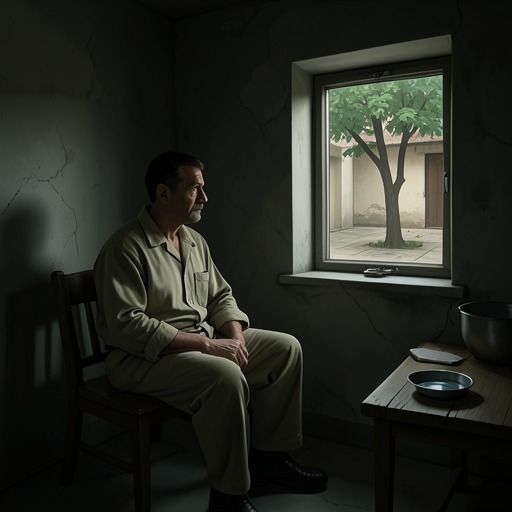
Pasha Rybkin
LimonovPasha Rybkin is a veteran Russian prisoner whose unlikely combination of toughness, good humor, and ascetic discipline makes him both a striking presence in Saratov prison and a decisive influence on Eduard Limonov. Though surrounded by a long history of crime, he is peaceful rather than threatening. His most consequential act in the narrative is to teach Limonov meditation, a simple practice that Limonov adapts to the constraints of prison life.
Identity and Prison Life
At thirty, Pasha has already spent ten years in prison. He is described as a colossus with a shaved head, a body and appearance that might suggest menace, yet his manner contradicts that expectation: he is peaceful and almost invariably in a good mood. The narrator characterizes him as part holy fool and part Asian ascetic, a comparison that captures the unusual mixture of unworldliness and discipline he brings to prison.
His habits make that discipline visible. In summer and winter, even when the temperature in his cell falls below zero, he walks around in shorts and flip-flops. He does not eat meat, drinks hot water rather than tea, and practices yoga, including impressive poses. These details distinguish him from the ordinary rhythms of the cell without making him aloof from its inhabitants. His asceticism is lived as a routine, not presented as a performance or a claim to status.
Pasha’s background is inseparable from criminality, but it does not define his whole character. Limonov sums up the scale of the crimes around him by likening Pasha to someone surrounded by crimes as forest dwellers are surrounded by trees. The contrast matters: a man with ten years behind bars and a life encircled by offenses is nevertheless portrayed as calm, generous in spirit, and capable of recognizing wisdom in another person.
Friendship with Eduard Limonov
Pasha is one of the prisoners Limonov gets along with best. He addresses him formally as Eduard Venyaminovich and quickly recognizes him as a wise man. His praise is strikingly direct: he assures Limonov that people like him are no longer made and that he has never met anyone like him. The exchange establishes a relationship based not on Limonov’s celebrity or political reputation, but on Pasha’s personal judgment of the man he encounters in prison.
That recognition also runs in the other direction. Limonov’s account calls Pasha a good, wise gangster: the criminal history is acknowledged, but it does not cancel the qualities that make him a valued companion. Pasha’s peacefulness and good humor sit alongside the severity of his past, allowing the character to resist the simple division between criminal and moral person. In prison, where reputations can precede their owners, the bond rests on something more immediate than either man’s public image.
Teaching Meditation
Pasha’s most important contribution is teaching Limonov to meditate. The practice begins with a plain physical arrangement: sitting cross-legged, keeping the spine straight, closing the eyes, and attending to the breath. The difficulty is not mastering an elaborate technique but accepting that there is nothing more to do. Thoughts continue to arise; rather than trying to drive them away, the practitioner watches them pass and returns attention to breathing.
The account emphasizes meditation as a modest shift in one’s relation to mental agitation. Restlessness, boredom, and the desire to move do not have to disappear before they can be observed. Watching them creates some distance from them, so that a person is less entirely held by each impulse. The result is not represented as a grand revelation but as a glimpse of calm, and the progress is incremental. Pasha provides the practical introduction; Limonov, characteristically, recognizes its usefulness and puts it to work.
At first Limonov meditates on his cot in the lotus position. Once he understands the practice, he discovers that it does not depend on a conspicuous posture and can be carried out discreetly anywhere. He uses it during the transfers from his cell to the investigating judge’s office, through double doors, metal cages, and paddy wagons, amid police dogs and the curses of guards. The method Pasha teaches thus becomes portable: Limonov can retreat inward even while moving through the machinery of confinement.
Narrative Significance
Pasha changes what prison can mean for Limonov. The surrounding institutions control movement and isolate prisoners, but the meditation lesson gives Limonov a way to attend to his own mind within those limits. His practice does not remove the prison or alter its conditions; it changes how fully its noise, discomfort, and imposed routines can command his attention. Pasha’s influence is therefore quiet but consequential, transmitted not through political argument or a dramatic rescue but through instruction in how to sit, breathe, and observe.
The narrative also sets Pasha’s teaching within a wider account of Limonov’s developing equanimity. The narrator suggests that Limonov’s encounter with Zolotarev and the strange experience in the Altai following Zolotarev’s death may have prepared him for meditation, and even speculates that the trapper somehow sent him this gift. That is the narrator’s conjecture, not a claim made by Pasha. Pasha remains the immediate human source of the practice: the experienced inmate who explains it, and whose lesson Limonov carries from the cot into the prison’s most controlled passages.