Lenya Kosogor
LimonovLenya Kosogor is a Russian émigré, former prisoner of Kolyma, and would-be writer who becomes one of Eduard Limonov’s few sources of practical support after Tanya leaves. His significance lies in the contrast between a life marked by extreme hardship and an unrealized literary ambition, and in his quiet care for a younger man who had once avoided him. When Limonov reaches his lowest point, Lenya does not offer a grand rescue: he stays beside him, helps him secure welfare, and gives him a concrete example of a life built around work rather than fame.
Identity and Background
Lenya has spent ten years at Kolyma. Among the émigrés, his imprisonment is known through his appearance in The Gulag Archipelago: they identify him as the man Aleksandr Solzhenitsyn wrote about. Lenya takes pride in having his name recorded there, and measures the length of his sentence against Solzhenitsyn’s own experience. He imagines that he, too, could write about the Gulag and become rich and famous, but never does so. His history gives him a claim to tell a consequential story; his failure to turn that claim into a book leaves him suspended between recognition and unrealized possibility.
That stalled ambition makes him an illuminating counterpart to Limonov. Both men are émigrés with literary hopes, and both are drawn to the prospect of fame. But Lenya’s claim to a readership rests on what happened to him in the camps, while Limonov’s sense of a future has depended on the belief that his adventurous life will eventually make him known. Lenya has a name in a famous book, yet does not produce the book he imagines; Limonov still wants to become famous, but after Tanya’s departure can no longer trust that this future will arrive.
Finding Limonov and Staying Beside Him
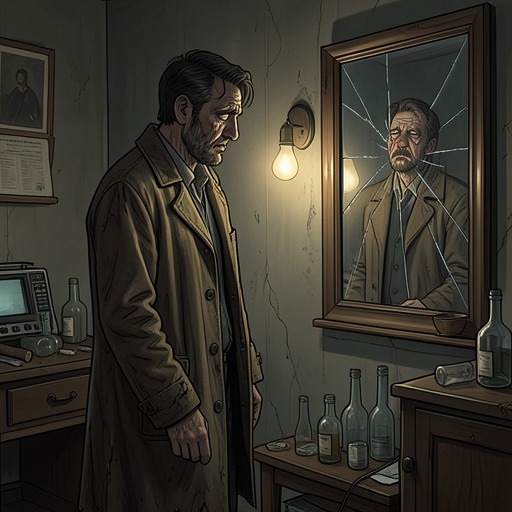
After Tanya leaves on February 22, 1976, Limonov disappears into a week of blackout drinking. When he wakes on February 28 in a room at the Winslow Hotel, Lenya is at his bedside. The narrative suggests that Limonov has been walking the streets and may have fought someone: he has a couple of black eyes, but remembers almost nothing of the week. Lenya’s presence is one of the few definite facts in the aftermath of this collapse.
Lenya had found Limonov lying on the sidewalk, practically unconscious and half dead from the cold. From then on he does not leave his side. The account presents his help both as a good deed and as something psychologically complicated. Limonov had usually avoided Lenya because he feared that Lenya brought bad luck. Now the arrogant young man has reached rock bottom, and Lenya may feel some private satisfaction at the reversal. The possibility of that satisfaction does not cancel his care: he takes Limonov to the welfare office, where Limonov is allocated $278 a month. The rescue is modest and material, a bed and a limited income rather than a way out of misery, but it gives Limonov a means to survive.
The Winslow’s cheapest room costs $200 a month, leaving Limonov $78. Lenya’s intervention therefore does not restore him to security or work; it helps establish the narrow conditions in which his decline continues. Limonov does not seek employment. He drinks cheap California wine, rummages through restaurant garbage, asks compatriots for money, and sometimes steals purses. He wanders poor and dangerous neighborhoods, enters abandoned buildings to talk with vagrants who often do not share his language, and sometimes takes shelter in churches. Against this landscape of degradation, Lenya’s continuing presence is a durable human connection, even when it cannot change the direction Limonov has chosen.
A Model of Work and Ordinary Life
Months later, Limonov has been acting as a handyman and helper in Steven Gray’s household. He repairs a table leg, oils garden tools, and cooks borscht that the guests enjoy. He knows the house well, and recognizes that Steven’s snobbery might make the idea of employing a Russian poet as a butler appealing. As Limonov considers asking for the position, Lenya’s example gives the imagined future a practical shape: he thinks of becoming a mover like Lenya, buying a truck, then two, and eventually running a moving company.
This is not evidence that Lenya owns a moving company or has achieved the prosperous life Limonov pictures. The aspiration belongs to Limonov. Lenya functions as the available example of a working life that might be built incrementally, far removed from the fame Limonov once expected his adventures to bring. In his fantasy, employment leads to a business, and a business leads to domestic stability with Tanya: shared meals, mutual care when either partner is ill, and a settled home. The dream borrows Lenya’s occupation but enlarges it into a story of recovery and reconciliation.
The contrast is sharp because Lenya’s own circumstances are not presented as a success story. He is a former prisoner who hopes to write but never does; Limonov turns his work into an imagined route towards becoming a boss. Lenya’s example matters less as a promise that such a transformation will happen than as proof that Limonov can still picture a future made from ordinary labor. In that moment, the man who had helped him endure a breakdown also supplies the outline of a life that might follow it.
Narrative Role
Lenya links the humiliating physical facts of Limonov’s collapse to the later possibility of restarting. The bedside scene at the Winslow establishes his loyalty through action, while the welfare payment shows the limits of that loyalty: he can help Limonov secure money, but cannot make him want work or restore his confidence after Tanya’s departure. His assistance is neither a dramatic cure nor a mere gesture. It keeps Limonov housed while he chooses to live at the margins.
The narration also uses Lenya’s unrealized authorship to echo Limonov’s recurring danger of mistaking a hoped-for identity for an achieved one. Lenya believes his experience could make him a successful writer, but does not write; Limonov imagines future fame, then falls into a room where his world has contracted to a few paces. Yet Lenya does not simply mirror that failure. He continues to act for someone else, and his concrete kindness outlasts Limonov’s earlier superstition about him. In the passage from cold pavement to the imagined moving business, Lenya stands as both a fellow loser and an unceremonious guide toward survival.