Alexander Dugin
LimonovAlexander Dugin is introduced as the intellectual fascist who fascinates Eduard Limonov and helps shape the National Bolshevik project. A philosopher and prolific reader with a gift for theatrical storytelling, Dugin offers Limonov more than a set of political ideas: he supplies a dramatic language of history, violence, and destiny. Their partnership gives an embryonic opposition movement a party name, a newspaper title, and a flag, but the intellectual and social gulf between their followers eventually becomes too wide to bridge.
Introduction and Political Setting
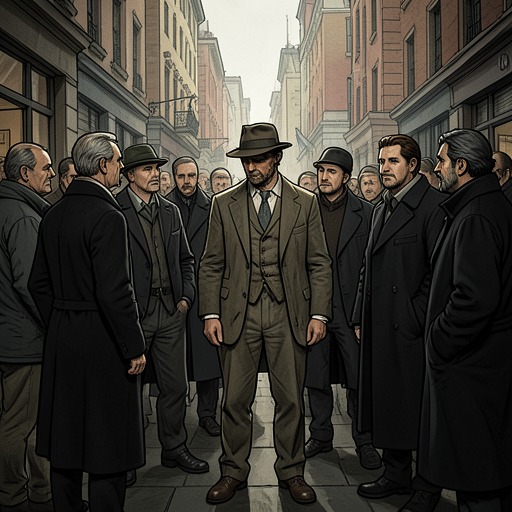
Dugin appears at a banquet organized by Alexander Prokhanov, editor in chief of Dyen. Limonov has come into contact with a motley circle of nostalgic Communists and uncompromising nationalists, trying to persuade himself that they represent the nation’s vital forces. He meets Dugin while recounting the violent career of Konstantin Kostenko, a battalion commander he had encountered while reporting in Transnistria. The meeting starts with a story of a man who made himself master of a town and seemed to expect his own violent death; Dugin recognizes in it the shape of a tale that demands to be preserved.
Dugin is described as a thirty-five-year-old philosopher who has already written half a dozen books. His learning and confidence distinguish him from the other political figures around Limonov. Limonov finds the established opposition comrades inadequate, but in Dugin he encounters someone whose thought and manner seem to answer his own appetite for action and danger. The attraction is not simply agreement over a political program. Dugin makes political history feel like an imaginative world populated by powerful, unstable figures.
Storytelling and Intellectual Influence
Dugin responds to Limonov’s account of Kostenko by suggesting that the battalion commander knew he was going to die and wanted some trace of his obscure, violent fate to survive. The interpretation gives the story a literary afterlife: Kostenko’s conversations become not merely an account of wartime adventure but a last act of self-inscription. Dugin’s confidence in reading the story impresses Limonov, who is willing to entertain the thought that Dugin knows more than he does.
The next toast gives Dugin an opportunity to tell his own set-piece story, about Baron von Ungern-Sternberg. He draws out the portrait of an anti-Bolshevik aristocrat who led cavalry into Mongolia, commanded men through a mixture of bravery and cruelty, and became a figure of supernatural authority to Mongol horsemen. Isolated from his White allies, Ungern-Sternberg’s unit took on the character of a sect; his rule joined power and violence, and he was eventually captured and hanged by the Red Army. Dugin’s delivery is as important as the story. The narrative slows while he builds suspense, his warm, cello-like voice turning a scholarly account into a performance. The book compares his command of the scene to Werner Herzog’s Aguirre and Joseph Conrad’s Kurtz. Limonov, who ordinarily disdains intellectuals, is captivated and wishes that someone might one day tell his own life with comparable force.
Dugin’s physical presence reinforces the contrast between bookish scholar and commanding performer. He is large, bearded, and hairy, yet moves lightly, sometimes balancing on one leg while lifting the other behind him. He speaks fifteen languages, has read widely, drinks alcohol straight, and laughs openly. The narrator distinguishes him from the Parisian poseurs and crude nationalists Limonov has already met: Dugin represents a third type, the intellectual fascist, steeped in books and esoteric theories. Limonov admires him despite the age difference and resolves to learn from him.
Ideology and the Founding Project
Before meeting Dugin, Limonov’s political thinking is characterized as confused and sketchy. Dugin does not make it less confused, but under his influence it becomes more elaborated, acquiring a dense web of historical and philosophical allusions. Dugin rejects the idea that fascism and communism must be opposites. Instead, he reveres both and assembles a deliberately heterogeneous pantheon that includes Vladimir Lenin, Mussolini, Hitler, Mayakovsky, Julius Evola, Jung, Mishima, Wagner, Lao-tzu, Che Guevara, and Rosa Luxemburg. When Limonov proposes adding Charles Manson, Dugin is willing to make room for him too. In this scheme, ideological color matters less than what the men regard as vital impetus.
The two men imagine themselves as complementary partners: Dugin is the man of thought, Limonov the man of action; one is cast as Brahmin, the other as warrior. Their ambitions are larger than their existing alliances, and they decide that together they can accomplish what their opposition comrades cannot. The partnership becomes organizational as well as theatrical. Neither later agrees on who invented the name National Bolshevik Party: after their separation, each claims it, and later each attributes it to the other when seeking respectability. Their shared enthusiasm at the time is clear, even if authorship is not.
Limonov’s contribution to the new project is more definite in two other respects. He devises the name of the future newspaper, Limonka, meaning the grenade, and a painter friend draws the flag on a kitchen table. Its white circle on a red background recalls the Nazi flag, but replaces the swastika with a black hammer and sickle. The party has a name, a newspaper title, a flag, and an initial member, the Ukrainian student Taras Rabko. The beginnings are small, but the movement’s symbols announce the provocative fusion of political traditions that Dugin and Limonov have embraced.
The Party, Its Factions, and the Split
Dugin’s influence continues within the party through his performances as a storyteller. At the party’s bunker, his office is comfortable, with an electric heater, carpets, a samovar, and bookshelves filled to the ceiling; Limonov’s is spartan, although he sometimes practically lives there. The bunker attracts fashionable artists and provincial young activists alike. When Dugin is in good form, he holds both groups with stories of Japanese kamikaze sacrifices, Mishima’s suicide, and Ungern-Sternberg’s paramilitary Buddhist sect in Mongolia. His beard, heavy eyebrows, and warm voice restore the spell that had first won Limonov over.
His writing has a different effect. Dugin submits dry, abstract, and tedious articles to Limonka with solemn seriousness, apparently convinced that these doctrinal essays form the paper’s backbone and explain its appeal to readers. He dislikes the newspaper’s tone and appearance, preferring the look of confidential journals associated with the European far right. Limonov, who largely produces Limonka himself, does not dare refuse the articles, even though Dugin’s power to captivate a room does not translate into persuasive prose.
As time passes, the divisions between the two men’s followers become increasingly visible. Dugin’s disciples include fascist students with large schoolbags and anti-Semitic Orthodox priests. They look down on Limonov’s recruits, who are commoners drawn to rock music and fistfights and who care little for fascist history; some are actively put off by it. Zakhar Prilepin belongs to this latter constituency and dislikes the movement’s references to the Freikorps. He is also uncomfortable with Limonov’s affectionate nickname for Dugin, Dr. Goebbels.
The quarrels grow poisonous, and Dugin eventually leaves the party to establish a center for geostrategic studies, described in the book as prosperous and partly funded by the Kremlin. His departure ends the partnership that had joined the storyteller and the activist. The party is left with Limonov’s recruits rather than Dugin’s intellectual following, and Prilepin is relieved by the separation. Dugin’s importance in the narrative therefore rests both on what he helps create and on the split he cannot prevent: he gives the movement an imposing mythology, while the competing cultures inside it expose the limits of the alliance.