Garri Kasparov
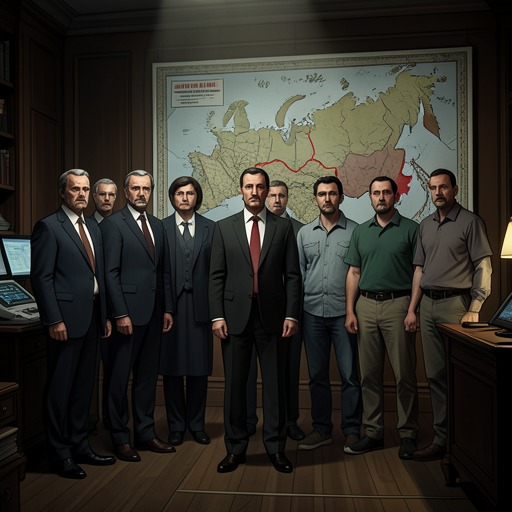
LimonovGarri Kasparov is presented as both a world-famous former chess champion and the most persuasive public face of The Other Russia, a coalition formed with Eduard Limonov and a former prime minister under Vladimir Putin. At a joint press conference, Kasparov’s polished democratic case briefly persuades Emmanuel Carrère that Russia’s opposition might be on the verge of a historic opening. The scene’s force comes from the reversal that follows: a British journalist’s dry constitutional correction turns the imagined breakthrough into a demonstration of how easily hope can outrun political reality.
Identity and Political Position
Several months after Carrère encounters the National Bolshevik movement, he learns that The Other Russia is forming under the leadership of Kasparov, Limonov, and a former prime minister who served under Putin. The coalition brings together figures whose public identities seem difficult to reconcile: a world-class chess champion, a former member of Putin’s government, and a writer whom Carrère initially considers a disreputable fascist. The unlikely grouping prompts Carrère to reconsider not necessarily Limonov himself, but the position Limonov occupies in Russian politics.
That reassessment gives Kasparov particular importance in the narrative. His presence helps make Limonov newly legible as part of an opposition alliance rather than simply as the leader of an isolated extremist fringe. Yet the coalition’s breadth does not by itself establish shared convictions or a common political future. The account presents the alliance through its public appearance and through Carrère’s shifting judgments, leaving the relationship between its members’ beliefs deliberately unsettled.
The 2008 Election and the Democratic Case
At the press conference, Kasparov takes the offensive and presents the presidential election scheduled for 2008 as a historic opportunity. Putin is nearing the end of his second term, and the constitution bars him from running for a third consecutive term. Because no officially endorsed successor has yet emerged, Kasparov argues that a democratic opposition has a chance to fill the apparent political opening.
His diagnosis connects that opportunity to the conditions he says ordinary Russians face. The media, he argues, is gagged; people cannot freely see how fed up the country is with oligarchs, corruption, and the unchecked power of the security services. Kasparov speaks with striking eloquence. Carrère describes his voice as resembling a cello and admits that, listening to him, he begins to think the Swedish filmmakers in the room may be right to expect a consequential rise for The Other Russia.
The press conference draws journalists as well as party militants. A Swedish group is making not a short report but a documentary involving three months of filming. Its members appear convinced that Kasparov and Limonov may come to power, and anticipate selling the film internationally. Their confidence gives the opposition’s future an almost cinematic shape: the event is being recorded as though the ascent it hopes to document were already underway. The scene does not confirm that expectation; it shows how powerfully the possibility can be staged and believed.
Skepticism and the Constitutional Limit
Carrère’s brief excitement is interrupted by a British journalist sitting beside him. The journalist dismisses Kasparov’s account and argues that Russians love Putin rather than resent him. More consequentially, he points out that the constitution prohibits three consecutive terms, not a later return after an intervening president holds office. The distinction suggests that the formal barrier Kasparov identifies may not prevent Putin from eventually returning to power.
The aside changes Carrère’s perception at once. He had begun to imagine that he was witnessing the beginning of a democratic breakthrough; now he returns to the skeptical view represented by a perceptive friend who regards the idea of democratic opposition as something outside the rules of Russian politics. Kasparov’s speech, moments earlier a possible sign of historic change, begins to sound to Carrère like noisy provincial rhetoric. The narrative does not independently settle the argument by showing the coalition’s electoral prospects. Instead, it makes the narrator experience the gap between an eloquent political claim and the constraints that might defeat it.
The Partnership with Limonov
Kasparov’s public prominence contrasts with Limonov’s quietness at the press conference. Standing beside and slightly behind Kasparov, Limonov listens attentively as he describes the authorities’ persecution. He does not appear to be waiting impatiently for his turn to speak. Carrère’s attention shifts from Kasparov’s warm voice to Limonov’s inscrutable face, and he cannot tell whether Limonov believes in the democratic project, finds amusement in playing the virtuous democrat, or enjoys the possibility of acting as a wolf among longtime dissidents and human-rights activists.
That uncertainty complicates the alliance without making Kasparov’s own role disappear. He supplies its articulate democratic argument; Limonov’s presence makes the coalition’s meanings less secure. Carrère recalls a passage from Limonov’s Diary of a Loser that celebrates small, inept, and politically hopeless causes while imagining violence against orchestral musicians if Limonov ever came to power. The British journalist, after seeing Limonov’s book and its images of him in camouflage beside Serbian paramilitary leader Arkan and other controversial figures, suspects that Limonov’s allies might themselves be in danger if he gained power. Kasparov is therefore framed not only as an opposition leader but as one half of a partnership that observers interpret in radically different ways.
Narrative Significance
Kasparov’s significance in this account lies in the tension between political possibility and political performance. His case is specific: a coming election, a constitutional term limit, a government with no publicly endorsed successor, and a population allegedly kept from expressing its discontent. Its eloquence moves Carrère and encourages the Swedish filmmakers to imagine an impending transfer of power. But the journalist’s point about the limit on consecutive terms exposes a loophole in the opposition’s optimism, while Carrère’s sudden retreat into skepticism shows how fragile his confidence was.
The later political landscape in the book reinforces the difficulty of imagining a stable democratic alternative, though it does not supply a direct account of Kasparov’s subsequent actions. In other scenes, patriots gather at the Moscow White House amid conflicting claims about constitutional legitimacy, and the Russian public is described as becoming so dissatisfied with democracy, the market, and their associated injustices that the Communist Party becomes a serious electoral alternative. These wider pressures place Kasparov’s appeal within a struggle over what opposition, democracy, and popular legitimacy can mean. The narrative leaves him at the press conference: forceful and convincing on the podium, but surrounded by doubts about whether his vision can overcome the political rules and public resentments that the scene brings into view.