Alexander Rutskoy
LimonovAlexander Rutskoy’s role in the confrontation at the Moscow White House is defined by a sharp reversal: once beside Boris Yeltsin in the building that had symbolized the democrats’ triumph, he becomes the rebel parliament’s rival president. A former military leader in Afghanistan and vice president of the Russian Republic, he occupies the center of a crisis in which constitutional authority is claimed by both sides, while the army’s allegiance remains uncertain. His encounter with Eduard Limonov makes that uncertainty personal, and his eventual surrender marks the end of the rebels’ brief bid to hold power.
Identity and Political Position
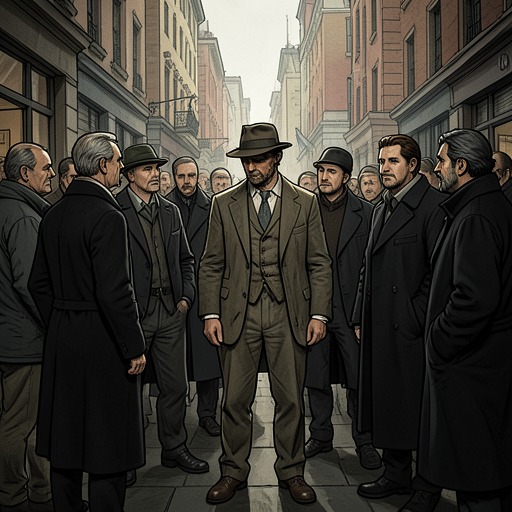
The account presents Rutskoy as a senior officeholder whose political position does not fit neatly into a stable camp. He is vice president of the Russian Republic and a former military leader in Afghanistan. The narrative also places him in Yegor Gaidar’s team, even as it describes him repeatedly attacking the prime minister, whom he derides as the “little boy in pink shorts.” The nickname refers to a photograph of the prime minister playing golf in that outfit. This antagonism is part of Rutskoy’s profile before the revolt: he is already challenging the government from within its political orbit.
His change of sides is made more striking by the building at the heart of the crisis. Two years earlier, the Moscow White House had stood worldwide as a symbol of Yeltsin and the democrats’ victory; Rutskoy had been there at Yeltsin’s side. Now he joins Ruslan Khasbulatov, the Duma’s president, in leading a rebellion against Yeltsin. The reversal gives the conflict its unstable character: the same place and some of the same political actors now stand for the opposing claim to legitimacy.
The Rebel Presidency
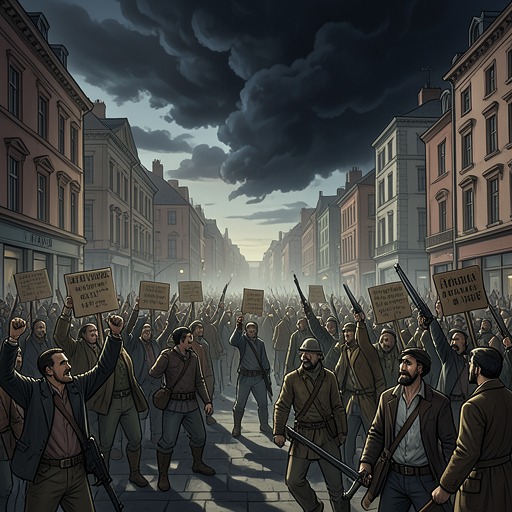
When several thousand patriots gather outside the building, their political identities are mixed. Some are fascists, but in this confrontation they present themselves as defenders of constitutional order and accuse the democrats of preparing a dictatorship. The narrative does not treat their claim as straightforwardly credible or dismissible; it emphasizes how difficult it has become to separate constitutional argument from political opportunism. Against that unsettled background, Rutskoy and Khasbulatov convene an extraordinary session of the dissolved parliament.
The assembly declares the dissolution unconstitutional, deposes Yeltsin, names Rutskoy president in his place, and occupies the White House. It says it is acting by the will of the people and will leave only if forced out at bayonet point. Rutskoy is thus not merely one participant among the parliamentarians: the assembly makes him the rival head of state. Yet the declaration does not settle the practical question of power. The rebels must still determine whether the military will support them, and their claim to rule depends on an army whose response neither side can take for granted.
Limonov’s Audience with Rutskoy
During the occupation, Rutskoy locks himself in an office on the building’s highest floor, with soldiers posted outside. At three in the morning Limonov insists on seeing him and obtains an audience. Rutskoy is dressed in army fatigues and appears feverish. He does not quite know who his visitor is, but the pressure of the night has made him willing to speak to almost anyone. Limonov begins by addressing him as “Comrade President,” a form of address Rutskoy is not accustomed to and likes.
The general has spent the evening calling military bases to find out where they stand. When Limonov asks how things look, Rutskoy answers “Normalno,” a deliberately elastic expression that might suggest anything from a reassuring report to a worsening situation. The word captures the central uncertainty of his position: the decisive question is whose side the army will take, and even the idea of acting for the law is complicated by the rival claims of Yeltsin and Rutskoy. The United States, Britain, Germany, and France have declared support for Yeltsin against the new putschists; the news appears to shake Rutskoy.
Limonov urges him to treat Western support for Yeltsin as predictable and argues that the rebellion is not a coup but a democratically elected parliament resisting dictatorship. Rutskoy agrees, frowning as though he is encountering the argument anew and trying to retain it for a future speech. But agreement on the justification for the revolt does not produce agreement about what to do. When Limonov presses him to distribute weapons, Rutskoy calls it premature. Limonov invokes the Russian Revolution of 1917, the idea of a moment ripe for action, and the word kairos, which he has learned from Alexander Dugin. He challenges Rutskoy to decide whether he wants to be remembered as a great man or a coward.
Rutskoy responds angrily that military decisions should be left to specialists and dismisses Limonov as a writer and intellectual. The encounter exposes a divide inside the rebellion: Limonov wants the general to seize the moment and prepare for armed resistance, while Rutskoy reserves the decision to himself and rejects pressure from a civilian visitor. The audience ends not with a plan but with Limonov’s dismissal. Later, when addressing his own party convention, Limonov recalls Rutskoy as the general who had been told that the moment was ripe and had refused to act.
Surrender and the End of the Revolt
By dawn, Limonov and Taras Rabko learn at a subway station that tanks have surrounded the White House. The prospect of victory has given way to the recognition that the rebellion is lost. During the attack, Rutskoy says he will commit suicide like Hitler in his bunker, but he surrenders in the afternoon instead. The account stresses the human cost of the delay: it gives the assault time to claim 150 casualties before his surrender, and the ensuing violence becomes a bloodbath. The dead and wounded include not only insurgents but also passersby, older people, and children; inside the building, security forces hunt the besieged through offices, halls, and toilets.
Limonov and Rabko escape the park after being caught in the fighting, then hide through the night before going to Tver. From there, the book describes the collapse of confidence in the official account of the crisis and the weakening of the word democracy as an uncontested description of what has happened. Rutskoy’s surrender closes the immediate military contest, but it does not resolve the confusion over which side represented constitutional order or who could claim moral authority after the bloodshed.
Narrative Role
Rutskoy’s importance lies less in a developed private history than in the pressure his office and military background bring to the revolt. The rebel assembly can name him president, and Limonov can call him “Comrade President,” but neither title answers whether the army will obey him or whether he will authorize resistance. His ambiguous “Normalno,” his hesitation over weapons, and his surrender form a sequence in which the appearance of command repeatedly meets the limits of command.
The later convention scene turns that failed encounter into part of Limonov’s political memory. Limonov presents the moment as a test of historical timing, recalling that Rutskoy rejected the chance to act when the bravest men were gathered and ready to fight. That recollection is also a contrast between the general’s caution and Limonov’s self-image as someone who recognizes the decisive moment. In the larger account, Rutskoy’s brief elevation and defeat show how titles, constitutional claims, and military authority can pull apart in a crisis—and how quickly a rival presidency can end when the forces holding the building are overwhelmed.