Yegor Gaidar
LimonovYegor Gaidar was the young economist Boris Yeltsin turned to when Russia’s first elected president faced the task of building a market economy in a country with no market tradition. Gaidar’s faith in liberalism and urgency about reform made him the architect of shock therapy. The policy’s speed was meant to forestall reaction, but price liberalization and failed voucher privatization helped turn the promise of shared national wealth into a chaotic transfer of opportunity—and left Gaidar defending the transition as the least disastrous available choice.
Background and Appointment
Gaidar came from the high Communist nomenklatura, the very political world from which he advocated a decisive break. The book presents him as a young prodigy with an absolute faith in liberalism: his conviction in the market was described as more fervent than that of prominent advocates of free-market economics in the United States and Britain. His ancestry and his doctrine thus pull in opposite directions. He was formed within the Communist elite, yet placed his hopes in an economic system Russia had never experienced.
Yeltsin, conscious of his own lack of economic expertise, brought Gaidar forward to devise a remedy. Their problem, as they saw it, was not simply how to replace state control with markets, but how to do so before reactionary forces could defeat reform. They believed that gradual action would leave reformers vulnerable, so they resolved to move very quickly. The name they gave their program, shock therapy, captured both its intended force and the abruptness of the experiment.
The Shock-Therapy Program
The first major measure was price liberalization. It produced inflation of 2,600 percent, a shock severe enough to undermine the accompanying Russia’s voucher privatization program. On September 1, 1992, vouchers worth ten thousand rubles were mailed to every Russian citizen older than one year. Each voucher was intended to represent a share in national wealth. The scheme aimed to turn people who had been expected to work for the collective into investors, while encouraging businesses and private property to take root.
By the time the vouchers arrived, however, inflation had stripped them of nearly all their value. Their recipients found that a voucher might buy a bottle of vodka, and many sold theirs to people prepared to offer roughly the value of a bottle and a half. That disparity turned a universal grant into an opening for buyers with the means and foresight to gather vouchers on a large scale. Among those who emerged from this process as billionaires within months were Boris Berezovsky, Vladimir Gusinsky, and Mikhail Khodorkovsky, figures the narrative uses to represent the new oligarchs.
A Market Without Rules
The rise of these fortunes is presented not as the straightforward result of a settled market but as the consequence of creating one overnight without the institutions that might govern it. The young businesspeople who bought up vouchers were described as intelligent and energetic, with talents that had been prohibited under the old system. Then they were suddenly told to put those talents to work in an environment without rules, laws, a banking system, or taxation. The transition opened space for business while leaving the terms of business unsettled; the narrative compares the resulting landscape to the Wild West.
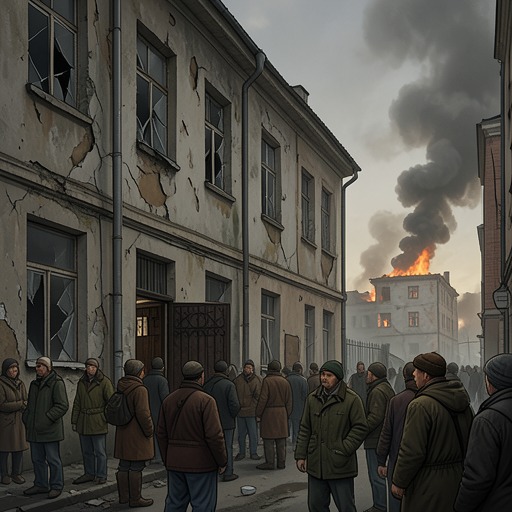
That social cost was not abstract. The public argument over reform was conducted amid demonstrations in Moscow by pensioners reduced to begging and soldiers who had not been paid, alongside Communists and nationalists angered by the loss of equality or empire. Gaidar’s program therefore appears in a conflict over who would bear the disruption and who could turn it to advantage. The old promise of a radiant future had been recast in the language of the market, but the people who felt themselves broken by reform were now able to speak out rather than fear being sent to Siberia.
Political Reception
The political message associated with Gaidar’s party offered a sharp contrast to those hardships. In an advertisement, a prosperous family in a suburban house votes for the party; after leaving the polling station, the child jokes that the dog cannot vote. Eduard Limonov calls this imagined middle-class scene an insult to nearly all Russians. The episode makes the party’s difficulty legible: its picture of comfortable private life was far removed from the experience of people struggling with the consequences of reform.
The satire does not mean that voters turned uniformly against the governing party. The account says that people often voted for the party in power simply because that was how voting worked in Russia. Yeltsin and Gaidar won the elections described, while Vladimir Zhirinovsky nevertheless received a quarter of the vote. Gaidar’s political project consequently occupies an uneasy position in the narrative: it could prevail electorally even as the social image used to sell it alienated the very population whose lives the transition was remaking.
Retrospective Defense and Significance
Before his death, Gaidar, by then a former prime minister, told a journalist that the choice had not been between an ideal transition to a market economy and a criminalized one. It had been between a criminalized transition and civil war. This retrospective defense gives his role its starkest formulation. It does not erase the inflation, the worthless vouchers, or the rapid concentration of wealth; instead, it frames those outcomes against the danger Gaidar believed a slower or defeated reform might bring.
Gaidar is therefore depicted neither simply as a technocrat nor as a detached observer of reform’s damage. He helped drive a program whose speed was deliberate, whose economic shock was immense, and whose institutional vacuum benefited those able to exploit it. The account leaves that tension unresolved: the transition was defended as a way to avert civil war, yet its costs fell unevenly and its promise of shared ownership was compromised almost as soon as the vouchers reached the public.