Viktor Alksnis
LimonovViktor Alksnis, the Black Colonel, is presented as a hard-line Soviet military representative whose theatrical public persona made him conspicuous among otherwise drab opponents of Mikhail Gorbachev. A television-studio encounter brought him into close contact with Eduard Limonov, and their subsequent calls, faxes, and shared expectation of a coup turned a brief meeting into a political alliance. In 1993, Alksnis again entered the narrative as the person who alerted Limonov that patriots were assembling at the Moscow White House.
Identity and Public Image
Alksnis appears amid the political uncertainty surrounding Gorbachev, who had lost the confidence of both democrats and conservatives. The latter wanted to preserve power, while the former had initially admired Gorbachev and then grown disappointed when he seemed unwilling to press ahead. At Andrei Sakharov’s funeral, a young man’s comparison of Gorbachev to an awkward Jedi prompted a journalist to ask who played Darth Vader. The young man’s answer—that there were plenty of candidates—leads the narrative to the hard-liners in the Politburo and military-industrial complex, and then to Alksnis, described as a second-stringer whose media success stood out against the group’s colorless, uncharismatic image.
That contrast helps explain his prominence in the account without making him a leader of the entire opposition. He was a parliamentary representative for Soviet military personnel in Latvia, and he used public appearances to denounce Baltic separatists and recommend martial law. His political language gathered together constituencies that would ordinarily be difficult to reconcile: Marxist-Leninists, Stalinists, neofascists, Orthodox believers, monarchists, and pagans. He presented their proposed alliance as a sacred union intended to prevent the country’s disintegration, which he attributed to people who did not love it and wished to subordinate it to foreign powers. The breadth of this list, and its mixture of political and religious identities, gives his project an explicitly coalition-building character; its common ground is defense of the state against the alleged threat of disintegration.
Meeting with Eduard Limonov
Eduard Limonov met Alksnis during a brief trip to Moscow, when both had been invited to take the anti-Gorbachev side in a television discussion. Their opponents included democrats, former dissidents, and people from the Memorial Society. The program therefore placed Alksnis and Limonov together in a public confrontation across political lines, rather than presenting their association as a private acquaintance formed in isolation from current events.
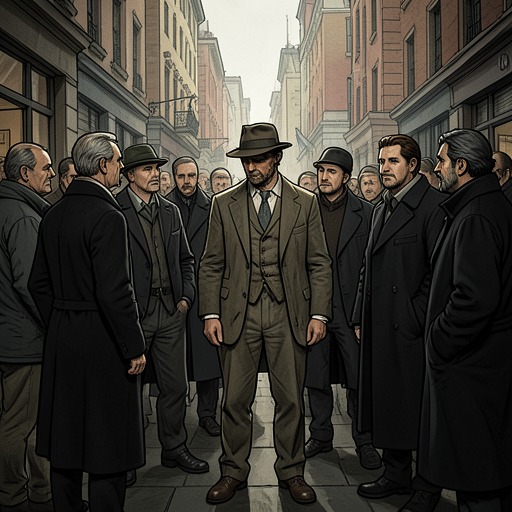
The narrator emphasizes Alksnis’s appearance: dressed in black leather, wearing a savage grin, he resembled an actor auditioning for a villain’s part. This image is not merely a description of his clothing. It accentuates the gap between the muted hard-liners surrounding him and the easily recognizable antagonist he seemed to perform in public. The account links that performance to his calls for martial law and his denunciation of separatists, making his forceful appearance part of the way his politics reached an audience. Limonov and Alksnis became close soon after the broadcast. Their affinity is a significant turn in Limonov’s political trajectory: he was not simply reporting on a hard-line figure but entering an active relationship with him.
Comrades, Journalism, and Coup Expectations
After the television program, Alksnis introduced Limonov to his comrades. The group included soldiers and members of the security services; its members read Mein Kampf and The Protocols of the Elders of Zion. They also published ultranationalist newspapers, among them Dyen. The democrats nicknamed that paper the Herald of the General Staff, while it described itself as a newspaper of the intellectual opposition. The competing labels expose a struggle over political identity: the publication claimed an oppositional and intellectual role, while its opponents associated it with the military establishment.
Limonov made his debut as a Russian journalist in Dyen. This detail gives the association a consequence beyond political companionship: contact with Alksnis’s circle also provided a setting for Limonov’s return to Russian-language journalism. After Limonov went back to Paris, the two men stayed in touch by telephone and fax. They encouraged one another amid what appeared to them to be the prospect of an imminent coup d’état. The account thus traces their relationship across distance, from the television studio in Moscow to continued exchanges after Limonov’s departure, while placing their private communication within a shared anticipation of political upheaval.
The 1993 Crisis and Alksnis’s Role
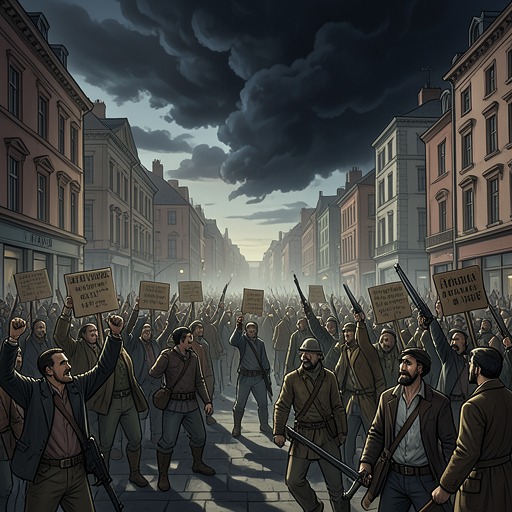
In September 1993, while Limonov was staying in Moscow, Boris Yeltsin announced on television that he was dissolving the Duma and calling new elections. Limonov was watching with a bowl of broth when the telephone rang. Alksnis was on the line and told him that events were heating up and that the patriots were meeting at the Moscow White House. Limonov emptied his bowl and set out for the gathering.
The call establishes Alksnis as an intermediary who could alert Limonov to a rapidly developing confrontation. It does not establish that Alksnis himself was at the building, and the episode leaves the focus on the effect of his news: Limonov moves immediately from watching the announcement to joining the assembled patriots. Several thousand people were already outside the building, which had been a worldwide symbol of Yeltsin and the democrats two years earlier. In that reversal, a site associated with the democratic triumph became the meeting place of opponents who claimed to be defending constitutional order. Alksnis’s brief phone call connects his earlier hard-line alliance with Limonov to this later crisis, where the political alignments and symbols of the preceding years had been sharply rearranged.