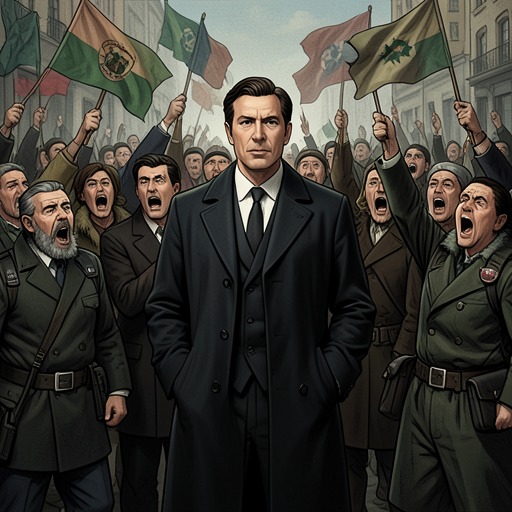
Pristavkin
LimonovPristavkin is a presidential adviser on human rights and a cultural apparatchik whose prison visit turns an old political antagonism into a negotiation over Eduard Limonov’s freedom. He presents himself as an advocate for a wronged writer, but his proposed remedy depends on a staged admission of guilt and the protection of the Federal Security Service from embarrassment. The encounter makes his liberalism consequential and compromised at once: he can challenge the treatment of a prisoner, yet he works through the same institutions whose authority shapes the prisoner’s choices.
Identity and Political History
Before the meeting, Pristavkin and Limonov had clashed in a debate about the crimes of communism. Limonov had denounced him as a traitor and a sellout; Pristavkin, in turn, took opportunities to attack Limonov as a fascist. He had even written in Literaturnaya gazeta that prison was the best place for him. Their history gives the visit a deliberately uneasy premise: the man now asking to speak privately with Limonov is not an old ally arriving to make amends, but a former opponent whose motives are difficult to read.
Pristavkin is identified with the Gorbachevian cultural establishment, and the public face he brings to the colony is that of a visiting human-rights official. Yet the scene does not present him simply as a principled reformer. His later offer is pragmatic and explicitly tailored to the calculations of officials: it would give the security service a way to save face while allowing Limonov to leave prison. The character’s significance lies in that mixture of access, political adaptability, and apparent concern for the prisoner.
The Delegation and the Private Meeting
The director announces the visit of a delegation of the kind periodically shown around the penal colony. Pristavkin has specifically requested a meeting with the prisoner Savenko, and the director asks whether Limonov consents. The question itself surprises Limonov: prisoners are ordinarily expected to obey, not to be consulted. He is also wary of what the invitation might signal to the people around him, but accepts.
When the delegation arrives, about ten carefully selected, clean-shaven inmates wait in silence. The visitors’ flushed faces suggest they have just come from a plentiful lunch, while their questions about prisoners’ welfare invite answers that the men have reason to fear giving honestly in front of the director. Limonov watches Pristavkin watching him. He notices that his former opponent has lost hair, gained weight, and developed blotches on his skin, and privately contrasts the apparatchik’s appearance with the fitter life of an adventurer. The detail keeps the meeting from becoming an abstract exchange of political positions: both men assess one another, and the prisoner measures the visitor against the life he himself has chosen.
Pristavkin then asks to speak with Limonov alone, but addresses him as Limonov rather than Savenko. Limonov corrects him. The correction briefly makes the prisoner’s identity a point of friction in front of the delegation: the official name by which the authorities classify him is not the name he insists upon. In the director’s office, Pristavkin takes him by the arm and seats them side by side on a sofa, like old friends. Limonov has imagined remaining standing while the visitor took the director’s chair, a posture that would acknowledge the actual imbalance between them. Pristavkin instead arranges a show of familiarity, without removing the institutional setting that gives the encounter its stakes.
The Bargain
Pristavkin begins with praise. He calls Limonov a major Russian writer, commends The Book of Water, and says it has been shortlisted for the Russian Booker Prize. He invokes the concern of the PEN Club and argues that the terrorism charges against Limonov are untenable. He contrasts an artist with Mikhail Khodorkovsky, whom he describes as a genuinely serious economic criminal, and insists that Limonov does not belong among killers. The appeal is both personal and strategic: Pristavkin offers recognition of Limonov’s literary standing, then uses that standing to argue that the state has treated him too harshly.
Limonov does not simply accept the division Pristavkin draws between writers and killers; he replies that some of the killers are admirable men. Pristavkin laughs and invokes Dostoyevsky, then assures him that the matter will be taken care of. When Limonov tentatively indicates that he will not refuse such help, Pristavkin reveals its condition. Limonov should admit guilt, he says, not because the admission needs to become public, but to prevent the Federal Security Service from losing face. It could remain in the file, he suggests, and Limonov might be released within a month or two.
The proposal makes Pristavkin’s method plain. He offers a practical route out of prison, but asks Limonov to perform submission to the judgment he had refused to accept at trial. Limonov studies his face for signs of a trap and declines. The narrator specifies that he values his reputation as a man who will not fold more than his freedom. Pristavkin’s intervention therefore creates pressure without immediately securing agreement: the bargain’s price is not merely a sentence in a file, but a threat to the identity Limonov has built around defiance.
Consequences and Narrative Role
After the visit, Limonov’s fate appears to hang in the balance, and the possibility that it is being discussed at the highest levels gives him a strange standing inside the colony. Respect mixes with jealousy; others also seem to think it safer to keep their distance. When questioned about the meeting, he minimizes it, suggesting that Pristavkin was drunk and that nothing will come of it. The dismissal contrasts with the influence the episode may carry beyond the prison: Limonov’s own reading of the encounter is deliberately guarded, while his lawyer later confirms that his prospects have changed.
Public opinion has turned in Limonov’s favor. Rather than seeing him as a terrorist, people increasingly cast him as a Dostoyevskian writer producing important books from a house of the dead. The lawyer interprets Pristavkin as an opportunist who recognized a chance to play the liberal. That judgment complicates the apparent generosity of the private meeting: Pristavkin’s praise and offer may be sincere in their practical effect, but the book presents them within a political moment in which helping Limonov can also serve the visitor’s public position.
Limonov continues to reject the bargain as Pristavkin originally framed it. His lawyer then proposes a narrow alternative: avoid the question of guilt while emphasizing that Limonov never contested the verdict. Limonov agrees to that formulation. The eventual concession is thus not the confession Pristavkin sought, but a compromise that preserves a distinction Limonov considers essential. Pristavkin does not personally determine the final terms in the account, yet his visit opens the negotiation and makes its central conflict visible: release can be pursued through accommodation, but even a technical concession carries a cost when honor and refusal have become part of a prisoner’s public identity.