The Fountain
MabinogionThe Fountain is both a remarkable landscape and a test of arms: a spring beneath a singular tree becomes the center of a ritual that transforms the weather, draws a black knight into combat, and alters the lives of Kynon son of Clydno and Owain son of Urien. Its challenge is not simply to reach the water. The visitor must endure the storm that follows its use and face the knight who arrives when the birds are singing.
Setting and Apparatus
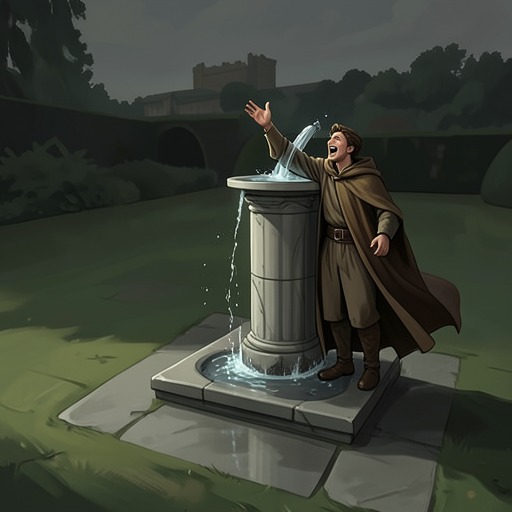
The fountain lies in an open space on the summit of a wooded steep. The route to it leads from a glade, where a huge black man directs travelers onward, up the steep to a wide, valley-like clearing. A tall tree stands in the middle of that space, its branches described as greener than the greenest pine trees. Beneath it is the fountain; beside the water rests a marble slab, and on the slab is a silver bowl secured by a silver chain so that it cannot be carried away.
The arrangement makes the place feel at once accessible and controlled. A visitor can lift the bowl and use it, but cannot simply remove the object that enables the challenge. The fountain is also set apart from the black man’s glade: he supplies directions and explains what will happen, while the visitor must travel to the summit and perform the act that triggers it. In Kynon’s account, the site and its sequence are laid out beforehand, turning the approach into a test whose stages are known but whose danger remains immediate.
The Water, Storm, and Birds
Throwing a bowlful of water onto the marble slab produces thunder, followed by a hailstorm severe enough to threaten any person or animal caught without protection. The storm strips every leaf from the tree. Once it passes, the sky clears, birds settle on the bare branches, and their song becomes the interval of apparent wonder before the next danger arrives. The same pattern occurs when Kynon and, later, Owain reach the fountain: water, thunder, hail, cleared sky, leafless tree, birdsong, and the approach of a knight.
The storm is more than a display attached to the spring. The black knight complains that it has left no exposed person or beast alive in his dominions. Kynon survives by turning his horse’s flank toward the hail and holding his shield over the horse’s head and neck and above his own head. The account makes survival depend on practical protection rather than on escaping the storm altogether. The birdsong then marks a sharp change in the scene: after the violence of the weather comes extraordinary music, but that beauty is also the signal that the knight is near.
Kynon’s Defeat and Owain’s Victory
Kynon reaches the fountain after hearing its challenge from the black man. When the black knight arrives, the two charge; Kynon is overthrown. The knight takes Kynon’s horse along with his own, but leaves Kynon’s weapons with him and does not imprison or despoil him. Kynon returns by the road he came, ashamed of the defeat and of the black man’s derision. He spends the night at the same castle as before, where his hosts neither mention his expedition nor hear him speak of it. The following morning he finds a dark bay palfrey ready for him, a horse he later says he would not exchange for the best palfrey on the island of Britain.
Owain follows the same route and repeats the fountain’s ritual, but his encounter turns differently. After the storm and birdsong, he meets the black knight and fights him. Their lances break; they continue with swords, and Owain wounds his opponent, who flees toward a great castle. Owain pursues, but the castle’s portcullis falls as the knight enters, trapping Owain at the gate. The site’s challenge therefore leads beyond the fountain itself: defeating its guardian does not give Owain an immediate, uncomplicated return, but draws him into the next stage of the adventure.
The Fountain as a Held Domain
Owain eventually becomes the Countess of the Fountain’s husband, and the earldom’s people do him homage. The fountain then becomes not merely the place where he proved himself, but the center of his public responsibility. He defends it with lance and sword, overthrowing each knight who comes there. The defeated knights are sold for their full worth, and Owain distributes what he gains among his barons and knights. The account connects his force at the fountain with his popularity among his subjects: he guards the place, and the proceeds of that defense circulate among the people who serve him.
Owain holds this role for three years. His long absence from Arthur’s company becomes consequential: Arthur grieves over losing him and fears that another year without seeing him will pass. The fountain’s importance thus extends from its strange physical mechanism to the relationships and obligations formed around it. First it stages a repeated ordeal; later it is a defended possession and the focus of a rule that keeps Owain away from his former court.
Narrative Significance
The Fountain’s sequence is built on a contrast between repetition and reversal. Kynon establishes the pattern and suffers defeat; Owain encounters the same storm and birds, then overcomes the knight. Yet victory does not close the adventure, since the pursuit ends at the castle gate with Owain trapped. The fountain is consequently a threshold between a known ritual and less predictable consequences, rather than a challenge whose outcome alone resolves the story.
Its elements also make the location unusually legible as a narrative device. The chained bowl identifies the action that begins the ordeal; the storm tests endurance; the birds announce the approaching opponent; and the knight converts spectacle into combat. Later, Owain’s three-year defense gives the same site a political and social life. What begins as a perilous encounter at a spring becomes a source of authority, reward, and separation from Arthur’s company.