Fiji Islands
MayaThe Fiji Islands are the Pacific setting where an ecological survey becomes a meditation on colonization, environmental responsibility, and the passage of time. Their island habitats preserve extraordinary endemic life, but the history of imported species, plantation development, and European settlement shows how quickly that balance can be disturbed. Fiji’s position on the 180th meridian gives the same landscape a second role: a place where the millennium’s calendar boundaries become a public contest and a proposed time capsule connects the present to the year 3000.
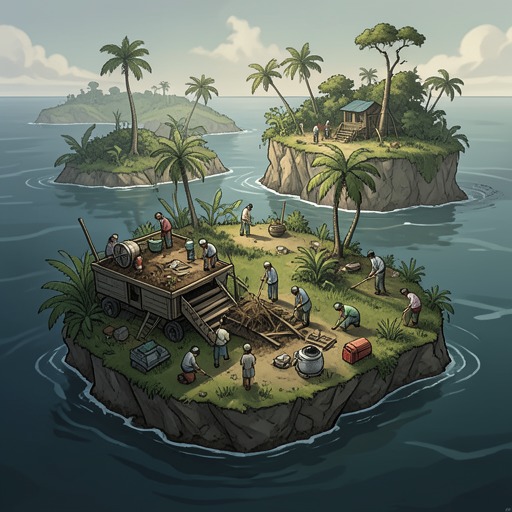
Archipelago and Ecological Setting
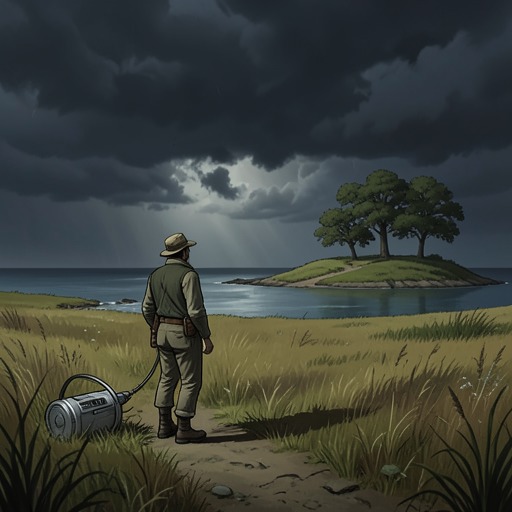
The Fiji Islands form the last stage of a two-month Pacific expedition during which Frank Andersen studies the ecological effects of imported plants and animals. The introduced organisms range from shipborne rats, mice, insects, and lizards to deliberately imported species such as opossums and mongooses, brought in to control agricultural pests. Domestic animals that escape, including cats, goats, and pigs, add further pressure, as do herbivores such as rabbits and roe deer that can become easy prey. The account treats these introductions not as isolated additions to island life but as interventions in ecological systems with long histories of their own.
The South Pacific is especially revealing because isolated islands maintained ancient ecological balances and distinctive assemblages of endemic plants and animals until relatively recently. Oceania has a particularly high proportion of endangered animal species in relation to its land area and population. Imported organisms are only part of the explanation: deforestation and the careless exploitation of plantations also erode soil and destroy traditional habitats. The islands’ isolation, once a condition for distinctive local ecosystems, makes the effects of outside introductions especially consequential.
Introduced Species and Cascading Consequences
The narrative describes a recurring chain of attempted biological control. Rats and insects arrived with ships; in response, settlers introduced new animals, including toads to suppress insects in sugar plantations and cats to control rats. Those supposed remedies could become pests worse than the original problem, prompting the importation of predators to control them. The new predators, in turn, endangered birds and native reptiles, creating pressure for still larger predators. The sequence makes intervention appear less like a clean solution than an escalating cycle in which each attempt to repair an imbalance creates another.
The account contrasts such short-term interventions with the long time required to form a functioning food web. Poison, viruses, and methods of inducing infertility have become alternatives, but the narrative questions whether a new ecological chain can simply be assembled to replace what has been disrupted. Its sharpest contrast is between the ease of damaging an ecological balance formed over millions of years and the difficulty of restoring it. Commercial language such as globalization and trade agreements is set against subsistence: food once gathered or grown for local use increasingly gives way to crops intended for wealthy markets. The loss is therefore not only biological but also a change in how people relate to the land and what it produces.
Colonial History and Environmental Irony
European contact is presented as a late but transformative phase in the islands’ history. Shipborne pests were among the first ecological consequences of settlement; later came further introductions, plantation agriculture, and the exploitation of valuable sandalwood. European plantation interests also brought 60,000 workers from India, and people of Indian descent now make up more than half the population of the archipelago. Migration was accompanied by epidemics: cholera depopulated several islands, and measles killed a third of Fiji’s population in 1890.
The narrative draws a deliberate, unsettling connection between historical cannibalism and the relative preservation of parts of Fiji’s environment. Fear of the so-called cannibal islands deterred earlier European landings: Abel Tasman sailed past in 1643, James Cook in 1774, and Captain Bligh and his exhausted officers passed islands in an open boat after the mutiny on the Bounty without daring to take coconuts. The narrator suggests that this deterrence helped limit outside incursions, and sets that history against the later destructive effects of colonial expansion. The comparison is framed as a paradox, not as a denial of the violence of cannibalism: the text acknowledges the violation of human rights while arguing that Western ecological recklessness also breaches human obligations to the natural world.
Taveuni’s Living Ecosystems
Taveuni supplies concrete examples of both ecological vulnerability and relative resilience. Its birdlife includes more than a hundred species, many native to the island, including the Orange-breasted Pigeon. The Indian mongoose was never introduced there, a fact identified as decisive for the survival of the island’s varied bird population. Introduced magpies occupy ecological space, and toads have displaced the original frogs toward the forests, yet the island’s birdlife remains remarkably rich. Fruit bats, including a species with a wingspan reaching one and a half metres, are also part of its fauna; they are known as flying foxes or beka, and older island residents regard cooked beka as a delicacy.
The island’s plant life is similarly diverse: more than a thousand species have been identified, many of them endemic. Mangrove wetlands and coconut palms line the coast, while fern-rich tropical forest and native trees occupy the interior. Orchids and hibiscus add to the range of tropical plants, and Fiji’s national flower, the Tagimaucia, grows only on Taveuni and neighbouring Vanua Levu. Offshore, the account describes abundant fish, echinoderms, molluscs, fungi, and coral visible even without a snorkel. These details give the ecological argument a particular setting: the endangered balance is not an abstraction but a habitat whose richness can be named and observed.
Conservation and Local Stewardship
Bouma, a small village on eastern Taveuni, offers an alternative to selling land for immediate profit. Its residents recognized the value of the tropical forest as a resource for nature lovers and film crews, including those associated with Return to the Blue Lagoon. When offered substantial payment for land intended for logging, they debated the proposal and ultimately rejected timber sales in favour of turning the forest into a national park. The decision was presented as a way to secure an income that could last longer than the one-time payment for the trees.
The resulting protected park covers 5,000 hectares and is prepared to receive ecotourists. Local residents build and maintain the trails, including guardrails on steep sections, and provide toilets, picnic areas, and campsites. Similar projects are being planned elsewhere on the island. The narrator enters the protected area from Bouma, crosses the cheerful Bouma River, and pays five Fijian dollars at a small hut, where advice is available about the seven kilometres of trails. A packet of biscuits and a bottle of water are practical purchases for the walk; the warning that lighting a fire could have catastrophic consequences underscores the care demanded by the forest. The village’s choice makes conservation a locally managed source of livelihood rather than an abstract ideal.
The Meridian and the Millennium
Fiji’s ecological role intersects with a geographical and calendrical distinction. The islands are among the few places crossed by the 180th meridian, and Taveuni is described as lying on the line where one can pass from one day to another without travelling through snow. This position produces an unusual division between yesterday and today, or between today and tomorrow, and makes the islands significant in debates about which Pacific territory will enter the year 2000 first.
The contest depends not on the meridian alone but on the interaction of date lines, daylight-saving time, and sunrise. Fiji advanced its clocks by an hour in an effort to enter the new year before Tonga and Little Pitt Island; only Taveuni and a couple of other Fijian islands actually lie on the 180th meridian. In a later conversation about the millennium plans, the narrator recalls that the group had been in Fiji in connection with these arrangements. The location thus links an earlier interview about endangered species in Oceania to a later discussion of how political decisions and clock time organize the turn of the millennium.
At the meridian site where Ana and José interviewed Frank about endangered species, a Millennium Monument is planned. Visitors can place a greeting to the fourth millennium in a glass capsule, seal it inside a brick, and have that brick incorporated into the monument. Each capsule costs five hundred dollars; a foundation is to maintain the monument for a thousand years and guarantees that the capsules will be opened at a ceremony on 1 January 3000. The narrator considers placing there a twentieth-century manifesto: a written account of the tropical summit held at Maravu Plantation Resort, preserving a record of the group’s meeting on the island. Fiji therefore holds together two scales of time: ecological balances built over millions of years and a human message deliberately entrusted to a future a thousand years away.