Vestfold
MayaVestfold is the setting of the narrator’s childhood discovery of a dead roe deer, an encounter that gives the landscape a lasting place in his understanding of mortality. Remembered from adulthood, the forest near his childhood home becomes both a formative natural environment and the origin of a private fear that later shapes his intellectual life and reflections on family loss.
Childhood and the forest encounter
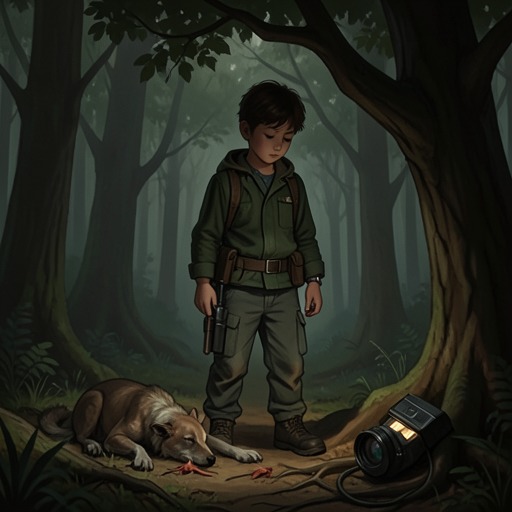
Before the narrator was eight, while his family lived in Vestfold, he ran along a forest path with hazelnuts in his pockets, eager to show them to his mother. On damp ground partly covered with autumn leaves, he saw a small roe deer lying still, with leaves scattered across its body. He initially thought it was asleep and approached, perhaps to touch it or brush away the yellow and red leaves, before realizing that the animal was dead.
The discovery became frightening not only because the deer had died, but because the narrator understood that he, too, was a living animal whose time on Earth would end. He did not tell his parents or grandparents: the experience seemed too shameful and humiliating to disclose. In retrospect, he identifies that self-imposed silence as part of what made the encounter traumatic, imagining that he might have received help if he had gone home crying and told his mother.
A place remembered through mortality
The narrator describes the discovery as having remained almost like a physical sensation inside him. The dead animal persists in his subconscious as an image that never rises or moves, and the possibility that he himself might disappear has continued to trouble him. The forest thus enters his life not simply as a childhood setting but as the place where mortality first became personal and immediate.
That early encounter also helped direct his interest in nature and his studies. His curiosity widened from the individual animal to the immense spans of natural history and cosmic time: he recalls already knowing about the Big Bang and vast distances in space as an eager twelve-year-old, and making the age of Earth and the still greater age of the universe part of his sense of identity.
From childhood memory to adult crisis
Years later, after a perilous flight from Nadi to Matei, the narrator’s old wound reopens. He connects his panic about his own limited lifespan with the childhood discovery in Vestfold, describing himself as a paleontologist afraid of bones, a zoologist struggling to accept that he is an animal, and an evolutionary biologist troubled by the limits of his time on Earth. His professional study of dead vertebrate remains has not insulated him from the knowledge that he, too, will eventually become part of the material he studies.
He tries to contain that fear by placing his brief life within the larger history of life, treating himself as a fleeting part of something greater. Yet this widening perspective does not reliably bring peace: he admits that contemplating ever longer periods has sometimes made matters worse. The memory of Vestfold therefore marks both the beginning of his effort to think beyond the individual self and the limit of that effort as a source of consolation.
Memory, family, and continuing life
The narrator’s later reflections on loss echo the structure of the childhood memory: an event becomes part of a life not only through what happened, but through how it is remembered, withheld, and revisited. In Salamanca, he and Vera speak at length about their daughter Sonia, whose memories they can keep alive only by making room for them together. Their conversation takes place amid the accumulated life of an ancient city, but it is the shared recollection of their child that gives the past a living presence.
The narrator connects their estrangement to the grief they both carried after Sonia’s accidental death. He acknowledges that his repeated reproaches intensified Vera’s pain, and says that she eventually left because she could not live under the same roof with his grief while bearing her own. In this later account, memory is not a settled record: the parents’ retelling can deepen pain, sustain their connection to Sonia, and potentially give an earlier loss a new meaning. The childhood landscape of Vestfold remains the earliest point in the narrator’s account of how knowledge of death enters the self and continues to shape the life that follows.