Museo del Prado
MayaMuseo del Prado is both a physical setting and an interpretive hinge in the novel: Frank enters it looking for a clue about Ana and leaves with a new way of seeing the two majas. The paintings bring together an elusive historical question, a family’s guarded oral tradition, and the story’s unsettling traffic between living faces and images made in the past.
The museum as a place of investigation
After spending days in Madrid and visiting flamenco venues in the hope of finding some trace of Ana, Frank recognizes that the Prado is not merely a landmark but a clue. José had urged him to go there, while an earlier suggestion from another visitor had pointed him toward a particular kind of search. Frank crosses Plaza de Cánovas del Castillo, also known as Plaza de Neptuno, and passes Goya’s statue with the Ritz behind it before entering the museum, conscious that he is approaching the solution to a mystery.
His first extended encounter is with El jardín de las delicias. The crowded painting, with more than a hundred enchanted human figures and a comparable profusion of vertebrate animals, gives Frank a visual language for his sense of human life as one part of a larger living world. Its imaginative abundance and fragility shape his response to the museum; he does not simply move through rooms collecting clues, but measures the images against his own ideas about life and the human animal.
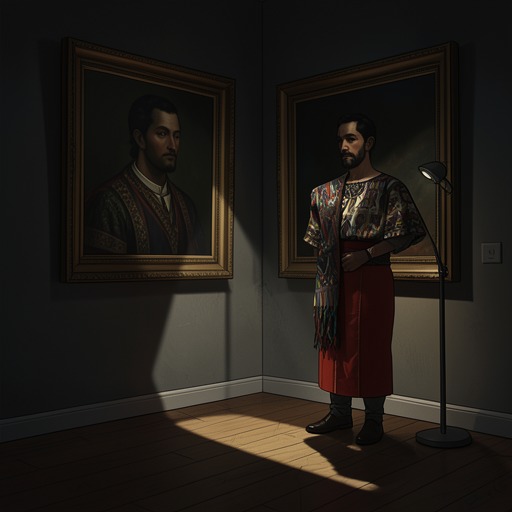
The investigation then brings him to Goya’s La maja desnuda and La maja vestida. José’s account supplies a history of their display: the paintings hung at the Royal Academy of Fine Arts of San Fernando from 1836 to 1901, where the nude version was never shown publicly; after their transfer to the Prado in 1901, La maja desnuda was initially kept in a room with restricted access. The museum’s present display thus carries the afterlife of earlier concealment: the nude image was not simply available to every viewer from the beginning.
Looking closely at the two majas
Frank first reacts to the paintings as if they showed the same woman, but José tells him to approach and look more carefully. The clothed figure appears more hurriedly and less finely painted; she also seems heavier and more heavily made up than the nude. The differences are not incidental to the revelation. They direct Frank away from the assumption that the paintings are straightforward duplicates and toward the possibility that their apparent identity is assembled from distinct elements.
What Frank recognizes is that Ana’s likeness belongs to the head, face, and hair, not to the nude body. The image seems divided: a body belonging to one model, with Ana’s face placed over it. Frank describes the recognition to himself as Ana’s head seeming transplanted onto the nude model. The Prado therefore gives him not a simple answer to who posed for Goya, but a more complicated account of how an identity could have been made visible—and concealed—inside a painting.
The paintings acquire further force through the novel’s account of their history. José says Goya had been finishing La maja desnuda when he encountered a small jester carrying a mysterious portrait of Ana María Maya. The portrait astonished him; according to the family legend, he released the jester and painted Ana’s face over the nude figure to hide the real model’s identity. The Prado’s two paintings become the surviving material center of a tale in which an image from a supposed future changes the face of a work from the past.
Display, access, and the unresolved image
The paintings’ institutional history parallels the risks attached to their subject. José notes that the nude was withheld from public display at the academy and initially placed in a restricted-access room at the Prado. He also explains that a living Roma woman who posed nude in Goya’s time could have risked her life. The mystery of the paintings is therefore not only an art-historical puzzle: visibility has consequences, and the image’s exposure is entangled with the danger of identifying the woman represented.
The novel does not turn the museum into a final authority that settles the past. A Prado catalogue calls La maja desnuda an intimate painting whose enigma remains unresolved. The narrator of the later framing story seizes on the difference between an enigma that has not yet been solved and one that can never be solved. That distinction allows the novel to hold historical uncertainty open while imagining that family knowledge, oral tradition, or an undiscovered source might still alter what is known about Goya’s model and the paintings’ making.
Repeated visits and images across time
Frank’s first visit is part of a larger pattern of return. On the Wednesday after meeting José, he arrives shortly after the museum opens, revisits El jardín de las delicias, then goes upstairs to stand before the two majas. He spends a long time looking Ana in the eyes and finds it unsettling that the painted face seems to look back; he even imagines that a wink would not surprise him. The museum’s pictures have shifted from objects to be examined into presences that seem to answer the viewer’s gaze.
That impression belongs to the novel’s wider play with images and media. The family legend presents a miniature portrait so lifelike that its unknown technique seems magical, and José insists that the legend predates photography. In the Goya story, the portrait’s impossible appearance helps explain why the painter changes the face of the nude. In the contemporary plot, the Prado’s painted likeness leads Frank to recognize Ana’s face across time. Later, a photograph of Frank himself, taken in the Alcázar gardens by the mysterious jester, brings the image-making motif back to the living narrator. The paintings are thus not isolated masterpieces: they are one link in a sequence of portrait, painting, photograph, and video through which the story tests what images can reveal and what they leave hidden.
Narrative significance
The Prado makes recognition a matter of looking again. Frank’s first response—these figures are identical—gives way to a more exact distinction between face and body, likeness and model. That change supports the novel’s central uncertainty about Ana: her resemblance to the maja is undeniable within the story, yet the explanation depends on a family legend whose versions vary and for which José says he has found no written record.
The museum also ties private and public histories together. Its paintings preserve the mystery in a publicly visible form, while their earlier restrictions and the danger faced by a nude Roma model point to the social pressures surrounding that visibility. For Frank, the Prado is where a search prompted by José becomes a recognition; for the novel, it is where art history, oral memory, and the instability of photographic and painted likeness converge without reducing the enigma to a settled fact.