Marseille
MayaMarseille is where the family legend of El Planeta’s meeting with a mysterious jester takes shape: a working port becomes the threshold between a journey home and a tale passed down through generations. The city’s docks, warehouses, and transient sailors anchor a story whose uncertainties are part of its meaning.
A stop on El Planeta’s journey
According to the version recounted in the novel, El Planeta set out from Cádiz in the spring of 1842 for the sanctuary at Les-Saintes-Maries-de-la-Mer in the Camargue. He reportedly reached Marseille on May 26 and worked as a dockworker to earn money for his return journey. The narrative places the encounter a few weeks later, during the first days of June.
The tale is presented not as established history but as oral tradition. José says he has found no written record of the Andalusian version, and notes that the story has many variants within the Maya family. He also mentions a supposedly independent Swiss tradition. Marseille is thus both a specific place in the legend and a point where its uncertain, multiple tellings begin to branch.
The jester arrives at the harbor
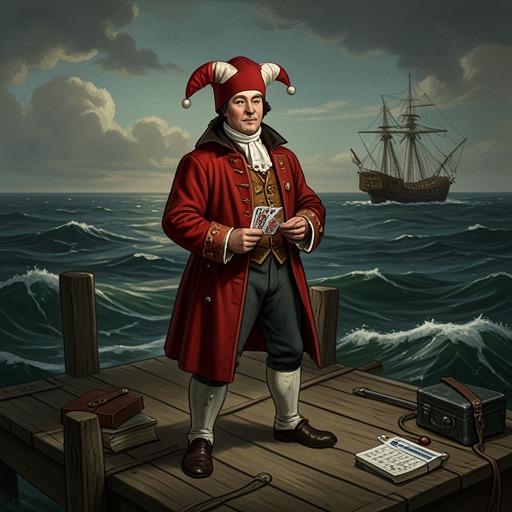
One June afternoon, El Planeta was at the quay, ready to unload a schooner that appeared to have been battered by a storm. The ship is said to have been Norwegian. Before its passengers came down the gangway, a little man climbed over the side, jumped ashore, and ran between the port sheds. Onlookers saw him, while the sailors speculated about who he might be.
The fugitive is described as a dwarf dressed as a jester, in violet clothing and a green-and-red cap with upturned points. Bells attached to his clothes and cap rang as he hurried through the warehouses. The combination of a storm-damaged vessel, a hurried escape, and the bells makes his arrival a vivid interruption in the ordinary labor of the quay; his identity, however, remains unresolved.
A German sailor also disappears from the scene. In one version, language makes communication on the Marseille quay difficult: he speaks neither French nor Spanish, and the jester speaks German. A variant says the sailor eventually settled as a baker in a Swiss village. The legend therefore ties Marseille to routes beyond the port, but does not settle what connected the sailor and the jester or what became of the latter after his escape.
The warehouses and the card legend
After the schooner had been unloaded, El Planeta went to sleep among the port sheds, having nowhere else to stay while he saved for his return to Cádiz. Hidden among empty wine barrels, he found a man crying inconsolably. When El Planeta approached, he recognized the man as the unhappy jester. In one telling, the jester tried to cover himself; the account does not supply a shared spoken language through which the two could readily explain themselves.
Some versions extend the encounter: El Planeta and the jester spend several days together among the Marseille sheds, and one night the jester tries to tell his story through gestures and drawings. He sketches a French deck, identifying its hearts, diamonds, clubs, and spades, then recites a short verse for each of its 52 cards in German. El Planeta is said to have remembered some of the verses despite not understanding their language. The cards and verses turn an encounter shaped by failed speech into a story transmitted through images, performance, and memory.
From port memory to family myth
The account links Marseille to the later history of the Maya family through El Planeta’s return to Seville with the story of the enigmatic jester. The narrator connects that tale with an extraordinary event said to have happened to Ana’s great-grandfather, Manuel, in June 1894—exactly 52 years after the Marseille episode. The interval makes the deck’s 52 cards resonate with the legend’s chronology, though the excerpt does not yet explain the later event.
Marseille’s role is therefore less that of a fully documented historical setting than a hinge in an oral narrative. The harbor brings together a singer traveling home, a storm-marked ship, a vanished sailor, and a fleeing performer; what El Planeta carries away is not a verified account but a tale whose details recur in family memory. Even the surviving copper engraving of El Planeta by Francisco Lameyer is drawn into that imaginative afterlife: some viewers think it depicts a joker, or, in the narrator’s phrasing, a dwarf. The city’s brief encounter becomes the beginning of a legend that travels farther than its protagonists can be shown to have gone.