Dr. Chenko
MemoryDr. Chenko is the physician who oversees the development, installation, and testing of the controlled-seizure device intended to manage Miles Vorkosigan’s post-revival seizures. His role is practical rather than grand: he explains a complicated intervention, urges Miles not to delay care, performs the surgery with unusual consideration for his patient’s anxieties, and converts the successful test into a daily regimen. Through Chenko, treatment becomes not an abstract promise of a cure but a sequence of decisions, measurements, and habits.
Identity and Medical Role
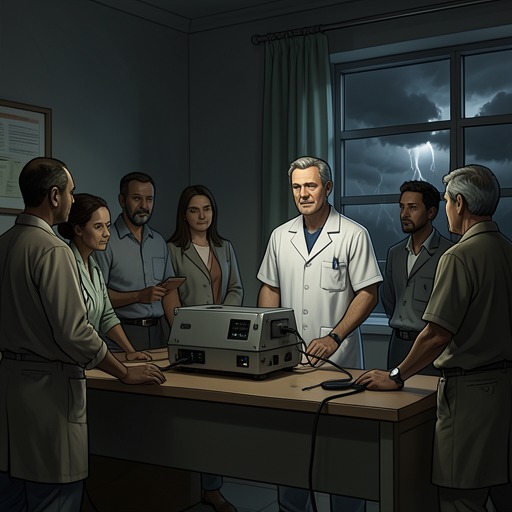
Chenko first appears calling from the Imperial Military Hospital’s veterans clinic. He greets Miles cheerily, apologizes for the delay, and explains that the microengineering has proved more difficult in execution than in planning. The result is a device small enough to insert beneath Miles’s skull, designed to trigger seizures in a controlled way. The team is not yet claiming success: Chenko says they are ready to test it, and that final calibration and surgery will follow only if the device works properly.
That distinction matters. Chenko presents the treatment as experimental and conditional, not as a guaranteed fix. His explanation gives Miles a clear sense of what comes next—test, calibration, then an operation—while acknowledging the engineering uncertainty behind each step. The device’s purpose is also specific: rather than preventing every seizure outright, it is meant to provoke one safely and under controlled conditions.
Caution and Timing
The call arrives while Miles is preoccupied with a separate investigation and has just been trying to bathe. He responds with brief approval, but privately recognizes the timing as bad. Chenko asks when he can come in and proposes the following day. When Miles says he has had no further episodes since the one induced in the laboratory, Chenko does not treat that absence as a reason to abandon the plan. He advises Miles not to wait too long, and, as Miles is about to disconnect, adds that he should avoid stress.
The exchange shows Chenko balancing urgency with restraint. He does not dramatize the danger or press Miles with a threat; instead, he gives measured advice based on the recurrence of symptoms and the risks of postponing treatment. His afterthought about stress is notably difficult to apply to a patient caught in a high-pressure crisis, but it remains a concrete part of his medical guidance. Chenko’s concern is grounded in Miles’s body and the practical conditions affecting it, even when those conditions cannot simply be set aside.
Surgery and the Smoke-Test
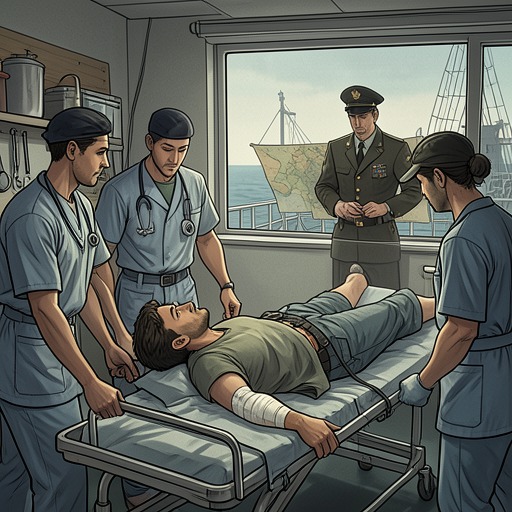
When the operation goes ahead, Chenko adapts his approach to Miles rather than insisting on the usual experience of being unconscious and uninformed. He has become familiar with Miles’s somewhat paranoid outlook, so he lets him remain awake and watch the procedure on a monitor positioned above his head-clamp. The operation to install the device’s internal portion proves shorter and less frightening than Miles expected. Chenko allows him to go home the next morning.
Two afternoons later, they meet again in the hospital neurology laboratory for the smoke-test. Chenko’s manner remains patient and professional as he monitors the result. The induced convulsive symptoms last barely half as long as Miles’s uncontrolled seizures, and the device suppresses his movements. Chenko also expects the hangoverlike effects Miles reports to diminish, though he asks him to observe those effects over the next day-cycle and provide his own account. The assessment therefore combines observable results with attention to the patient’s subjective experience; the test is encouraging, but observation continues after the laboratory demonstration.
Daily Management and Significance
Chenko’s instructions make the device part of ordinary life. He tells Miles to check the activation unit’s monitor-readout panel at the same time each evening, before bed, and to discharge the device when the neurotransmitter level rises above one-half—but before it exceeds three-quarters. He compares the check to brushing one’s teeth, framing a technical intervention as a repeatable habit rather than a one-time medical event. The care plan depends on Miles learning to monitor his own readings and act within a defined range.
Miles’s first question after hearing the test results is whether he can fly. Chenko says he can do so the next day. That brief exchange gives the procedure its immediate measure of success: the device is not only an implanted mechanism or a favorable laboratory result, but a means of returning Miles to an activity he is eager to resume. Chenko does not promise that the condition has vanished. Instead, he establishes a workable system—surgery, calibration, monitoring, and limits—through which Miles can manage its effects. His understated competence makes medical care part of the story’s movement toward renewed agency, while preserving the daily discipline and uncertainty that treatment entails.