Vaughn Weddell
MemoryVaughn Weddell is a molecular biologist and former Jackson’s Whole researcher whose expertise helps uncover the biological sabotage of Simon Illyan’s memory chip. Once known as Dr. Hugh Canaba, he brought a history of secret genetic research to Barrayar; in the present investigation, his unusual background proves as useful as his scientific skill. He identifies the engineered organism used against Illyan and helps turn an invisible biological agent into evidence that can be found and acted upon.
Identity and Background
Weddell lives under a new name and identity on Barrayar. An early mission by the Dendarii brought him there as a refugee from Jackson’s Whole, along with a new face and some of the galaxy’s most secret genetic research. His former work included Sergeant Taura among its earlier, more ambiguous projects. The account does not resolve the nature of that work, but it gives Weddell a consequential history behind the polished identity of an Imperial scientist.
His established work is at a laboratory in the Imperial Science Institute biofacility outside Vorbarr Sultana, where he conducts secured work for the Imperium. Miles Vorkosigan describes him as a molecular biologist by training, with a range of unusual early experiences that makes him a useful wild card. The same description includes a warning: Weddell is brilliant, but can be self-important and difficult. His later conduct bears out both sides of that assessment. He supplies essential knowledge, while his manner tests the patience of the people who need it.
Recruited to Investigate Illyan’s Chip
When Miles asks Admiral Avakli to add a specialist to the team examining Illyan’s malfunctioning chip, he recommends Weddell’s broad expertise. The assignment is not merely to inspect the damaged chip: Miles wants an autopsy even if the chip is already beyond repair, so that ImpSec can learn what caused the malfunction. Weddell is brought in to help identify any wider scientific connections that Avakli’s team might uncover.
Their meeting also brings Weddell’s old connection to Sergeant Taura into the present. Miles offers greetings from her; Weddell is surprised that she is still alive. Miles then turns directly to the investigation, asking whether Weddell’s first ideas point toward natural causes or sabotage. Weddell says he has several ideas, but the exchange does not yet disclose what they are. His eventual importance comes through the evidence he can interpret, not an early declaration of certainty.
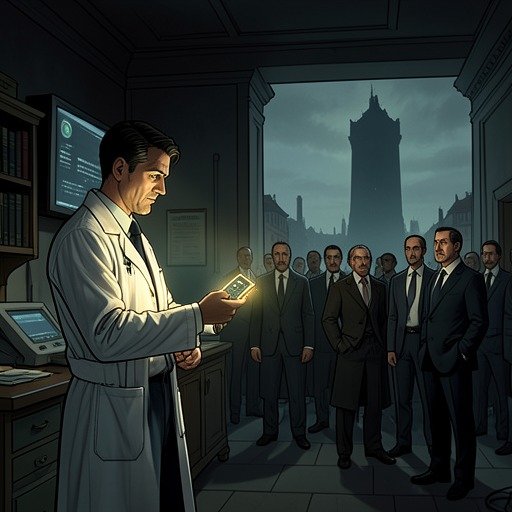
At a briefing, Avakli credits Weddell with helping assemble the chain of causality. Weddell presents an enlarged, computer-colored image of what he has reconstructed as a bioengineered apoptotic prokaryote. When Miles asks him to simplify the explanation, Weddell translates the technical account into the basic idea of a small organism that consumes material. The exchange establishes their practical division of labor: Weddell brings specialist knowledge, while Miles presses him to make that knowledge usable in an investigation.
Reconstructing the Delivery Method
A later examination of the evidence-room inventory sharpens the inquiry. The stored vector-delivery box was designed to hold six small capsules; its records accounted for one previously removed for examination and recorded as destroyed, but only three remained in the box. Weddell reacts with dismay when Miles reveals the intact material, because he had spent a week reconstructing the relevant biological evidence while a complete sample had been stored downstairs. The discovery gives his analysis a firmer basis and an ironic turn: the investigators had been working to reconstruct what they could now examine directly.
Miles orders a sample sent for molecular analysis and requires Weddell to confirm whether it matches the material recovered from Illyan’s chip. Weddell remains with the sample and his data in the ImpSec clinic laboratory, following Miles’s instructions closely enough to spend the night there. He confirms that the evidence-room material is not only the same kind of prokaryote used on Illyan, but from the same batch. That match ties the stored capsules to the attack rather than leaving them as a merely similar specimen.
Weddell also corrects an assumption about how the agent reached Illyan. The capsule was neither permeable nor soluble and was not designed to be swallowed. It could be broken with a pinch, releasing its contents into the air. The prokaryotes were carried inside hollow, sporelike particles: small enough to remain airborne, then able to dissolve on contact with a wet surface such as a mucous membrane or the bronchia. This explanation connects the capsule’s design to a plausible route of exposure and makes the evidence relevant to the search of the building’s air system.
From Scientific Finding to Visible Evidence
Weddell’s work becomes practical when the investigators need to locate traces of the delivery system. He prepares a clear liquid and an atomizer at short notice. The solution is designed to reveal the distinctive exterior structure of the vector capsules, rather than to make the prokaryotes themselves easy to detect. That distinction matters: the biological agent is too difficult to search for directly, while its delivery casing offers a recognizable target.
Miles directs the team to the return-air vent and filters. There, the colonel removes the grille and Weddell sprays the surface; after a tense wait, a black light makes a red fluorescence appear. The procedure turns Weddell’s molecular analysis into a visible result at a specific location in the ventilation system. As the evidence is presented, Miles appoints General Allegre acting chief of ImpSec and orders the arrest of General Haroche on the capital charge of treason. Weddell does not make the arrest, but his identification and detection method contribute to the scientific chain that makes the confrontation possible.
Character and Narrative Role
Weddell’s characterization rests on the friction between capability and temperament. Miles recognizes his brilliance while privately anticipating that his obnoxiousness will earn him trouble; Avakli, by contrast, makes sure Weddell receives credit for the scientific work. Weddell’s own reactions—his surprise at Taura’s survival, his technical confidence, and his complaint that an intact sample was available after a week of reconstruction—show a specialist who is not inclined to conceal either his history or his irritation.
The investigation repeatedly makes his expertise answerable to concrete tests: identify the organism, compare the samples, explain the capsule, and help find its traces in the air system. That sequence gives his unusual past a present function without resolving every ambiguity in it. Weddell’s last documented contribution is collaborative and material: alongside the colonel and forensic technician, he applies the detection solution that makes the hidden residue visible. The evidence establishes his role in exposing the sabotage, but does not specify what becomes of him after Haroche’s arrest.