Lucas Haroche
MemoryLucas Haroche is a veteran ImpSec officer whose reputation rests on quiet, consequential work: stopping conspiracies before they become public disasters. The same experience that made him a possible successor and mentor to Miles Vorkosigan also equipped him to exploit the agency’s secrecy. His eventual exposure as the person who poisoned Simon Illyan turns a career marked by counterterrorism success into a story of professional trust betrayed from within.
Identity and Career
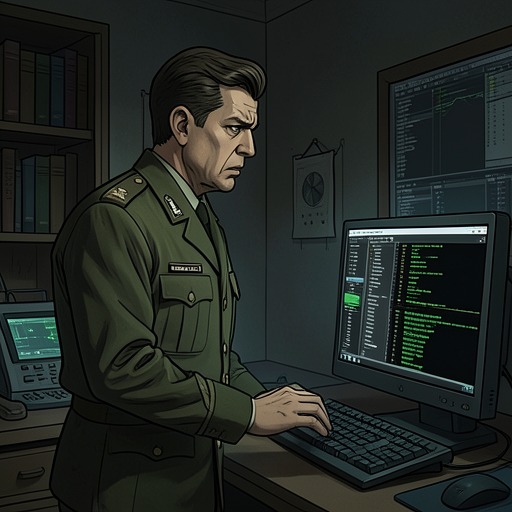
Haroche heads Domestic Affairs, the ImpSec department responsible for tracking treason plots and antigovernment groups within Barrayar. Its work is thankless by design: successes remain secret, while failures attract blame. Miles regards the title with private irreverence, but understands that the position is among the service’s more difficult assignments. Haroche has been a fixture at ImpSec headquarters since before Miles, and his decade in the post has left him graying and slightly rumpled. He speaks in a deep, rich voice, sometimes humorous, with a western provincial accent that years in the capital have not erased.
Within ImpSec, Haroche has a formidable reputation that is scarcely known outside the agency. One celebrated example is the Yarrow case, treated internally as a textbook counterterrorism success. A hyperisolationist faction aligned with Count Vortrifrani planned to suicide-drop an old jump-freighter, the Yarrow, onto the Imperial Residence. The vessel also carried explosives; those explosives proved to be the clue that allowed Haroche’s team to find the plotters. Vortrifrani distanced himself from the conspiracy, but his support was weakened, and the Imperium was less troubled by him afterward. The plot’s intended target and potential casualties underline the scale of what Haroche’s team prevented, even as the secrecy surrounding success kept the operation largely unknown to outsiders.
Haroche’s work also intersected with Komarran Affairs. During the response to Ser Galen’s saboteurs, he and Diamant coordinated personnel and assistance across their departments. Haroche was present when the Komarran prokaryote capsules were put away. At the time, he later said, he thought no more of them for years. This earlier contact with the capsules would become central to the concealed crime that brought his career to an end.
A Possible Successor to Illyan
Before the investigation turned against him, Haroche was positioned as a potential mentor to Miles. Simon Illyan apparently intended Miles to spend five years on the Domestic Affairs side under Haroche, filling a gap in his experience and preparing him to become Illyan’s successor when the chief was ready to retire. Haroche’s own record made the plan plausible: during his time as an agent, he had personally helped derail at least four serious plots against the Emperor’s life, in addition to the Yarrow case.
The proposed assignment was a poor fit from Miles’s perspective. He considered desk work and field operations to demand opposing habits, and he thought that if he had to take a desk position, Galactic Affairs on Komarr would better match his experience. Yet the intended pairing suggests that Illyan saw value in Haroche’s expertise precisely where Miles lacked it. The plan also gives Haroche a consequential place in Miles’s professional future: he was not merely another senior officer, but the person through whom Illyan apparently meant to prepare his successor.
That promise of professional continuity makes Haroche’s later dealings with Miles more charged. When Miles arrives back on Barrayar, Haroche is cordial, asks after his parents, and discusses the new Department for Sergyaran Affairs. The courteous exchange belongs to the public face of a seasoned official. Later, Haroche tells Miles that Illyan’s trust in him had been exceptional and that he had been slated to become Haroche’s assistant. The disclosure confirms the importance of the succession plan, even as the relationship between the two men has already become adversarial.
Obstruction and Suspicion
During the crisis around Illyan, Haroche becomes an obstacle to Miles’s access to the ImpSec chief. When Miles presses to see Illyan, Haroche regards the possibility that Miles might get off a second attack as a serious danger and formally objects to admitting him. He describes Miles as a high-priority item on a list of potential threats, then points to the abrupt termination of Miles’s career by Illyan as an apparent motive. Miles recognizes the humiliation built into this suspicion: in accepting responsibility for Illyan’s rescue, he has become vulnerable to the charge that he is acting against the man who dismissed him.
Haroche’s caution is not simply a general security posture. He is willing to let Miles through only under protest, and he treats the risk of another attack as reason to restrict contact with Illyan. When Miles waits outside ImpSec, Haroche appears with Illyan’s secretary four minutes and twenty-nine seconds after the gate staff has been alerted. The measured interval makes the headquarters’ response visible, while Haroche’s arrival marks the force of the institution he commands. His later conduct makes that display of vigilance deeply ironic: the officer guarding access to Illyan is concealing his own role in the danger.
The conflict sharpens when ImpSec arrests Duv Galeni during Gregor Vorbarra’s reception. Haroche arrives quickly and explains that he had reason that evening to suspect Galeni’s loyalty and had been alarmed to find him in the Emperor’s presence. He argues that ImpSec’s first duty was to remove Galeni physically, with explanations secondary to the protection of Gregor and his guests. His account presents the arrest as an exercise of institutional caution. In the later investigation, however, evidence of altered records and missing video points toward an inside job. When Miles brings the discovery to him, Haroche seals his office and shuts down his comconsole, then listens as Miles explains that the systems contain about twenty-five minutes of revised history. The missing record and altered time make the inquiry an internal-security crisis, not merely a dispute over Galeni’s arrest.
The Bribe and Exposure
Haroche tries to shape the outcome of the case by offering Miles a way to reduce the damage to Galeni. He proposes dropping the treason charge in favor of assault on a superior officer, with a year in prison and a dishonorable discharge; Miles might then seek an Imperial pardon. Haroche presents this as a way to get Galeni out of ImpSec, but Miles sees that it would leave Galeni guilty and destroy the political future he had hoped to build in a more peaceful Komarr. Miles refuses to treat a pardon as a substitute for acquittal.
Haroche then introduces Miles’s seizure disorder and says that he has obtained the medical reports from Miles’s ImpMil neurologist. He considers the proposed treatment promising. The offer reaches beyond the immediate case: it touches Miles’s longing to return to military service and to recover the Admiral Naismith identity that had given that service its shape. The narrative identifies Haroche’s approach as an attempted bribe of an Imperial Auditor. Its force lies in the way a professional opportunity and a possible path toward treatment could tempt Miles to compromise the inquiry. Miles recognizes the danger rather than accepting the bargain.
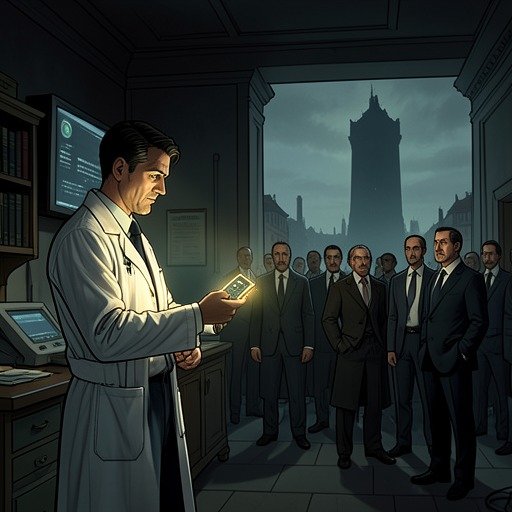
The exposure turns on a physical clue hidden in the office. Miles leads ImpSec personnel into Haroche’s former inner office and finds him crouched by the comconsole desk, levering a vent grille out of the wall. An opened folder lies nearby with another fiber filter. The timing reveals the attempted switch: Haroche appears to be removing the incriminating filter and arranging for a substitute elsewhere. The investigators dislodge the grille and apply a spray; under black light, red fluorescence makes the previously invisible trace visible. Miles tells Guy Allegre that he is now acting chief of ImpSec, pending Gregor’s approval, and orders Haroche’s arrest on the capital charge of treason. Haroche insists that it was not treason. Miles leaves open the possibility of a lesser charge if Haroche confesses and cooperates, while leaving the matter to the Service court.
Confession and Aftermath
Under Gregor’s questioning, Haroche explains that he had known about the Komarran prokaryotes from the beginning. Diamant of Komarran Affairs told him about them while their departments were coordinating the sweep against Ser Galen’s saboteurs, and Haroche was present when the capsules were stored. Years later, after he had become head of Domestic Affairs through the Yarrow case, he used the capsules against Illyan. Haroche says that he dosed Illyan once, waited several days, and dosed him again when nothing seemed to be happening after about a week. He had not understood how slowly or severely symptoms would develop and believed the treatment would not kill Illyan. He describes the second dosing as an impulse, though Gregor points out that it followed days of deliberation.
Haroche’s confession recasts the professional history that initially made him seem a natural steward of ImpSec. The man who had helped detect conspiracies against the Emperor used knowledge acquired during a counterterrorism operation to harm the chief he had served. His earlier presence when the capsules were stored, his later obstruction of Miles, the compromised records, and the attempted alteration of the filter converge on the same betrayal. The evidence supports the revelation of his responsibility, but does not establish the final sentence or disposition of his case.
For Miles, Haroche’s attempted bargain also marks the apparent death of Admiral Naismith. Later, while holding a private wake for that identity, Miles recalls its successive deaths and the latest one at Haroche’s hands. He recognizes that Haroche never truly possessed the power to give or withhold Naismith, despite how close Miles came to placing himself in Haroche’s hands. The realization changes the meaning of the wake: Miles is not mourning an identity Haroche controlled, but celebrating his escape from the bargain. Haroche’s importance to the ending is therefore twofold. He is the criminal whose actions are exposed and the figure through whom Miles confronts the temptation to trade integrity and selfhood for a desired return to service.