Piotr Vorkosigan
MemoryPiotr Vorkosigan, remembered as a young General Count who led hillmen against the Cetagandans, is a powerful presence in the life of his grandson Miles despite having died thirteen years before one of Miles’s reflections on him. His legacy is carried by a ceremonial dagger, a grave, and a vast, damaged tract of inherited land. Over time, those inheritances change meaning: what once seemed to command Miles becomes something he can set down, even as his family’s service continues to shape how he understands duty and home.
Identity and Historical Legacy
Piotr Vorkosigan was both a general and a count. In the history Miles recounts, the Cetagandans occupied Barrayar’s lowlands while hillmen resisted them from the difficult terrain. The very young Piotr led the hillmen in attacks on the occupying forces. The account gives his military reputation a concrete setting: the invaders might have avoided the hills by moving their lines back, but instead tried to push into terrain that favored their opponents.
That conflict left the Vorkosigan district among the most war-torn parts of Barrayar, and it lagged behind other districts in development. Miles recognizes the history as a reason for the region’s poverty, but also questions how long that explanation can continue to serve. The family’s ardent service to the Imperium, he reflects, has helped leave its district depleted: the state repeatedly takes Vorkosigans away for service without replacing what it borrows. He sees this as a hidden tax on the district, a cost associated with the family’s public loyalty rather than simply an abstract inheritance from Piotr’s generation.
The Dagger and Miles’s Changing Inheritance
Piotr’s ceremonial dagger once occupied a place of honor in Miles’s room. Earlier in his career, Miles insisted on carrying it at all times, as though the weapon could help prove something about him. When he later asks himself whom that display was meant to convince, he concludes that the answer has disappeared along with the dead man who might have been its imagined audience.
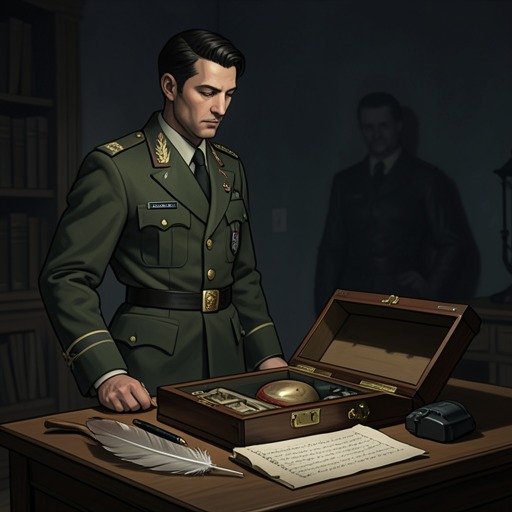
Miles takes the antique from its elaborate sheath and watches light move over its textured steel. The dagger remains a remarkable object, but its former hold over him has lifted. Where Miles had felt a kind of curse or command in it, he now sees only a knife. He returns it to its sheath and lets it fall back onto the shelf. The gesture does not erase Piotr’s influence; it marks a change in how Miles relates to it. He no longer needs the weapon to act as proof of his identity.
During a later crisis, the dagger acquires a more dangerous proximity. Alone at Vorkosigan House, Miles brings it to a small room and sets it beside an unopened bottle of brandy. He tests the blade against his wrists and throat, including the thin scars left by his cryonic preparation, but does not injure himself. He has already experienced death and fears the possibility of a failed attempt to revive him again; he does not want to die, though he cannot bear being alive in that moment. The scene makes Piotr’s heirloom part of Miles’s confrontation with despair, not evidence that Piotr’s memory directs his choice. The dagger tempts him, but it does not decide for him.
Land, Family, and the Unfinished Past
Piotr left Miles personal ownership of almost all the district’s wastelands rather than passing that land to Miles’s father with most of the family property. Miles does not know what message, if any, his grandfather intended. He wonders whether the blighted inheritance was a comment on his own early disabilities, or whether Piotr expected Miles’s father’s life to end before the land recovered. These are Miles’s possible interpretations, not an explanation established by the story.
Miles has never set foot on the tract. He plans to visit it in radiation gear after he has children, and knows that it contains unusual plants and animals. From the air, the land can appear to be recovering: radioactivity in some areas has fallen by half during his lifetime. Yet Miles understands that parts will not become usable until he is old. The inheritance therefore places Piotr’s mark on a future Miles has not yet seen, joining family continuity to the slow aftermath of war and contamination.
The district’s inheritance also complicates the pride attached to the family’s service. Miles recalls that Piotr’s resistance to the Cetagandans helped shape the region, while recognizing that generations of Vorkosigan service have not restored what the district lost. Piotr’s legacy is thus neither simply a heroic example nor merely a burden. It is attached to real courage and to consequences that remain visible in the land Miles owns.
The Grave and Piotr’s Narrative Role
On Miles’s birthday, he walks through the family garden and graveyard, where the Vorkosigans established their family plot after the destruction of Vorkosigan Vashnoi. He pauses first beside Sergeant Bothari’s grave, then spends several minutes looking down at Piotr’s. In the past, Miles had stamped and shouted at the stone, then whispered and pleaded with it. This time he feels that the grandfather and grandson have nothing left to say to one another.
Miles’s realization that he is addressing the wrong grave closes one stage of his relationship to Piotr. The scene does not suggest that the past has become irrelevant; rather, Miles recognizes that his present need cannot be answered by repeatedly appealing to the dead general. The dagger’s diminished authority and the silence at the grave form a parallel change: inherited symbols no longer supply Miles with a complete account of who he is.
Piotr appears through recollection and inheritance rather than through present action. His importance lies in the different forms his legacy takes for Miles: military history, family expectation, a weapon once carried as proof, and land whose recovery will outlast its owner’s lifetime. As Miles revises his understanding of those inheritances, Piotr remains consequential without remaining an unquestioned authority.