Martin Kosti
MemoryMartin Kosti enters the story at the threshold between adolescence and service: two months short of eighteen, looking for interim work, and hoping to join the Imperial Service when he becomes eligible. His brief employment as Miles Vorkosigan’s driver carries him from a gatehouse introduction to the Imperial Residence and, ultimately, a lightflyer journey to Silvy Vale. Though the evidence gives him only a few scenes, they establish a distinct position in Miles’s life at this point: a young, capable employee who is still learning, and whose practical presence accompanies Miles into a moment of grief and discovery.
Identity and Background
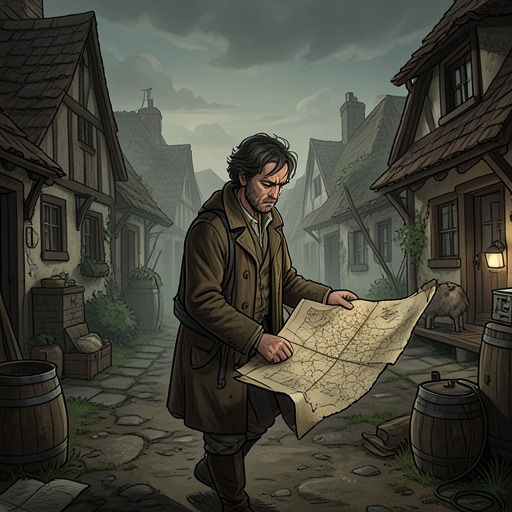
Martin first appears beside his older brother, a gate guard who introduces him to Miles. The brothers are visibly related: Martin is tall and blond and resembles Corporal Kosti, though his features are softer. He has brought a large lacquered box when Miles encounters him at the gate. The introduction makes his family connection immediately legible, while the contrast in their appearance distinguishes him from the sharper-featured corporal.
His immediate problem is ordinary but pressing. Martin says that nobody wants to hire him for only two months. He is waiting to turn eighteen and apply to the Imperial Service; until then, his mother has warned that, if he cannot find something to occupy himself, she will find something for him to do, probably cleaning. His search for a short-term job therefore sits between a specific future ambition and the household chore he would rather avoid. He is not yet entering the Service, but he is already orienting himself toward it.
A Temporary Job and a New Responsibility
Miles learns that Martin is looking for work and offers him a temporary position as a driver. Martin responds with an eager question about whether the offer is serious, while Miles leaves the possibility open with a brief, cautious answer. The exchange turns Martin’s immediate need into an opportunity: he can earn work before his eighteenth birthday, and Miles gains a driver for the period in which he needs one.
Martin has some experience with a lightflyer, though his answer indicates only that he has done a bit of flying. That qualification is modest rather than grand, and the story does not present him as an expert. Instead, he is a young applicant with enough familiarity to be considered for the task and enough room to learn. His later handling of both a groundcar and a lightflyer makes the offer concrete: driving is not merely a proposed job but the means by which he accompanies Miles through the following scenes.
Driving for Miles
At the Imperial Residence, Martin is at the controls of Count Vorkosigan’s armored groundcar, with Miles seated beside him in the driving compartment. He looks nervously back toward the gates and the guards gathered there, asking whether the situation will be all right. Miles answers that the small stretch of wrought iron will be straightened and repainted before he is due to be picked up. The moment gives Martin a practical, immediate concern in the midst of Miles’s casual confidence: he is responsible for the vehicle and alert to what has happened around it, while Miles treats the damage as something that will be repaired in time.
Martin is still learning the vehicle’s controls. When he tries to open the canopy, he searches through the unfamiliar array until Miles points out the control. His muttered thanks registers a small dependence on his passenger’s knowledge, without undoing the fact that Martin is the one driving. The scene thus presents their working arrangement in miniature: Martin takes on the task, Miles supplies direction when needed, and the young driver meets the demands of a job he has only just acquired.
The Journey to Silvy Vale
Martin later pilots a lightflyer as Miles directs him toward Silvy Vale, a mountain community. Miles uses the vehicle’s projected three-dimensional map to identify a particular landing place: a cemetery in a small valley, beside a brook and beneath trees. He estimates that reaching it on foot would take about four days, or two and a half days on horseback, whereas the lightflyer can make the journey in less than an hour. Martin listens, powers up, and takes them southeast over the ridge. His offer to get them there faster is met with Miles’s unfinished refusal, a brief exchange that leaves the focus on the destination and Miles’s state of mind.
For Miles, the cemetery is a place for a conversation with the dead, and he intends to send Martin away once they land. He does not want a witness to this private reckoning. But Martin’s role is not incidental: his piloting has carried Miles toward the place where he hopes to confront his failures and speak to Raina. Before they reach the intended landing spot, Martin interrupts Miles’s increasingly anguished reverie to report that he cannot land in the valley because it is all water. Miles sits up and looks out in astonishment; Martin identifies the unexpected obstacle as a lake.
This interruption gives Martin a practical function in a scene otherwise shaped by Miles’s inward distress. He does not know the emotional purpose of the trip, and the evidence does not show what he makes of Miles’s response. What it does show is that he notices the changed landscape, reports the problem, and forces Miles’s attention back to the present. Martin’s small but consequential contribution is to bring the journey to a halt at the moment its expected destination proves altered: the valley Miles remembers is now occupied by water.