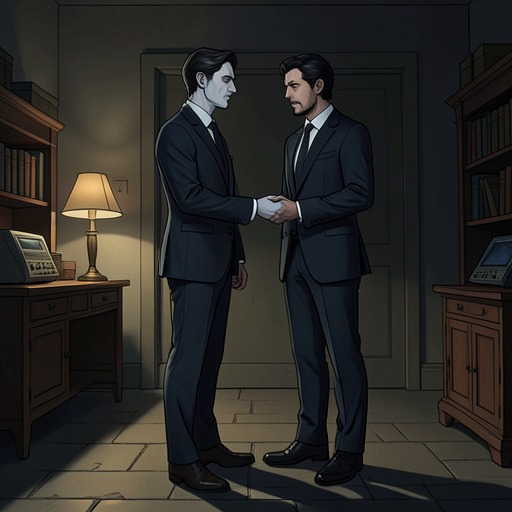
Guy Allegre
MemoryGuy Allegre is a senior ImpSec officer whose console becomes part of the technical trail in the investigation of altered records, without establishing that he personally altered them. When Miles Vorkosigan brings down General Haroche, he appoints Allegre acting chief of ImpSec. Allegre’s first hours in the post are defined by practical tests of authority: taking charge of Haroche’s arrest, catching up on the department’s business, and attending to Duv Galeni after his release.
Position and Institutional Context
Before the crisis, Allegre was Haroche’s second-in-command in Domestic Affairs. The investigation reveals that a remote alteration to ImpSec’s building admittance log passed through the section-head level of the system. Haroche explains that section heads could override the system’s lockouts; the relevant route was traced through Allegre’s comconsole, down to analyst level, and then to Duv Galeni’s comconsole. The log had not been changed on-site. Investigators instead followed its links to other ImpSec HQ systems, examining the code beneath the visible records to reconstruct the path.
That route makes Allegre’s workstation a significant point in the system’s chain of access, not proof that Allegre was the operator. Haroche’s account places his own Domestic Affairs deputy among the officers whose consoles could provide a route through the lockouts, while the trail continues from Allegre’s console to Galeni’s. Miles Vorkosigan explicitly cautions against treating the endpoint as proof of Galeni’s guilt: Galeni might have used the console, but somebody else might have used it in his name. Allegre, likewise, is not identified as the person who made the alteration. The distinction between a route through a system and the identity of the person who used it is central to the uncertainty surrounding the evidence.
Haroche also describes the broad discretion granted to departmental analysts, who review extensive information and whose reports inform decisions made at higher levels. In his account, an analyst could use analyst codes to gain access to a superior’s console and then move farther into the system. This institutional arrangement helps explain how an access trail could pass through an officer’s workstation without, by itself, establishing who was at the controls. Allegre’s place in the hierarchy therefore matters both to the technical investigation and to the command transition that follows it.
Appointment During the Investigation
After the evidence against Haroche is brought into the open, Miles Vorkosigan tells Allegre that he is acting chief of ImpSec pending Emperor Gregor’s approval. The appointment arrives in the same breath as a grave command responsibility: Miles orders Allegre to arrest his predecessor on the capital charge of treason. He also offers the possibility of a lesser charge if Haroche confesses and cooperates, leaving the eventual disposition to a Service court-martial. The exchange places Allegre between the authority of an Imperial Auditor and the military process that will judge the former chief.
Miles does not treat the appointment as an arbitrary emergency choice. He argues that Allegre is better prepared than the available alternatives: Olshansky is not yet seasoned enough, while the head of Galactic Affairs prefers his existing post. With an imperial marriage approaching, Miles considers Allegre’s experience in Komarran matters especially useful. These are Miles’s reasons for selecting him, not a confirmation that Allegre has already secured the permanent appointment. Allegre himself stresses that Gregor may not approve him as permanent chief, keeping the distinction between immediate responsibility and settled authority explicit.
The appointment also forces Allegre to act before he can fully take stock of the institution he has inherited. He recognizes that he must review the accumulated work and inform the department heads of what has happened. His uncertainty concerns the scale of the new role and the decisions awaiting him, not a refusal to take it up. Simon Illyan tells him to carry on and assures him that he will manage.
Command in Practice
Allegre’s first direct task is the arrest of Haroche. Miles asks him to take the former chief downstairs and have him exchange places, temporarily, with the department’s top analyst while Allegre catches up. Allegre answers firmly, but pauses when he realizes he has no husky sergeants available to perform the hands-on arrest. Miles judges that the officers present outnumber Haroche sufficiently, but deliberately leaves the operational decision to Allegre. Allegre resolves the immediate problem by recruiting Ivan Vorpatril, a colonel, and a commodore to help carry it out.
The moment shows command as an act of administration as much as rank. Allegre has just received the appointment, must arrest the man who previously stood above him, and has to assemble the personnel needed to make the order effective. His brief practical hesitation does not stop the operation; he finds a workable means of proceeding. The scene does not present him as having mastered the department already. Instead, it shows him beginning to exercise authority amid incomplete information and a sudden change in leadership.
At the new ImpSec HQ detention area, Allegre is present with the duty officer as Duv Galeni completes his exit documentation. Delia Koudelka is at Galeni’s side, and Ivan Vorpatril watches. Galeni is released from detention in rumpled dress greens, visibly exhausted after sleeplessness. Allegre’s presence places him on the administrative side of the transition from accusation to release: the record of Galeni’s departure is being completed under the supervision of the new acting chief and the duty officer.
Priorities and Narrative Significance
After the immediate crisis, Allegre names the work that cannot wait. He plans to examine the in-file on the comconsole upstairs, which still carries the burden of Haroche’s and Illyan’s preceding command, and to convene the department heads so that they can be informed of events. The unfinished business suggests that replacing the chief does not automatically repair the institution: Allegre must review what has accumulated and bring its leadership into alignment with the new situation. He asks Simon Illyan for suggestions, and Illyan’s answer is simply to continue.
Allegre also turns from departmental business to Galeni’s condition. He urges Galeni to go home, eat dinner, and sleep before making important decisions. This is a concrete, limited act of care rather than a broad claim about their relationship: after Galeni’s arrest and release, Allegre recognizes that exhaustion could weigh on the choices ahead and asks him to delay them until rested. His attention to Galeni accompanies, rather than replaces, his responsibility to take command.
Allegre’s narrative role is thus shaped by two linked uncertainties: the evidence trail is technically revealing but does not prove who used the system, and his own new authority is immediate but still subject to Gregor’s confirmation. He is neither identified as the culprit nor presented as a finished solution to ImpSec’s disruption. Instead, he becomes the officer expected to keep the service functioning while its records, personnel, and chain of command are being reassessed. The change from Haroche’s deputy to acting chief is significant precisely because it begins with unfinished investigations and practical duties, not with an assurance that the crisis is over.