Lem Csurik
MemoryLem Csurik is the Speaker of Silvy Vale and a community organizer whose leadership is shown through concrete projects rather than position alone. He helps build local power, expand education, and establish a clinic for the surrounding area. When Miles Vorkosigan returns to the valley, Lem’s work reveals a community moving beyond the stagnation of isolation, while his quiet company later helps Miles turn toward the living.
Identity and Return
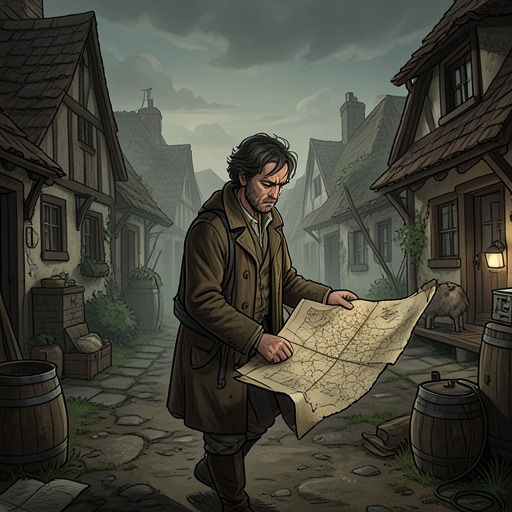
Lem is a wiry hillman about Miles Vorkosigan’s age. Their recognition is immediate when they meet at the clinic construction site: a decade earlier, Lem had been falsely accused of murder, and Miles had seen him again in Hassadar six years before this reunion. Compared with those earlier encounters, Lem now appears happier and more confident. The change is personal, but it also accompanies his emergence as a local leader: he has become Speaker of Silvy Vale, a position he has held for about two years.
The account associates Lem’s political outlook with ideas he encountered while living in Hassadar, describing him as a young advocate of Progressive ideas. Yet his ambitions take practical form in the valley. Rather than merely speaking for change, he gathers workers, recruits expertise, and arranges exchanges that make projects possible with the resources available locally.
Building the Clinic
When Miles arrives, Lem is working at the site of a new six-room building, then the largest structure Miles has seen in Silvy Vale. Lem explains that it is to be a clinic serving the whole area. The community aims to get it under cover before the first snow and have it ready by Winterfair, when a physician is expected to arrive. Until then, the valley has had only a medtech who visits on a weekly circuit; the planned doctor is intended to provide a more sustained local service.
The physician is a scholarship student of Countess Vorkosigan at the new school in Hassadar. In exchange for his education, he is to serve the community for four years, graduating around Winterfair. Lem’s plan extends beyond the clinic building itself: the community is also preparing a cabin for the doctor upslope. The project links education, medical access, and local accommodation in a single arrangement, turning the clinic from an idea into a coordinated commitment with a timetable and a person expected to staff it.
Lem takes Miles around the unfinished site and introduces him to the crew. Although the clinic is not yet complete, Lem describes its intended shape and use with such conviction that Miles can understand it as a realized plan in advance of its construction. The scene presents his enthusiasm alongside the labor and organization on which that enthusiasm depends.
Power and Local Initiative
The clinic’s prospects rest in part on a hydroelectric dam the people of Silvy Vale built themselves. Lem explains that they had waited for a powersat receptor promised by the District, but their place on the priority list meant that the promised equipment remained out of reach. He therefore looked for another route to electricity, visiting the older, low-technology hydro plant at Dos'tovar and asking two people from there to help choose and build a dam.
For the electrical system, Lem recruited an engineer from Hassadar whose house Lem had helped build. The engineer’s use of a cabin beside the new lake as a summer vacation place became part of the exchange. The community still owes for the generators, but the dam itself was selected for its short span, substantial drop, and available water flow. Lem expects the installation eventually to be outgrown; its limited capacity is not a reason to wait, but a starting point for further growth.
The dam also has a direct connection to the clinic effort. In Lem’s account, basic power is what allows the valley to move out of stagnation, and electricity for the clinic helped make it possible to win the District lottery that provided for the doctor. The sequence underscores the interdependence of his projects: local infrastructure supports services, while cooperation beyond the valley supplies skills or resources that residents cannot easily provide alone.
School and Family
Lem’s organizing extends to the school. He has added another room, and the school now has two teachers. Harra Csurik, his wife and Raina Csurik’s mother, teaches the older children; a girl Harra trained teaches the younger ones. When Miles asks where Harra is, Lem explains that she is teaching at the school that day. The details show an educational effort that is growing through both additional space and the training of another local teacher.
Lem’s own explanation of his persistence points back to Harra. When Miles observes that he did not let obstacles stop him, Lem credits what he learned from her. The surrounding account identifies Harra as the person he means. Their partnership is therefore part of the work’s foundation: Lem’s projects do not stand apart from the community’s teaching and care, and his account of his own determination acknowledges a source of support close to home.
Relationship with Miles and Narrative Role
Lem’s reunion with Miles begins at the clinic site, but it develops into a relationship of hospitality. At a gathering for Silvy Vale, Miles is the occasion for a party that is, in Lem’s wider community, a celebration of the valley itself. Later, after midnight, Lem accompanies Harra and Miles to the waterside. He has charge of the mead and distributes it judiciously, while otherwise keeping a mellow silence.
That restraint matters to the scene. Miles has come to the valley intending to stand before the dead, and after the gathering he considers seeking a solitary, potentially destructive end to his distress. Instead, he reaches the waterside with Lem and Harra beside him and recognizes that the conversation he needs is with the living. He tells Harra that he has something to disclose, but the available account stops before revealing what he says. Lem’s role is not to resolve Miles’s trouble or speak in his place; his presence helps make a different kind of encounter possible.
Through Lem, Silvy Vale appears not as a static backdrop to Miles’s grief but as a community actively making its future. The clinic, dam, and school all depend on patient cooperation, local initiative, and practical exchanges. His reunion with Miles connects that collective work to a more intimate form of support: at a moment when Miles might retreat into isolation, Lem joins Harra in providing company without pressing him to explain himself.