Lieutenant Vorberg
MemoryLieutenant Vorberg’s rescue makes him both the object of a successful hostage operation and its unintended casualty: after Miles Vorkosigan’s seizure disables the operation’s progress, a plasma arc injures Vorberg, who nevertheless survives and is expected to recover. His brief, consequential appearance links the mission’s success to the harm caused by the person attempting to bring him to safety.
Identity and Introduction
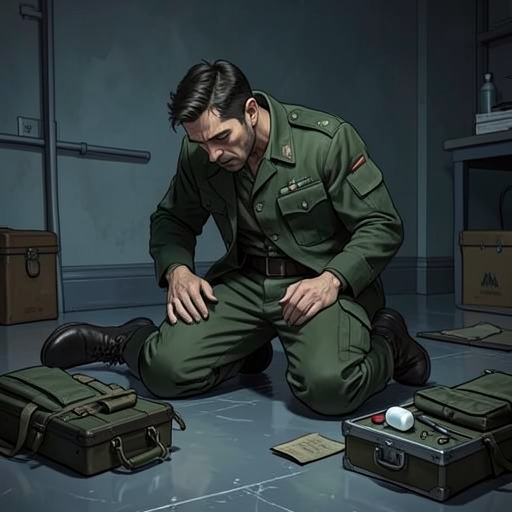
Vorberg is a Barrayaran courier officer serving with ImpSec. Hijackers hold him aboard their ship, where the Dendarii rescue team finds him alive but addled by sedatives. The team’s medical technician checks that he is not subject to mechanical or chemical booby traps before the rescuers begin taking him toward their waiting shuttle. The operation initially appears to be proceeding smoothly, and Vorberg is the hostage the squad has gone aboard to retrieve.
The rescue changes course when Miles Vorkosigan collapses and the plasma arc built into his armor locks on. Its discharge injures Vorberg before the rescuers can reach the shuttle. The weapon’s beam cauterizes the wounds, and the sedatives leave Vorberg with little awareness of what is happening; these circumstances help him survive until medical care is available. The rescue party gets everyone out, but Vorberg’s extraction is no longer an uncomplicated success.
The Dendarii surgeon reports that Vorberg’s injuries can be treated and that he is likely to be on his feet again by the time he reaches home, an expected journey of about six weeks. The treatment will leave him about three centimeters shorter. This outcome gives the rescue a concrete cost without turning Vorberg into a continuing participant in the investigation: the narrative establishes his survival and recovery prospects, then returns attention to the consequences Miles must confront.
Before the accident, Vorberg had not seen Miles Vorkosigan’s face, which was concealed by his combat-armor helmet. Afterward, the surgeon reports that Vorberg retains only a hazy, confused memory of the rescue. When he is convalescent, he is handed over to the Barrayaran Counsel’s office on Zoave Twilight for shipment home through normal channels. His limited memory and the ordinary repatriation process close his part in the mission while underscoring the distance between the rescue team’s technical records and the hostage’s fragmentary experience.
The Rescue in the Record
Appendix C preserves the operation through recordings from the Dendarii combat armor: the penetration of the hijackers’ ship, the hostage retrieval, Sergeant Taura’s Green Squad rescuing the freighter’s crew, and the events involving Miles Vorkosigan’s Blue Squad. The archive combines suit video with medical and communications telemetry, making Vorberg’s rescue visible from the squad’s equipment-level perspective even though his own recollection is hazy. For the people who carried out the mission, the recordings turn a confused emergency into a sequence that can be reviewed; for Vorberg, the evidence of what happened exists more fully in the record than in memory.
Miles reviews the real-time material, including the recording from suit 060, and finds the captured moment of Vorberg’s injury difficult to watch. He wishes he could remove the Blue Squad record from his report, but recognizes that an unexplained gap in the most consequential sequence would attract Simon Illyan’s attention. He considers deleting the entire appendix instead, so that the missing account would be concealed among the absent squad records. Vorberg’s brief role thus leaves a lasting documentary trace: the operation gets him home, while its official record becomes a source of scrutiny for the rescuer whose equipment caused the harm.
The Cost of Rescue
Vorberg’s role exposes a gap between the mission’s operational success and its human cost. The squad reaches its hostage and gets everyone out, yet the rescued officer is harmed not by the hijackers but by the equipment of the person trying to save him. The accident therefore complicates the mission’s success without erasing it: Vorberg survives and is expected to recover, while the rescue leaves a consequence that cannot be filed away as a clean victory. His limited recollection sharpens that contrast. The armor recordings preserve the event in detail, but the person at its center remembers it only hazily; the rescue is at once a lived ordeal, a fragmentary memory, and an official record.
Recovery and the Limits of the Record
The account gives a prognosis, not a confirmed medical ending: the surgeon says the cuts are clean and just below the knee joints, a position that avoids more complicated treatment, and expects Lieutenant Vorberg to be back on his feet by the time he reaches home, roughly six weeks later. The forecast also includes a lasting physical consequence—he will be about three centimeters shorter—but the narrative does not follow him through rehabilitation or establish his eventual condition. His fate therefore remains bounded by what the rescue record can verify: survival, a treatment plan, and a reasoned expectation of recovery.