Charlie Treadaway’s trial and conviction
MovingThe supplied passage does not depict Charlie Treadaway’s trial or establish his conviction. It contains no account of the charges, courtroom proceedings, evidence, verdict, or sentence. Instead, it follows Lucas after a visit to his mother and shifts into a recollection of the family home and his father’s departure. The passage can therefore offer context about Lucas’s state of mind and the narrative’s movement into memory, but it cannot support a substantive account of the trial itself.
What the Passage Shows
Lucas is overcome by sleep deprivation and dreams that he is in a boat capsizing in a lake. In the dream, he is certain he will drown and that nobody will save him. Katya wakes him hours later, bringing a tea tray. The scene then returns to his departure: he gathers his jacket and the photograph album, reassures his mother that he will come back, and leaves without kissing her. Her smell, which seems to him to suggest that she is deteriorating, distresses him. These details establish the immediate emotional circumstances of Lucas’s visit, not any event in Charlie Treadaway’s trial.
The Return to Chelsea
Lucas takes a cab back to Chelsea and stops at a newsagent near Bartholomew Lodge for basic provisions, including tea, coffee, milk, sugar, biscuits, cereal, and a tin of Ambrosia creamed rice. Back at his mother’s flat, he takes coffee and the album into the sitting room, adjusts the recliner, and studies a photograph of the house where he grew up. The passage’s concrete sequence—from leaving his mother to returning to the photograph—makes the album a hinge between the present visit and memories of his childhood.
River Walk and the Recalled Past
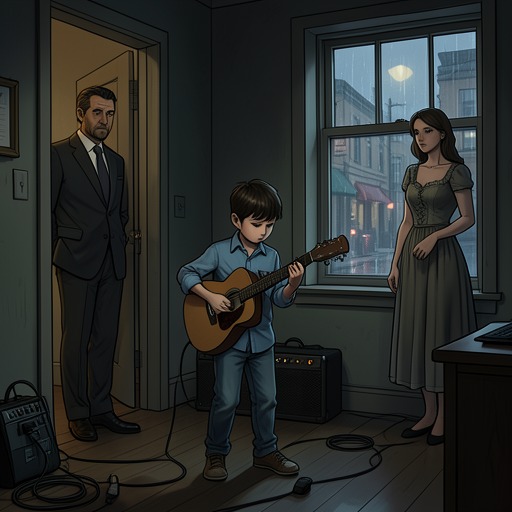
The photographed house is a white-washed 1930s semi in Chelsea, near the river, with a yellow front door framed by roses. Lucas remembers bees in the garden and the security he associated with being inside the house. That remembered safety is not entirely reliable: he wonders whether his father really smoked a pipe in the sitting room or whether the detail has become confused in memory. He recalls more broadly a privileged childhood, including cycling along the Embankment, boating in Battersea Park, and walking along King’s Road between his parents as they swung him off his feet.
The recollection turns to the rupture that followed. When Lucas was ten, his father left River Walk for good. Although he knew other boys whose parents were divorced, he had not expected his own family to separate. Nearly half a century later, encountering the word divorce still produces an acute physical response. This remembered separation gives the passage its clearest account of lasting consequence, but it does not supply information about Charlie Treadaway’s trial or conviction.