Edwina decides to sell Number 137
MovingEdwina decides to sell Number 137 after the house’s deterioration becomes impossible to overlook and its rooms no longer feel like a home she wants to inhabit. The decision shifts from a thought she has dismissed before into action: she contacts an estate agent to arrange a valuation, beginning a practical process of leaving a place bound up with her former selves and memories.
The House’s Newly Visible Decay
Before her cataract operation, Edwina had been blissfully unaware of the house’s condition. Returning from Moorfields Eye Hospital with new plastic lenses, she suddenly saw cobwebs hanging from the ceilings, mouse droppings in the kitchen drawers and woodworm spreading through the wood. The change is not simply that the house has begun to decay; she can now see the decay that had escaped her notice.
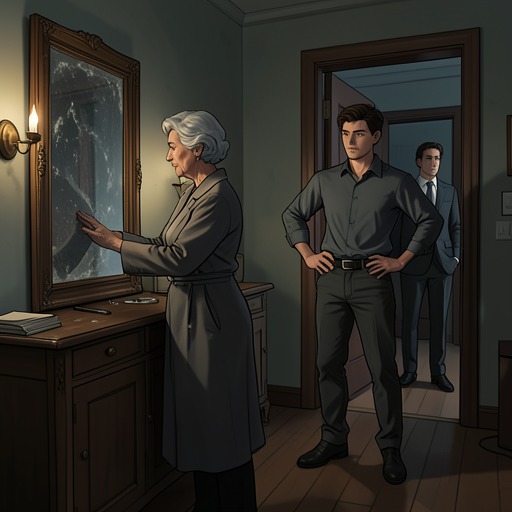
The signs gather throughout the building: cracks along the skirting boards, musty smells, and a fraying downstairs lavatory pull cord she has already had to knot twice. Ivy thickens over the basement windows until the kitchen is dark even in June. The house seems to turn against her, while its neglected rooms make its scale and upkeep increasingly difficult to live with.
From a Repeated Thought to a Decision
More and more of the house has fallen out of use; Edwina has not entered some rooms for months. She considers looking at the home as a visitor might, but selling is no longer merely a possibility raised and immediately dismissed. This time, the idea makes sense to her: she does not want to remain a prisoner in her own past.
That resolve has an intimate counterpart in her sense of self. Edwina thinks of her former selves as nested one inside another, from the lonely boarding-school girl to the young wife, mother and widow. The house, like that imagined stack of earlier Edwinas, holds the accumulated shape of a life; deciding to sell it means confronting that history without agreeing to stay enclosed by it.
Putting the Sale in Motion
After making up her mind, Edwina is surprised by how calm she feels. She phones the estate agent down the road and arranges for someone to come and value the house. The step gives the decision a date and a practical next action rather than leaving it as an abstraction.
She writes the appointment in both her desk diary and the wall calendar, aware that the estate agent is due on Friday. That leaves two days to make the house presentable, including vacuuming and bleaching the lavatory. The preparations register the immediate consequence of the decision: the home she has long occupied must now be seen and assessed by someone who may help bring her departure about.
Significance
The decision marks a change in Edwina’s relationship to the past. Number 137 is not just a deteriorating building: its rooms have become part of the life she remembers and the life she still carries within her. Selling it cannot undo that history, but it offers a way to stop treating the house as the place where all of it must remain physically preserved.
The scene also makes the change legible through ordinary tasks. A phone call, a valuation appointment, a diary entry and a list of cleaning jobs turn an inward recognition into a sequence of outward acts. Edwina’s calm accompanies that movement: for once, the thought of selling does not retreat into dismissal but sets the house, and her future in it, in motion.