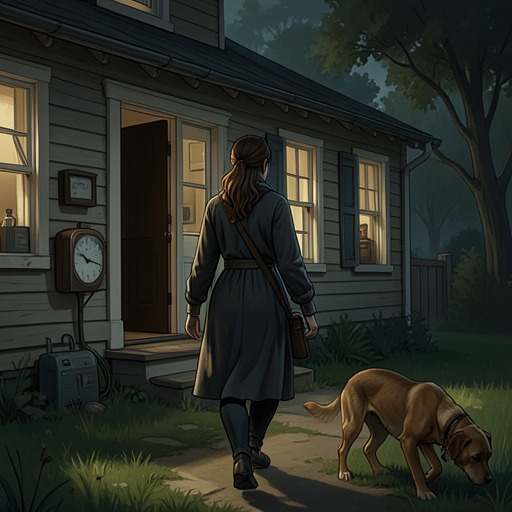
Fern Woolbright discovers she is pregnant
MovingFern Woolbright’s discovery that she is pregnant transforms a string of bodily symptoms into an urgent personal and family crisis. At nineteen, she had not understood her exhaustion, nausea, aversion to certain foods, and unusually sensitive sense of smell as signs of pregnancy; the diagnosis forces her to confront both the future those symptoms imply and a question of paternity she cannot safely answer aloud.
The consultation and the diagnosis
Fern comes to Dr Leonard’s surgery because her mother has told her to discuss how she has been feeling. Dr Leonard has known her since she had chicken pox as a toddler, a familiarity that makes his attempt to raise the possibility especially uncomfortable. He looks mortified as he suggests that she may “possibly, conceivably… aha, apt choice of word… be with child”. Fern initially takes the phrase literally: there is no child with her, and she has arrived alone. The gap between the doctor’s euphemism and what he means gives the realization a brief, almost comic delay before it becomes serious.
When the meaning lands, Fern laughs involuntarily and asks whether he means she is pregnant, immediately insisting that she cannot be. Asked about contraception, she says that she is not on the pill but has a Dutch cap “should the occasion arise.” Dr Leonard then asks whether she is conscientious. Fern pauses a moment too long; he explains, in careful and embarrassed terms, that a barrier method only works if the device is in place. Her blush travels from her throat to the roots of her hair, and he offers to take blood to make sure. The exchange does not establish precisely what happened on any particular occasion, but it makes Fern’s uncertainty and discomfort visible before the test confirms what she fears.
What the news means to Fern
The diagnosis settles the question of her symptoms but opens a much larger one in Fern’s mind. She is nineteen, and her immediate conclusion is that she has ruined her life. That response marks the distance between the doctor’s cautious medical language and the scale of the consequence as she experiences it: pregnancy is not an abstract possibility but a sudden foreclosure of the future she thought she had.
Her mother had guessed before the GP raised the possibility. She is white-faced but efficient, telling Fern that this is not the end of the world and contrasting it with what has happened to Minty Landreth and Paul Landreth. For a moment, Fern thinks her mother may suggest an abortion. She imagines the appeal of simply falling asleep and waking to find the problem gone, as when her tonsils were removed at nine. The comparison conveys her wish for a clean, externally managed solution; it does not mean that her mother actually recommends one. In this first response, practical reassurance and Fern’s private wish for the crisis to disappear coexist without resolving what she will do.
The unspoken question of paternity
The pregnancy is not the only secret the diagnosis brings into focus. Fern’s father is given time to absorb the news while she is away; her mother warns that the worst of his temper will be over by the time Fern returns. The comparison of his anger to a hurricane that eventually blows over frames the family’s response as frightening but temporary. When Fern comes back, he is in his study with his head in his hands. He tells her he is disappointed, but adds that he is grateful James Frobisher is the father.
Fern cannot correct him. She knows that the father might instead be Charlie Treadaway, and the thought is bound up with the fact that Charlie may have supplied the drugs that killed her cousin, Elise Landreth. Her father’s assumption gives the situation an outwardly simple explanation, while Fern’s knowledge makes it dangerously more complicated. The gap between what the family believes and what Fern can say is therefore central to the discovery’s consequences: pregnancy makes her concealed relationship with Charlie newly consequential, but does not make disclosure possible.
James’s proposal
Telling James is painful for Fern, and he is initially so shocked that he says he thought he was only coming for Sunday lunch. Then, in a reversal of the ordinary rhythm of the visit, he gets down on one knee and asks her to marry him. The proposal supplies an immediate response to the pregnancy, but it does not settle the concealed question of who the father is. Instead, the scene places James’s commitment beside Fern’s unspoken knowledge: he reacts to the news by offering marriage, while she cannot tell him what she does not know for certain.
The discovery thus links a medical consultation to a chain of decisions and silences. Dr Leonard’s blood test confirms Fern’s condition; her mother’s prior suspicion and her father’s disappointment make it a family matter; and James’s proposal turns it toward marriage. Yet the most consequential fact remains withheld from those around her. The pregnancy is confirmed, while the identity of its father remains uncertain to Fern and unknown to her family.