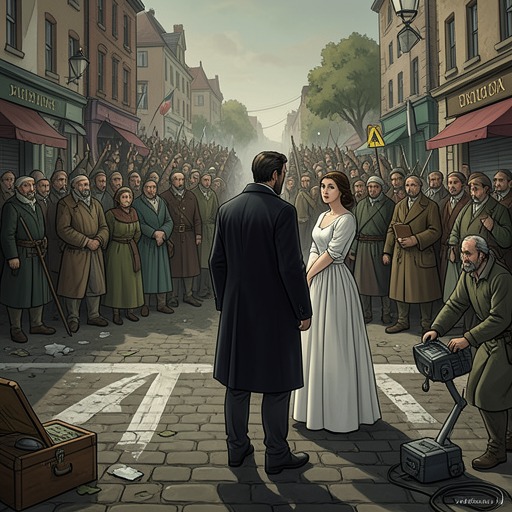
The inquest into Elise Landreth’s death
MovingThe inquest into Elise Landreth’s death is the moment when a death already surrounded by gossip becomes a public legal record—and when Lucas Spinner identifies the accused, Charlie Treadaway, as his stepbrother. Held in October after Minty Landreth tells her sister Rosemarie Woolbright that the hearing is approaching, it gathers family members, witnesses, journalists, and Charlie’s supporters around the question of how Elise died and who supplied the drugs that killed her. Its evidence clarifies the immediate circumstances while leaving the emotional and moral dimensions of the case unresolved.
Publicity and attendance
In September, as Fern Woolbright’s pregnancy becomes increasingly visible, Rosemarie receives a call from Minty Landreth about the October inquest. She promises to attend in support of her younger sister. The hearing also renews the media’s attention to Charlie Treadaway. Reporters bring forward his earlier life, including photographs of him in chorister’s robes, and publicize the identity of his mother, the children’s illustrator Edwina Treadaway, also known as Edwina Spinner. The coverage notes that Edwina was widowed young before marrying political speechwriter Dickie Spinner.
The press turns Edwina’s illustrations for Betsy and Tom into a vehicle for insinuation, setting their cosy make-believe against the sordid reality of the case. Charlie’s school history is revisited as well. Wyebourne College declines to comment, while Glennings co-educational boarding school issues a public statement presenting him as a much-loved member of its community and describing drugs as a modern scourge. The contrast between the schools’ responses becomes part of the spectacle surrounding the hearing: the inquest concerns Elise’s death, but the publicity also puts Charlie’s past and his family’s reputation on display.
Fern would rather avoid the proceedings. Her parents believe she should show support, however, and she attends with them, seated between them and feeling like a prisoner. Her presence is complicated by her concealed connection to Charlie and by her pregnancy. The courtroom is therefore not simply a place where she hears evidence; it brings private feeling into dangerous proximity with public scrutiny.
What the witnesses establish
The account of Elise’s death is already widely known by the time the inquest hears it. Elise choked in her sleep before suffering a cardiac arrest. Kasia Bogonavitch raised the alarm after discovering her in the bed of her absent boyfriend. The testimony makes the bodily consequences of the death brutally immediate. Rowena Treadaway recounts trying to give Elise the kiss of life and clear her airway by putting her fingers into Elise’s throat. Her efforts failed; she remembers Elise’s lips turning blue.
Lucas is called as the next witness, and Fern recoils at seeing him take the stand. He tells the court that he gave Elise a lift from London to Oxford on the day of the party. They had encountered one another earlier and arranged to travel together. Elise carried little beyond a leather shoulder bag and had not committed to a return journey, saying she might meet someone. Asked what that meant, Lucas explains that she thought she might meet a man.
The questioning turns from Elise’s plans to the drugs at the party. Lucas acknowledges that young people were drinking and smoking, including some cannabis, but says that drinking was more common. Asked how he can be sure Charlie supplied the drugs that killed Elise amid the confusion, he describes seeing her retrieve her bag and join Charlie in the opposite corner of the room. He heard them laugh. His account gives the court a specific sequence: the bag, the meeting, and the exchange he says he witnessed.
That account has a parallel in Lucas’s later recollection of the party. From a distance, he had watched Charlie and Elise move toward one another and begin talking closely. Elise kept reaching for Charlie’s arm; he shrugged her off. She searched urgently for her handbag, found it beneath a pile of coats, and clutched it as she returned to him. Lucas then saw the pair turn their backs on the party while an exchange took place. Elise embraced Charlie tightly afterward, and he had to pull her hands away to leave. The recollection supplies context for the inquest testimony without changing its limits: Lucas says what he saw, while the court must determine what that observation proves.
The stepbrother’s identification and Charlie’s silence
The decisive disclosure comes when Lucas is asked how he can be certain that the person he saw was Charlie Treadaway. He answers that Charlie is his stepbrother and that he has known him since the age of eleven. The courtroom reacts with an audible gasp from those who did not know of the relationship. Lucas’s evidence thus does more than identify the alleged supplier: it reveals a family bond that makes his testimony intimate as well as incriminating.
Barbara Spinner, Lucas’s mother, is also called. Fern senses that Barbara is relishing her appearance in court; her statement sounds practised, and she raises her head after saying she called the police. The detail gives Barbara’s testimony a theatrical edge, as observed through Fern’s hostile, unsettled perspective. The inquest is not presented as a neutral space in which family histories disappear. Even a witness’s manner is registered through the loyalties and resentments of those watching.
Charlie does not testify. His solicitor tells the inquest that he is exercising his right to remain silent pending cross-examination at trial, and describes him as a person of previous good character. All eyes turn toward the hollow-cheeked young man in a white shirt and navy suit. His hair has been cropped close; he sits upright and cries. Fern’s response is intensely private: she longs to reach him, but turns her gaze away after their eyes meet. The divide between them is at once legal and emotional. She cannot comfort him openly, and his silence leaves the court without his account of the encounter Lucas describes.
Charge, aftermath, and the limits of the hearing
At the close of the inquest, Charlie is officially charged with possessing amphetamine sulphate and supplying heroin to Elise. He is to face a jury on December 19, 1981. The charge is a consequential legal result, but it is not a verdict on the question of guilt. As the group leaves the court, Gordon expects the matter to be finished by Christmas; Fern, by contrast, is panicked that Charlie’s mother may recognize her. She covers her necklace with her hand and lowers her head as she tries to get away. The public proceeding has exposed the accused and the witness, while Fern’s own place in the story remains concealed.
The inquest’s later significance is sharpened by Lucas’s retrospective thoughts. He remembers seeing Fern at the hearing with her parents and noticing the small bulge beneath her open coat; her pregnancy becomes evident to him there. His mother later tells him that Fern has married Captain James Frobisher, an Army officer, and is carrying another man’s child. Lucas remains troubled by whether Charlie ever knew about the pregnancy and, if he did, whether he cared. He is glad Fern does not attend the trial because he does not have to lie in front of her, though his reflection that the whole truth is a joke exposes the distance between testimony and the private history behind it.
From that later perspective, the inquest stands between a death and its legal aftermath: a man will go to prison, a baby will be born, and Charlie will disappear from the courtroom gallery when he is sentenced. The hearing can record Elise’s death, Lucas’s identification, and the charge brought against Charlie. It cannot settle what Charlie knew about Fern, make the witness’s family bond disappear, or reconcile love with accusation. Its force lies partly in that boundary: public evidence advances the case, while the most painful truths continue beyond the court’s reach.