Lucas confesses the theft and returns Edwina’s keepsakes
MovingLucas’s confession to Edwina turns the return of a nearly emptied jewellery box into an act of belated accountability. He admits that he arranged the burglary of her house, explains that school debts drove him to accept a solution from a creditor, and returns the small collection of family keepsakes that the thieves left behind. The disclosure gives Edwina the truth and the objects back, but it cannot undo the damage, restore Charlie, or erase Lucas’s earlier testimony.
The box and the decision to return
The confession begins before Lucas speaks to Edwina. The box is the only evidence that could possibly connect him to the robbery at Kennington Road. It has been ransacked, its valuable contents taken, while the things left inside are precisely those a thief would have no reason to want. Among them are a wedding ring too slight to be worth weighing, a lock of hair in a matchbox, a creased photograph of a family on a sun-bleached beach, and a Parma violets tin that holds baby teeth instead of sweets. The contrast between the box’s lost valuables and these intimate remnants makes its return more than the restoration of property: it carries a family’s private record of attachment and loss.
Lucas wipes his eyes on a pillowcase and recognizes that his decision comes too late to repair what he has done. Still, he does not want to spend the rest of his life ashamed of his actions; he wants, for once, to do something right. He puts the box back into the pillowcase because Edwina may want the keepsakes returned. Going to see her is an obligation he chooses to meet, not a means of retracting the consequences of his past: he cannot take back what he said in court, and he cannot give her son back.
Returning to Edwina
The pillowcase itself connects Lucas’s present act to the domestic history of the house. Edwina recognizes its floral fabric, bought many years earlier from a market stall for one shilling and thruppence. It first belonged in the nanny’s room, then became part of Lucas’s room, and later served in a spare room with maps on the walls. Now Lucas has returned from America carrying it, although Edwina has not seen it for decades. An ordinary household object has become the wrapping for the evidence of a concealed wrong—and for the belongings that survived it.
Lucas places the box on the table. Edwina recognizes it slowly: the thin leather is worn, its red has faded, and its golden clasp no longer shines. The box feels too light, confirming her fear that its contents are gone. When she opens it, the compartments are empty except for the small drawer at the very bottom. There she finds her tiny wedding ring, Lucas’s hair, the children’s baby teeth, and the photograph taken on that last day. The return restores these particular keepsakes, not the jewellery that was stolen. Their survival gives the encounter its emotional weight: the objects are materially slight, but each bears a family memory that the thieves did not understand.
What Lucas admits
With his head in his hands and his voice low but steady, Lucas tells Edwina that he had the box stolen. He had got into trouble at school and owed money to someone who would not forget the debt. When that person offered him a way out, Lucas accepted. He handed over the keys to the house and told the others when it would be safe to enter. The plan brought him the money he needed, and at first he believed no one had been hurt. His admission revises that calculation: the theft did injure people, and its consequences cannot be measured only by whether anyone was physically harmed during the burglary.
The confession also includes Lucas’s recognition of the assumptions he carried into his earlier relationship with Edwina and Alicia. He acknowledges that he probably was stuck up, and connects his attitudes to schools that did not believe in women like Alicia or Edwina. He says that he no longer cares about the beliefs those schools wired into him, but he does not use that change to claim innocence. The wrong at the heart of the scene remains specific: he arranged the theft, and he cannot change what happened in court or bring back Charlie or Elise.
A limited reconciliation
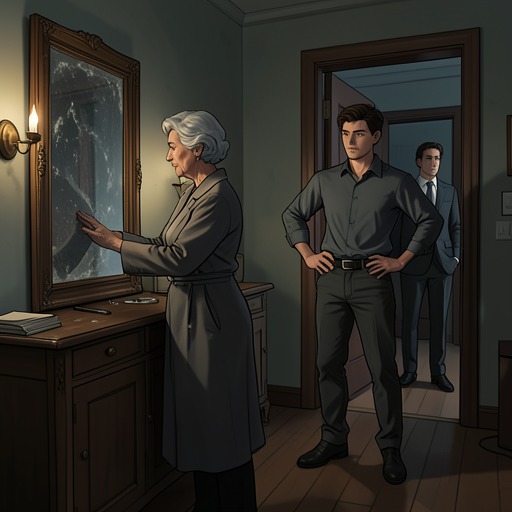
Edwina cannot speak after the confession. She trembles, presses her fingers hard against her mouth, and cries as Lucas explains what he did. When he stands to leave, she catches his hand with a fierce grip and thanks him. Neither looks at the other, and Edwina does not apologize. Their exchange does not supply a broad reconciliation or erase their history; it records a narrower change, from concealed culpability to acknowledged responsibility and from withheld keepsakes to their return.
The scene’s resolution is deliberately bounded. Lucas has done something he believes he owes Edwina, but he cannot reverse his testimony, restore Charlie, or make the family’s losses disappear. Edwina’s thanks recognizes the act without turning it into absolution. The box therefore holds together the event’s two outcomes: a tangible recovery of what remained, and the painful limit of what any confession can repair.