16
Piranesi16 is the real, human figure behind Piranesi’s imagined designation of a “Sixteenth Person”: a woman whose carefully marked route through the House gradually turns a supposed abstraction into a pursuer, correspondent, and person in need of protection. Her presence destabilizes The Other’s warnings and redirects Piranesi’s purpose from mapping the World to finding her before she reaches danger.
Identity and Introduction
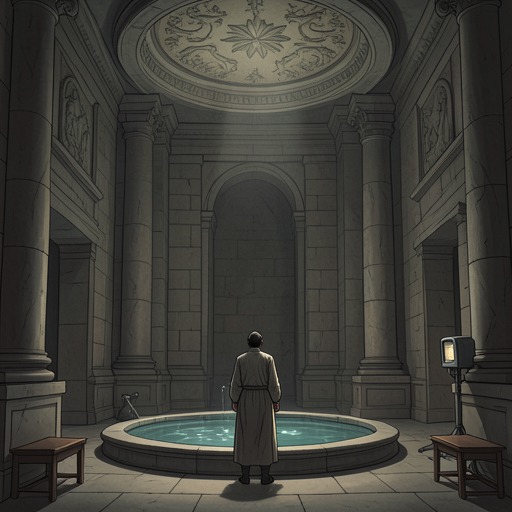
Piranesi has organized the House’s inhabitants into a count of the dead and the living, and reasons that an additional arrival would be the Sixteenth Person. He imagines that such a visitor could explain the distant regions of the World, so the prospect initially inspires curiosity rather than fear. When The Other insists that Piranesi avoid strangers, Piranesi argues that the newcomer might possess knowledge unavailable to them; The Other’s confused reaction also shows that he does not retain Piranesi’s theory of the numbered inhabitants.
The theory becomes fact when The Other admits that he has met 16. He immediately recasts the encounter as a warning: 16 is his enemy and, by extension, Piranesi’s. The mismatch between Piranesi’s hope for a knowledgeable visitor and The Other’s insistence on danger establishes the central uncertainty around 16: whether she is a threat, a potential ally, or both in the eyes of different people.
A Visitor’s Route Through the House
The first direct sign of 16’s presence is not a meeting but writing. Piranesi finds chalk marks and words that are not The Other’s, and recognizes that someone else has left them. He wonders whether reading 16’s message might itself be dangerous, since The Other’s warnings had focused on speaking to or listening to 16. The message proves to be directions, not an attempt to frighten or manipulate him.
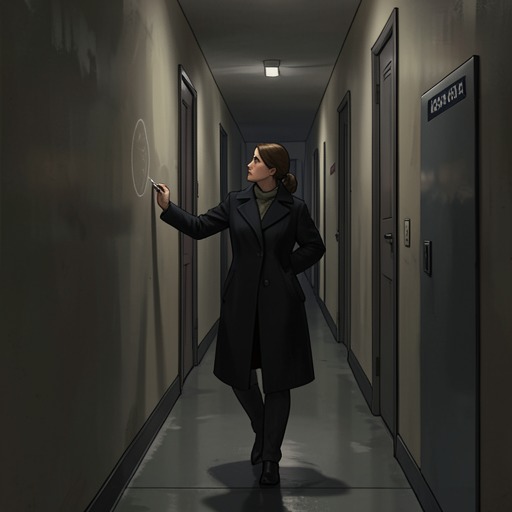
The directions lead from the Sixth North-Western Hall to the First Vestibule. Piranesi finds them clear and efficient, written in square, upright letters. He follows 16’s route back toward the First Vestibule, where yellow chalk marks each doorway; beneath the doorframes, 16 has repeated the instructions so that a Tide or accident destroying one set would not erase the route. The marks sit below Piranesi’s eye level, leading him to estimate that 16 is twelve to fifteen centimetres shorter than he is. A practical detail becomes a portrait: she is shorter than Piranesi, methodical, and prepared for the House’s hazards.
The route also gives 16 a spatial presence before Piranesi has seen her. Yellow chalk makes a path legible across halls and doorways, while the repeated instructions build in resilience against damage. In a place where movement is difficult and familiar routes can be disrupted, her marks offer Piranesi both evidence of another person and a means of tracing that person’s progress.
Conflicting Warnings and Motives
At a later encounter, Laurence Arne-Sayles tells Piranesi that someone is looking for him. When Piranesi asks whether he means 16, Arne-Sayles confirms that she has asked how to find him. This information directly contradicts The Other’s framing: 16 is seeking Piranesi, not The Other. Arne-Sayles says he will give her detailed directions, partly because he wants to injure The Other, whom he hates for having slandered him for twenty-five years. His stated motive is retaliation against The Other, not concern for 16’s safety.
Arne-Sayles also qualifies the apparent certainty of his assistance. Few people can reach the House unless someone shows them the way, and he says that 16 may never arrive. He contrasts her apparent ability to move between worlds with The Other’s dependence on candles, door-representing uprights, ritual, and equipment. The route is therefore more than a trail through the halls: access itself is uneven, and the people who know how to cross the boundary can determine who is able to follow whom.
Piranesi is left between incompatible accounts. The Other calls 16 malevolent and orders concealment; Arne-Sayles rejects that description while knowingly sending her toward Piranesi to provoke The Other. Neither man’s account settles what 16 intends. The evidence instead makes their conflicting interests visible: The Other wants distance from her, while Arne-Sayles wants her arrival to upset his enemy.
Piranesi’s Response and the Search for 16
Piranesi does not simply treat the writing as a forbidden or dangerous message. After checking himself for signs of madness, he reads the directions and retraces 16’s route. He then obtains blue chalk from the Second Northern Hall and returns to the Sixth North-Western Hall, where the directions begin, to write back beneath 16’s words. The exchange gives the chalk trail a reciprocal purpose: it is no longer only a record of where 16 has travelled, but a way for Piranesi to address her.
Later, Piranesi makes finding 16 his most important task, specifically to ensure her safety. He suspects that The Other has set a trap, perhaps by promising to meet her at a particular hall and time and to tell her how to reach Matthew Rose Sorensen. Although seeking The Other might be the most reliable way to locate 16, Piranesi wants to avoid him. He recalls the Prophet’s warning that The Other will become more dangerous as 16 draws nearer, and hopes to find her before she reaches The Other. The objective turns Piranesi’s earlier excitement about meeting the Sixteenth Person into a protective urgency.
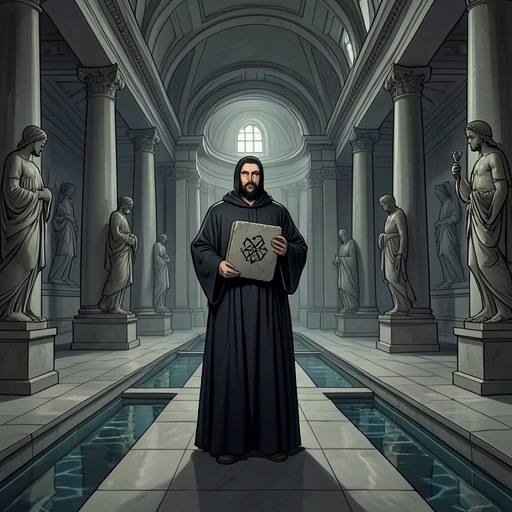
At the close of Piranesi’s life in the House, the search gives way to departure. He gathers his journals and favourite pens in his messenger bag and walks with Sarah Raphael toward the two Minotaurs in the South-Eastern Corner. A corridor-like opening appears between them, suggesting lights and moving colours beyond the House. Piranesi takes one last look at the Eternal House, and Raphael takes his hand as they enter the passage together. This ending does not show what becomes of 16, but it places Piranesi’s departure within the larger movement from an imagined numbered visitor toward real human connection beyond the labyrinth.
Narrative Significance
16’s identity is revealed through traces before direct encounter: a warning from The Other, directions written in chalk, a distinctive pattern of repeated marks, and Arne-Sayles’s account of her search. That sequence makes the reader, like Piranesi, reconstruct a person from partial and conflicting evidence. The chalk is especially consequential because it converts the House from a space Piranesi explores alone into a route another person has crossed and may cross again.
The figure also exposes the limits of The Other’s authority over Piranesi’s understanding. His instruction to hide from an unknown person presents isolation as protection, while Piranesi’s willingness to read and answer 16’s writing turns attention into a way of finding and safeguarding someone. The contrast is not resolved by a full account of 16’s character or intentions; instead, her partly unseen presence changes what Piranesi believes he must do. She becomes a test of whether the House’s inhabitants will be governed by fear and rivalry or by the possibility of reaching another person.»