Stanley Ovenden
PiranesiStanley Ovenden is a mathematician turned anthropologist, a student of Laurence Arne-Sayles, and one of several people associated with Arne-Sayles who disappear. His story is reconstructed from a journal entry the protagonist can scarcely understand, from the Prophet’s speculation about the dead in the House, and from the eventual arrangement of their remains. The novel never confirms which bones are Ovenden’s; instead, his uncertain presence among the dead makes the gaps in the protagonist’s memory converge with a larger human mystery.
Identity and Background
Ovenden was born in Nottingham in 1958. His father, Edward Francis Ovenden, owned a sweet shop; the journal records no information about his mother. He studied mathematics at the University of Birmingham and began postgraduate research in 1981. That year he attended one of Arne-Sayles’s celebrated lectures, “The Forgotten, the Liminal, the Transgressive and the Divine.” Soon afterward, he abandoned mathematics for a PhD in anthropology at the University of Manchester under Arne-Sayles’s supervision.
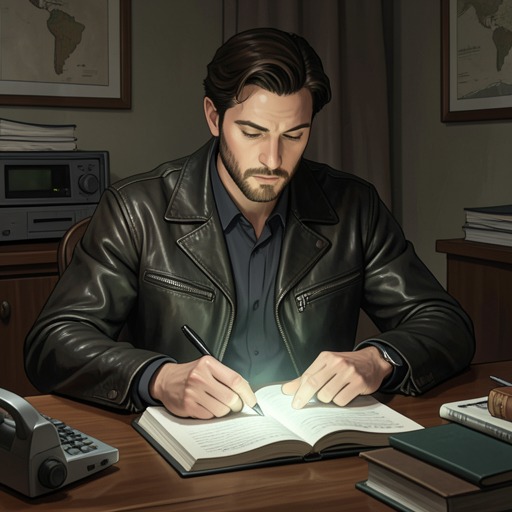
The details reach the reader through the protagonist’s recovered journals, whose numbering has been tampered with. The first three books, now labeled Journals 1, 2, and 3, were originally numbered 21, 22, and 23; someone scratched away the initial 2, though its ghost remained visible in the gel ink. Realizing that his present Journal 1 had once been Journal 21, the protagonist opened it to page 154 and found “Biography of Stanley Ovenden,” dated 22 January 2012. The altered covers make the biography more than a piece of background: it is evidence preserved in a record whose sequence has been deliberately obscured.
Arne-Sayles’s Circle
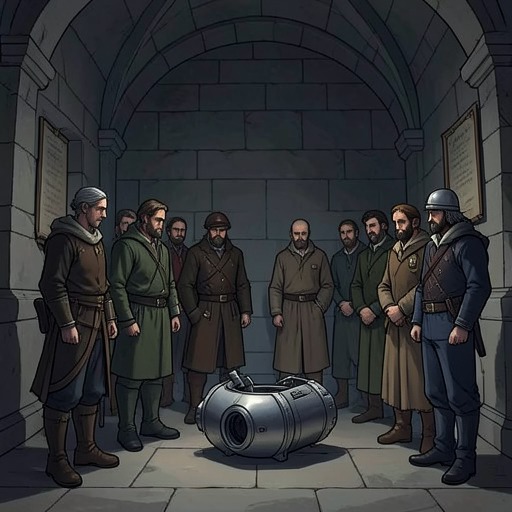
In the summer of 1987, Arne-Sayles rented Casale del Pino, a farmhouse twenty kilometres from Perugia, and brought a group of favored students. Ovenden was among them, alongside Bannerman, Hughes, Ketterley, and D’Agostino. Their shared involvement in Arne-Sayles’s “great experiment” did not produce a stable fellowship. Arne-Sayles treated questions as evidence of insufficient commitment and responded to dissent with attacks on his students’ personal and academic failings. Most of the group kept diplomatically silent; Ovenden continued to express doubts, seemingly unable to read or accommodate the social consequences of doing so.
When Tali Hughes defended him, Arne-Sayles turned his anger on her as well. The atmosphere at the farmhouse deteriorated, and Ovenden and Hughes increasingly spent time apart from the group. They became friendly with Maurizio Giussani, a young philosophy student at the University of Perugia. The journal says this friendship appears to have seriously alarmed Arne-Sayles. The account thus connects Ovenden’s skepticism not only to a clash over the experiment but also to the group’s fractures and the growing significance of a friendship outside Arne-Sayles’s control.
Giussani’s Disappearance
On the evening of 26 July, Arne-Sayles invited Giussani and his fiancée, Elena Marietti, to dinner at Casale del Pino. He spoke about the Other World, a place where architecture and oceans were confused together, and about the possibility of reaching it. Marietti understood the talk as metaphor, or perhaps as a description of a psychedelic experience. She left at about eleven because she had work the next day, driving home to Perugia, while the others remained. The English party had promised that one of them would take Giussani home.
Giussani was never seen again. Arne-Sayles claimed he had gone to bed shortly after Marietti left and knew nothing of what followed. Ovenden and the other members of the group said Giussani had refused a lift and set off on foot a little after midnight. It was a warm, moonlit night, and Giussani’s home was about three kilometres away. The journal records the competing accounts but does not resolve them. Ten years later, after Arne-Sayles was convicted of kidnapping another young man, Italian police reopened the case; the protagonist stops reading before the account’s outcome, unable to make sense of the words on the page.
Disappearance and Uncertain Identification
Ovenden’s disappearance becomes part of a recurring list of people connected to Arne-Sayles who vanished: Giussani, Ovenden, and Sylvia D’Agostino. In the protagonist’s notes on whether to write about Arne-Sayles, the mystery surrounding these three is marked as a compelling reason to pursue the subject. That investigative interest sits beside the recognition that several close associates have disappeared and that most of the survivors will not speak to journalists. Ovenden is therefore present both as an individual in the journal and as one element in an unresolved pattern.
The Prophet offers one possible explanation for where Ovenden went. After hearing about the thirteen dead kept by the protagonist, he recalls a biscuit box once kept on a little table beside the mugs in the corner of his university study. He guesses that it somehow reached the House, then suggests that one of the dead is almost certainly the young Italian associated with Ovenden and that another is Ovenden himself, who repeatedly came to see the Italian. He says he had warned Ovenden that he was asking for trouble, invoking guilt without explaining it. His recollection supplies a connection between the two disappearances, but not proof of what happened to either man.
Sarah Raphael later asks directly whether Ovenden is among the dead, along with D’Agostino and Giussani. The protagonist answers that one of them is highly probably Ovenden, while carefully correcting himself: this is what Arne-Sayles thought. He has no way to tell which remains belong to which person. The distinction matters. Arne-Sayles’s belief and the Prophet’s speculation make Ovenden’s presence plausible, but the dead cannot identify themselves, and the protagonist cannot independently verify their names.
Remains and Narrative Significance
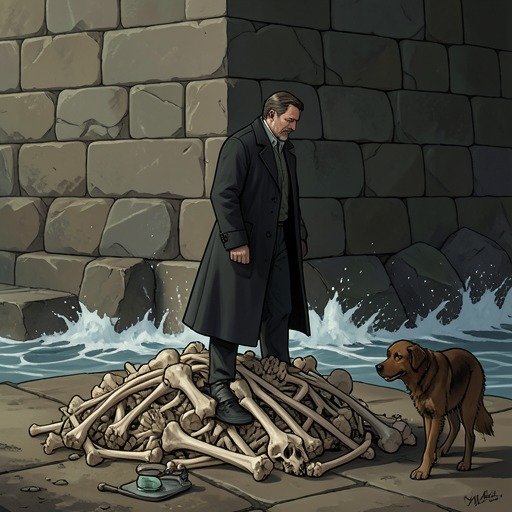
When Valentine Ketterley dies, the protagonist places his body in a sack of plastic netting. Its mesh lets fish and birds reach the remains while keeping the small bones from being lost. He estimates that the bones will be clean in six months and plans to gather and arrange them in an empty niche in the third north-western hall. Ketterley is to lie next to the biscuit-box man, with the long bones tied together by twine, the skull on the right, and a box of small bones on the left.
The entry names Ketterley’s future companions as his colleagues: Stanley Ovenden, Maurizio Giussani, and Sylvia D’Agostino. This is the strongest final material association between Ovenden and the other vanished members of Arne-Sayles’s circle, but it does not supply a forensic identification of the remains. The orderly niche, carefully sorted bones, and shared designation of “colleagues” set the protagonist’s patient care against the unresolved violence of their disappearances. Ovenden’s story ends not with a recovered testimony or confirmed identity, but with a place reserved among the dead and a name that the living can only tentatively attach to it.