James Ritter
PiranesiJames Ritter is a model, actor, occasional sex worker, and survivor of prolonged mental illness who was imprisoned by Laurence Arne-Sayles behind a false wall. Found gravely ill and unable to speak coherently, Ritter continued to describe a vast house of statues and rising seawater. His account is never conclusively explained: it may be read as delusion, as evidence manipulated by Arne-Sayles, or as testimony to the House itself. When Matthew Rose Sorensen later takes him back there, Ritter recognizes the place where he once slept—and is then returned to ordinary life rather than left to fend for himself in the labyrinth.
Identity and Background
Born in London in 1967, Ritter was described as very good-looking in his youth. He worked variously as a model, waiter, barman, actor, and occasionally as a prostitute. His adult life included prolonged episodes of mental illness: he was sectioned at least twice between 1987 and 1994, once in London and once in Wakefield, and was sometimes homeless. These circumstances matter to the account of his captivity, but do not settle what he experienced in the House. They make his testimony difficult for others to accept, while the specific and recurring detail in his story keeps it from disappearing into a simple diagnosis.
Ritter appears in Matthew’s recovered research as a subject with two entries in Journal no. 21, one titled “The disgrace of Laurence Arne-Sayles.” The first account records the public discovery of his imprisonment; the second sets out his biography and the unresolved questions around his claims. Matthew initially finds the first entry disappointing because it says little about who Ritter was. The shift from a scandal about Arne-Sayles to a fuller account of Ritter’s life makes him more than a piece of evidence in another man’s story.
Imprisonment and the House
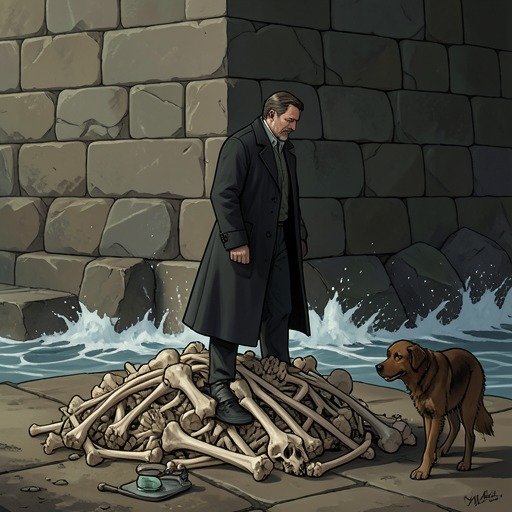
In April 1997, a woman cleaning Arne-Sayles’s house noticed brown liquid seeping from beneath a wall in a bedroom that Arne-Sayles said was unused. The liquid smelled of urine and faeces. When she pushed the wall and found that it moved, she called the police. Behind the false wall they discovered Ritter, seriously ill and entirely incoherent. He was taken to hospital for pneumonia, malnutrition, dehydration, and bipolar disorder. Investigators could not establish how long he had been imprisoned: people who knew him had seen him around Manchester in early 1995, making a captivity of as much as two years possible, but not certain.
Ritter’s own account complicated rather than resolved the case. As he gradually became able to speak, he insisted that his time at Arne-Sayles’s house had been brief and that he had spent most of the period in another house, filled with statues and flooded by the sea. In hospital he sometimes became agitated, insisting that he needed to return to the Minotaurs because they would have his dinner. Medication intended to control his delusions did not end his insistence on the house, its flooded basement, and its statues.
The surviving explanations for Arne-Sayles’s conduct remain competing theories, not established answers. One proposes that he brainwashed Ritter to support claims that other worlds existed and that Arne-Sayles and others had visited them. Ritter’s description resembles the rooms in Sylvia D’Agostino’s film, The Castle, as well as Arne-Sayles’s later prison book, The Labyrinth; it remains possible, however, that Arne-Sayles elaborated on Ritter’s hallucinations. The theory also leaves a pointed difficulty: if Arne-Sayles wanted to manufacture a witness, why choose someone with a history of delusional illness?
A second theory, advanced by the prosecution at Arne-Sayles’s October 1997 trial, treated the kidnapping as a consequence of his sexual tastes rather than his theories about other worlds. That account, too, fails to explain why Ritter spoke of a house with the sea in its basement. Arne-Sayles did not testify and never explained why he had imprisoned Ritter. The uncertainty therefore belongs to the record itself: Ritter’s experience is reported in detail, while its cause remains inaccessible.
Life After the Scandal
Angharad Scott attempted to interview Ritter for her biography of Arne-Sayles, but he took offence that no one believed his account of the house and refused to speak to her. In 2010, journalist Lysander Weeks located him for a retrospective on the scandal. Ritter was then working as a caretaker at Manchester Town Hall. Weeks described him as calm and self-possessed, and Ritter said he had been drug-free for a decade. Yet his account to Weeks remained the one he had given the police: for about eighteen months between 1995 and 1997, he had lived in a large house where the sea flooded the basement and sometimes rose to the ground floor.
Ritter recalled sleeping in a white, translucent cave beneath the marble sweep of a great staircase. He said that his work at Manchester Town Hall had saved him, because its great rooms, statues, and staircases resembled the other house and calmed him. The resemblance gives the building a practical role in his recovery: a familiar architectural scale and arrangement offers a measure of steadiness without resolving whether the remembered house was a hallucination, an actual place, or the labyrinth.
Ritter remained part of the mystery surrounding Arne-Sayles’s circle. When the police later investigated Matthew’s disappearance, Scott’s account of her missing would-be collaborator connected him to the group of people who had vanished around Arne-Sayles. The police described Ritter as a further possible disappearance in that pattern, while also noting that he had spoken to Weeks and worked at the Town Hall. His case thus occupies two positions at once: a known survivor of imprisonment and a witness whose account points beyond the explanation available to the investigators.
Return to the Labyrinth
After leaving the House, Matthew retains both his own identity and that of Piranesi. Raphael has shown him how to find the path into the labyrinth and back out, allowing him to travel between worlds. He decides to visit Ritter, taking a train to Manchester, a bus to Miles Platting, and then walking through an autumn landscape to a tower-block flat. Ritter answers the door as a thin, ravaged-looking man. Matthew asks whether he is James Ritter and, when Ritter confirms it, says that he has come to take him back.
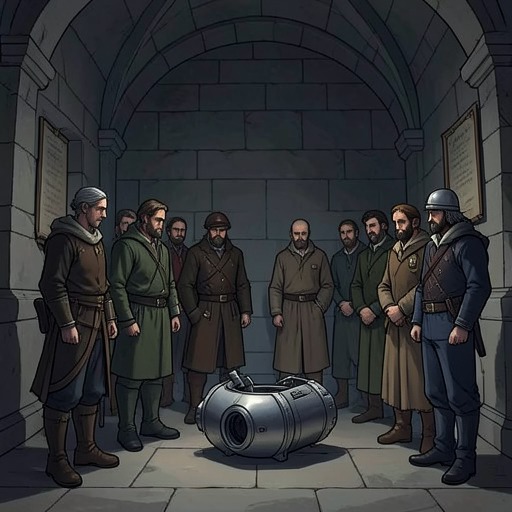
Matthew leads Ritter through the shadowy corridor and into the First Vestibule, where the Minotaurs rise around them. Ritter begins to cry, not from fear but happiness, and goes straight to the place he remembers beneath the great marble staircase. He closes his eyes and listens to the Tides. The scene gives his persistent testimony a startling physical confirmation within Matthew’s account: Ritter recognizes the House not as an abstract story but as a place associated with shelter, routine, and remembered sounds.
Recognition does not mean that Matthew leaves him there. When Ritter begs to stay, Matthew refuses because Ritter does not know how to feed himself and would die without someone to care for him. Matthew will not assume that responsibility in the House, but promises to bring him back whenever he wants and, if he ever returns permanently, to bring Ritter with him. The return therefore ends as both reunion and limit: Ritter is allowed to encounter the place he remembers, but his safety outside it takes precedence over the desire to remain.
Narrative Significance
Ritter’s story keeps the novel’s central uncertainty alive without reducing him to a puzzle that can be solved from the outside. His psychiatric history, homelessness, and incoherence after captivity help explain why others distrust his testimony, but the repetition of its particulars—the statues, flooded basement, Minotaurs, staircase, and sea—also gives it continuity across hospital, journalism, and the eventual return. The narrative presents neither a definitive diagnosis of his memories nor proof that Arne-Sayles deliberately fabricated them.
His final visit changes the force of the earlier account. In the House, the man once described as barely able to form a sentence knows where to go and responds with unmistakable joy; outside it, he has built a life in a monumental public building whose architecture steadies him. Matthew’s decision to take him back, and then to bring him out again, joins recognition to care. Ritter is not merely evidence for the existence of another world: he is a person whose attachment to that world must be weighed against his vulnerability within it.