Valentine Kately
PiranesiDr Valentine Andrew Ketterley is the scholar who enters the House as the Other, first presenting himself to Piranesi as an ally and ultimately revealed as his enemy. His history of opposing Laurence Arne-Sayles’s manipulation stands in sharp contrast to his own deception of Piranesi; his death in the Great Flood is followed not by revenge, but by Piranesi’s deliberate care for his body.
Identity and Background
Ketterley was born in Barcelona in 1955 and brought up in Poole, Dorset, as a member of an old Dorsetshire family. His father was Colonel Ranulph Andrew Ketterley, a soldier and occultist. The details give his identity a history beyond the House: he comes from a family associated with both military life and the occult, and later becomes a scholar in the same field of unusual knowledge that drew him into conflict with Arne-Sayles.
Ketterley studied under Laurence Arne-Sayles and went on to become a research fellow in Social Anthropology at Manchester. In 1985 he married Clémence Hubert; they divorced in 1991, and they had two children. In 1992 he left Manchester for a teaching post at UCL. In June of that year, he wrote to The Times to denounce his former teacher publicly, accusing Arne-Sayles of misleading and manipulating students with pseudo-mysticism and stories of other worlds. He called on the University of Manchester to dismiss Arne-Sayles, although the university did not do so until 1997, after Arne-Sayles was arrested for false imprisonment. In later years Ketterley refused to answer questions about Arne-Sayles, leaving his public break with his former mentor as a documented act rather than an open account of their relationship.
The Other and Piranesi
In the House, Ketterley is known to Piranesi as the Other. Piranesi later identifies him with that name after remembering that the Prophet had called the Other Ketterley. The distinction between the man’s name and his role in Piranesi’s life matters: Piranesi has understood their association as friendship, but the name attached to their relationship cannot make that trust true.
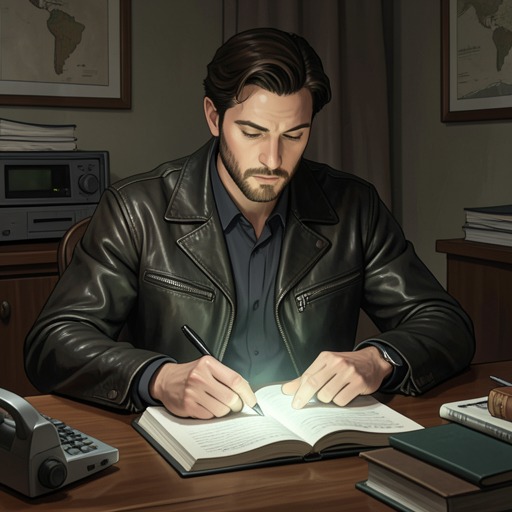
When Ketterley appears while Piranesi is examining the fragments of his journals, he stands in his shirtsleeves, entirely at ease, smiling at Piranesi as if he were an experiment that had gone unexpectedly well. He says he is delighted to see him and that a young, healthy man is just what he wanted. Piranesi screams at him to put it back; Ketterley laughs. His composure turns the scene into a confrontation between the person who has been treated as an object of experimentation and the person who has treated him that way.
The recognition breaks through Piranesi’s mistaken belief that the Other was his friend. He realizes that Ketterley has never been his friend and is his enemy. The revelation also exposes the role of memory in their apparent closeness: Matthew Rose Sorensen had once known Ketterley was an enemy, but when Piranesi forgot Matthew Rose Sorensen, he forgot that knowledge too. The friendship was therefore not merely falsified by new evidence; it had been sustained by the loss of the very memory that would have allowed Piranesi to recognize the danger.
Violence, Fear, and the Threat of the Gun
Before the final confrontation, Ketterley treats the danger posed by the person identified as 16 as a reason to prepare for lethal violence. He tells Piranesi that 16’s words are dangerous in any form and says that, although the written message took them both by surprise, they must be more careful at this critical time. He then reports that he has obtained a gun. The acquisition, he admits, was easier than expected; using it will be harder, because he is a dreadful shot and cannot hit anything. Even as he describes his lack of skill and uncertainty about practicing, he assures Piranesi that the nightmare will soon be over.
Piranesi begs him not to kill 16. Ketterley laughs and frames the choice as either killing 16 or allowing them to be driven mad. The exchange reveals the coercive logic behind his apparent reassurance: he recasts a threatened killing as a necessary response to danger, dismissing Piranesi’s plea rather than considering an alternative. The gun also makes his earlier calm menace concrete. Ketterley is not merely speaking of an enemy; he has acquired a weapon and is preparing to use it, despite his confessed inability to shoot accurately.
The Flood and His Death
During the Great Flood, Ketterley is caught in the force of the water that surges through the northern doors. A wave lifts him and hurls him against the southern wall, where he crashes into the statues about fifteen metres above the floor. Piranesi can only infer that this is the moment Ketterley dies: the water draws back, and Ketterley disappears into it. Nearby, the little inflatable boat spins across the water, repeatedly swallowed and then surfacing again. It might have saved Ketterley had he been able to reach it, a stark counterpoint to the gun he had acquired and the danger he had intended to direct at others.
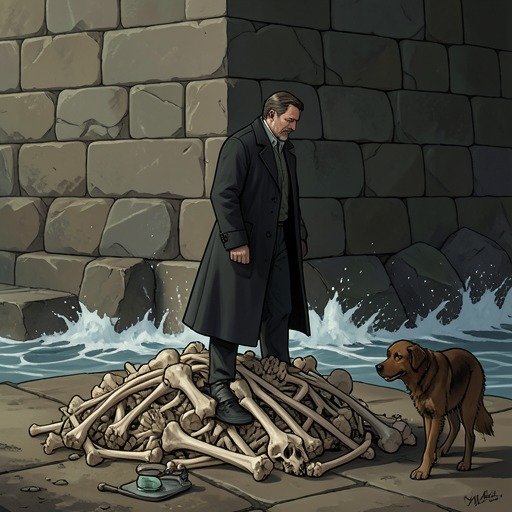
The death is confirmed later, when Piranesi finds Dr Ketterley’s body in an angle of the staircase in the Eighth Vestibule. The body has been battered against walls and statues; the clothes are in rags. Piranesi disentangles him from the balustrade, lays him straight, and carefully composes his limbs. He cradles Ketterley’s broken head in his lap. The physical care is deliberate: the man Piranesi had recognized as an enemy is now a vulnerable dead body requiring attention.
Piranesi’s Care for the Dead
Piranesi speaks to Ketterley without denying either the damage or their conflict. He tells him that his good looks are gone, but that the condition is temporary; he promises to place him where fish and birds can strip away the broken flesh, leaving a skull and bones that can be put in good order to rest in sunlight and starlight beneath the statues’ blessing. He also apologizes for having been angry and asks forgiveness. The words do not undo Ketterley’s betrayal, nor do they suggest that Piranesi has mistaken him for a friend again. Instead, they express the care for the dead that governs Piranesi’s conduct even toward an enemy.
Ketterley’s body and the gun both remain subject to the House’s tides. Piranesi does not find the gun; he concludes that the waters have carried it deep within themselves. Later that morning he finds Ketterley’s inflatable boat still idling in the First Western Hall, where the waters have fallen to ankle depth, unharmed. The survival of the boat beside the lost weapon and dead man sharpens the reversal: Ketterley had prepared for a violent end to the danger, but the flood takes his life, while Piranesi’s response is to tend his remains and imagine their eventual rest.
Death, Judgment, and Care
During the Great Flood, waves surge through the northern doors. One lifts Ketterley and hurls him against the southern wall, where he crashes into the statues about fifteen metres above the floor. Piranesi can only imagine that this is when he dies: the wave withdraws, and Ketterley disappears into the water. The small inflatable boat spins across the flood, repeatedly submerged and then surfacing again. Had Ketterley reached it, Piranesi reflects, it might have saved him—a bitter counterpoint to the gun he had acquired and the lethal danger he had imagined directing at others.
The narrative later confirms Ketterley’s death through the discovery of his body in an angle of the staircase in the Eighth Vestibule. He has been battered against walls and statues; his clothes are in rags. Piranesi disentangles him from the balustrade, lays him straight, composes his limbs, and cradles his broken head in his lap. The careful sequence of actions turns recognition into responsibility: although Piranesi has named Ketterley his enemy, he does not treat the corpse as an enemy to be discarded.
Piranesi addresses the dead man directly, acknowledging that his good looks are gone while assuring him that the damage is temporary. He says he will place Ketterley where fish and birds can strip away the broken flesh, after which he will arrange the skull and bones so they can rest in sunlight and starlight beneath the statues’ blessing. He also apologizes for having been angry and asks forgiveness. This care does not erase the deception or restore the friendship Piranesi once believed in. Instead, it shows that his duty to the dead extends even to someone who betrayed him.
The flood carries the gun away; Piranesi does not find it and believes the tides have taken it deep within themselves. Later that morning, however, he finds Ketterley’s unharmed boat still idling in the First Western Hall, where the water has fallen to ankle depth. The contrast leaves the intended weapon lost, the man dead, and the boat intact. Ketterley’s end is thus a reversal of his own plan to resolve danger through violence, while Piranesi’s final response is to tend the body and prepare it for rest.