Sylvia D’Agostino
PiranesiSylvia D’Agostino is a gifted mathematician and filmmaker whose search for a world beyond ordinary life leads her to Laurence Arne-Sayles. She becomes his most devoted student and an intimate attendant, but his influence also separates her from her parents and narrows her independence. Her disappearance in 1990 is never explained; later evidence suggests that she may be among the dead in the House, though no one can identify her remains with certainty.
Identity and Background
Born in 1958 in Leith, Scotland, D’Agostino was the only child of the poet Eduardo D’Agostino and grew up especially close to her father. As a teenager, she told a friend that she wanted to study Death, Stars and Mathematics. The University of Manchester offered no such course, so she studied mathematics instead. The choice of subject did not extinguish the larger ambition behind it: the desire to investigate mortality and the cosmos.
At the university, D’Agostino encountered Arne-Sayles and his lectures about communion with ancient minds and glimpses into other worlds. His ideas answered the cosmic longings she associated with Death and Stars. After completing her mathematics degree, she moved into anthropology under his supervision, a change that turned intellectual attraction into a lasting personal allegiance.
Devotion and Separation
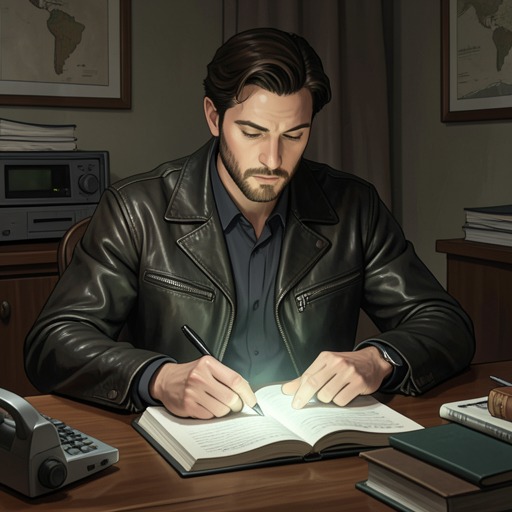
Among Arne-Sayles’s students and followers, D’Agostino was described as the most devoted. He gave her a room in his house in Whalley Range, where she worked without pay as his housekeeper and secretary. Because he did not drive, she also drove him where he wished to go, including to Canal Street on Saturday nights, where he went to pick up young men. The arrangement placed her close to his private life as well as his intellectual work.
She received her doctorate in 1984 but did not pursue an academic or teaching career. Instead, she remained beside Arne-Sayles and took a succession of menial jobs to support herself. Her own prospects and paid work receded while practical service to him continued.
In the mid-1980s, Arne-Sayles instructed her to quarrel with her parents. According to Angharad Scott, the demand was a test of loyalty. D’Agostino ended contact with them, despite their closeness, and her parents never saw her again. Years later, Ketterley characterized the order as an exercise in cruelty: Arne-Sayles gained no apparent advantage from the estrangement, but could cause anguish to D’Agostino and her family simply by making her obey. The episode makes the personal cost of her devotion concrete: allegiance to the man who promised access to another world came at the price of her existing family ties.
Work and Films
Two of D’Agostino’s films survive. Moon/Wood, a 25-minute Super 8 film made in the moors and woods around Manchester, uses a nearly monochrome palette of black, white, and grey, punctuated by blood-red. Its sparse, incomprehensible speech gives way to stark visual storytelling. An ancient hierophant dominates a small community, abusing women and inflicting cruelty on men. When a woman opposes him, he traps her in the moon’s reflection in a stream, where she cannot move and he beats her. Left alone, she asks a birch wood for help; the trees entangle and pierce the hierophant until he dies, releasing her. The imagery turns the natural world into the force that ends his domination.
Her other surviving film is untitled but commonly called The Castle. Shot on Betamax in very poor quality, it wanders through enormous rooms lined with statues, their floors crowded with puddles. The rooms seem to belong to different castles or palaces; the filmed space appears too vast to be a single building. Some viewers have taken the footage as a record of one of Arne-Sayles’s other worlds, perhaps the world described in his 2000 book The Labyrinth. Others have tried to identify the locations to show that the film depicts no other world, but none has been conclusively identified. Notes in D’Agostino’s handwriting accompany the film, yet they remain unreadable, like the peculiar code of her last diary. The film’s unexplained architecture and obscured notes leave her work poised between a record of a place and an image that cannot be verified.
Disappearance
D’Agostino seems to have kept diaries through much of her adult life. Her early volumes, from 1973 to 1980, were written in English and kept at her parents’ house in Leith. The diary she was using when she disappeared, in the spring of 1990, was found at the doctor’s surgery where she worked. It mixed hieroglyphs with English descriptions of images, possibly dream imagery; Scott tried several times to decipher it without success. The surviving record thus changes form as the story approaches her disappearance: the earlier diary can be read, while the final one preserves marks whose meaning remains inaccessible.
By early 1990, D’Agostino was working as a receptionist at a surgery in Whalley Range and had befriended a doctor there, Robert Allstead. She told him that her life was drudgery, while also saying she would always be grateful to Arne-Sayles for opening the way to a more beautiful world in which she was happy. Allstead did not know how to reconcile the hardship with that gratitude. He later told police that he was certain she was not using drugs; had she been, he would not have allowed her to work at the surgery.
When Arne-Sayles learned of the friendship, he flew into one of his jealous fits and demanded that she leave the job. This time D’Agostino refused. In the first week of April she failed to arrive at work. After she had been missing for two days, Allstead called the police; she was never seen again. The sequence marks a decisive break in the pattern of obedience, but the evidence does not establish what happened after her refusal or explain how it relates to her disappearance.
The Dead in the House
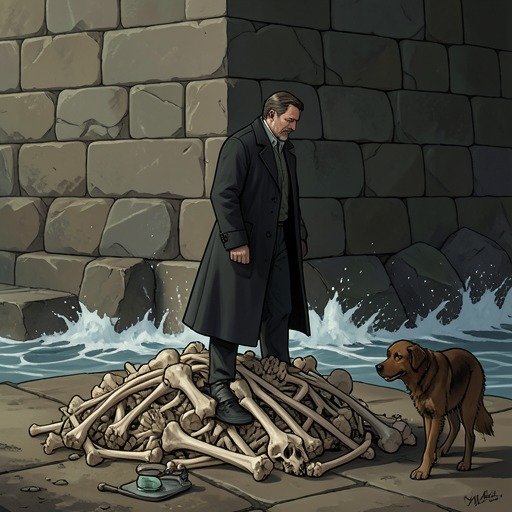
D’Agostino’s fate remains an inference rather than a solved mystery. When Piranesi tells Arne-Sayles that the House contains thirteen dead people, Arne-Sayles speculates that one may be D’Agostino, alongside people connected to him who had also disappeared. Much later, Sarah Raphael asks whether D’Agostino is among the thirteen; Piranesi answers that she may be, but he cannot tell which remains belong to whom. The uncertainty is essential: the House’s dead are cared for, but their identities cannot simply be read from their bodies.
At the end of the novel, D’Agostino is named among those with whom Valentine Ketterley will lie. Piranesi plans to place Ketterley’s bones beside the Biscuit-Box Man, with the long bones tied together in the middle, the skull on the right, and a box of small bones on the left. The planned burial associates D’Agostino with the House’s community of dead without resolving the identification of any particular remains. Her story therefore ends not with a recovered biography or confirmed death, but with an act of care and a place among the dead whose names and histories Piranesi preserves.
Narrative Significance
D’Agostino’s account is assembled from fragments: a biographical entry in Piranesi’s recovered journals, other people’s recollections, unreadable diaries, surviving films, and guesses about the dead. These sources do not produce a complete explanation of her fate. Instead, their differences show the distance between the vivid person described in the records and the unidentifiable remains in the House.
Her films echo the conflict in her life without proving that they are autobiographical. In Moon/Wood, a woman is immobilized by a powerful man and ultimately freed when the wood turns against him. In The Castle, rooms, statues, and water form an enigmatic place that viewers cannot conclusively locate. Read beside D’Agostino’s devotion to Arne-Sayles, her estrangement from her parents, and her final refusal to abandon her job, the films sharpen the contrast between submission and resistance, and between the promise of another world and the human relationships sacrificed in its pursuit. That interpretive connection remains suggestive rather than a settled account of what she intended or what happened to her.