People of the Alcove
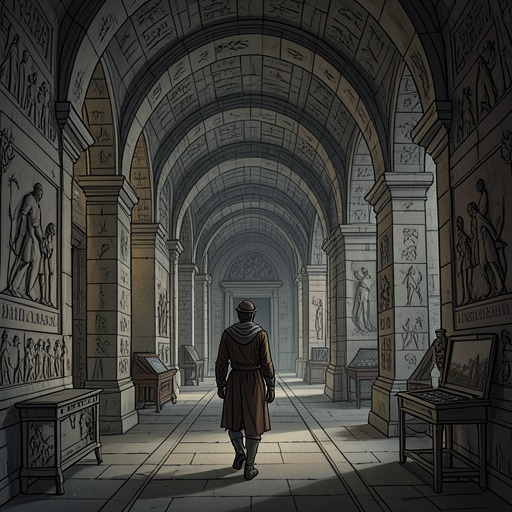
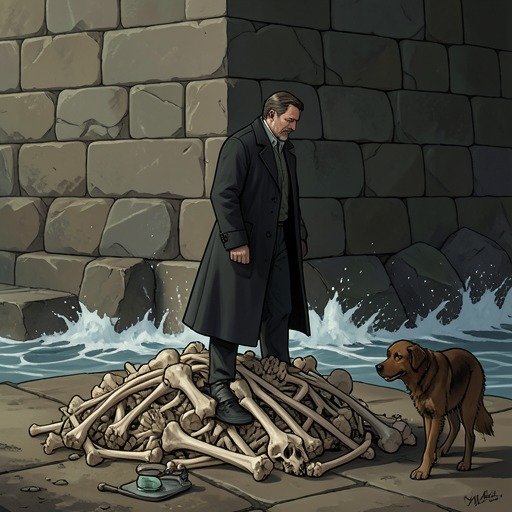
PiranesiThe People of the Alcove are ten skeletons laid side by side on an empty plinth in the northernmost alcove of the Fourteenth South-Western Hall. Piranesi’s account of them turns an anonymous collection of bones into a community: their arrangement suggests care among the dead, and his recurring visits extend that care into the present. They are among the clearest expressions of the ethical bond he forms with the House’s human remains.
Identity and Place
Piranesi identifies the group as Persons Five to Fourteen in his reckoning of the dead. He tentatively judges three skeletons to be female and three male, while the sex of four remains uncertain. The group’s place is specific and exposed to the tides: the bones lie together on an empty plinth in the northernmost alcove of the Fourteenth South-Western Hall.
The group includes the Fish-Leather Man, whose incomplete skeleton is much more worn than the others. Some bones have eroded until they resemble small pebbles; holes bored through some of them and surviving fish-leather fragments lead Piranesi to infer that the bones were once threaded together with leather thongs. He concludes that this skeleton predates the others and was originally displayed in a different fashion.
A Community Formed Through Care
Piranesi believes that those who came after the Fish-Leather Man gathered his scattered remains and laid him with their own dead. He interprets this act as evidence that the later people held human life in such reverence that they patiently collected his bones rather than leaving them dispersed. The inference gives the group a history of mutual regard: even before Piranesi begins tending them, their arrangement implies that one generation of the dead cared for another.
That arrangement also shapes Piranesi’s thoughts about his own death. He wonders whether he should lie with the group when his life ends, noting that there appears to be room for four more adults. Though he considers himself young and expects death to be distant, he has already imagined his eventual place among them. The question makes the alcove more than a burial site: it is a possible community and a future resting place.
Piranesi’s Devotion to the Dead
Piranesi visits all the dead, but gives particular attention to the Folded-Up Child. He brings offerings of food and water, along with water lilies gathered from the Drowned Halls, and tells the dead what he has been doing and what wonders he has encountered. He understands this practice as a way of ensuring that they are not alone. The People of the Alcove thus belong to an ongoing relationship, not merely to his catalogue of remains.
The visits require considerable effort. After several weeks away, Piranesi sets aside a day to reach all the dead, whose resting places lie several kilometres apart. He brings each one food, water, and water lilies. At every niche and plinth he whispers the name Addy Domarus, hoping the person to whom it belongs will somehow accept it; instead, he senses a faint repudiation. This episode shows both the intimacy and the limits of his care: he tries to restore an identity through naming, but does not presume that the name is received.
Significance
The People of the Alcove contrast with the instrumental treatment of human remains elsewhere in the story. In Arne-Sayles’s account, Marepool III is a head he wants to use in a magical rite, believing it contains a seer’s knowledge that will advance his research. The alcove embodies a different relation to the dead: bones are gathered, placed with others, and attended to rather than treated as a means to power or knowledge.
Piranesi’s own acts of care reinforce that distinction. When he finds Dr Ketterley’s body battered in a staircase, he disentangles it, lays it straight, composes its limbs, and cradles the broken head. His conduct toward the dead follows the same ethic suggested by the People of the Alcove’s arrangement: even damaged remains merit tenderness and a dignified place. The group therefore stands not only as a record of past lives, but as a measure of how the living choose to regard the dead.