Sarah Raphael
PiranesiSarah Raphael, known to the people of the House as 16, is the police officer who searches the labyrinth for Matthew Rose Sorensen and ultimately helps him recover a route between its enclosed world and ordinary life. She is first encountered as a torchbeam and a voice calling through the halls; later, she gives Matthew the name he cannot yet recognize as his own. Her importance lies not only in finding him, but in turning knowledge of the labyrinth’s paths into the means of rescue, return, and renewed contact with its inhabitants.
Identity and Introduction
The narrator first sees Sarah indirectly: light blooms at a distant doorway, then becomes a beam moving rapidly from wall to wall and corner to corner. The person carrying the torch is searching the darkness and calling for Raphael. Only when the searcher is identified as the Other does the scene’s significance become clear: Sarah is being sought by the same man from whom she has come to find Matthew. The sequence introduces her through pursuit and concealment rather than through a conventional entrance, with the House’s darkness and echoing halls making the search difficult to read.
Her identity becomes explicit through a message she leaves in pebbles. When the narrator finds that stones have been removed from a bank, he notices white pebbles scattered on the vestibule pavement; too late to avoid reading them, he sees the question, “ARE YOU MATTHEW ROSE SORENSEN?” The message names the person Sarah is trying to reach and gives the narrator a name whose meaning he has not yet recovered. It is both a practical signal and an abrupt disturbance of his understanding of himself: the question reaches him before he can decide whether it describes him.
Finding a Route Through the House
Sarah’s knowledge of the House is bound up with the problem of how to enter it and how to get out. She later explains that Laurence Arne-Sayles taught her to return to a pre-rational mode of thought, perceive paths around her, and choose the route that led to the labyrinth. She had expected metaphorical paths; discovering that the directions were literal came as a shock. Her account establishes that her access is learned rather than accidental, and that Arne-Sayles’s instructions gave her a method for crossing between worlds.
The House makes such knowledge consequential because movement is never simply a matter of walking forward. The narrator’s own journeys range from the distant western halls to the northern and southern limits he has reached, as well as the clouded Upper Halls, lily-covered Drowned Halls, and damaged eastern region. Even a familiar route can become hazardous: the way toward the One-Hundred-and-Ninety-Second Western Hall passes through a vestibule where the tides scatter sharp debris, dangerous to bare feet. Sarah’s later ability to find the way out therefore answers a problem the narrative has repeatedly made material: routes have distances, obstacles, and risks, and passage depends on knowing how to navigate them.
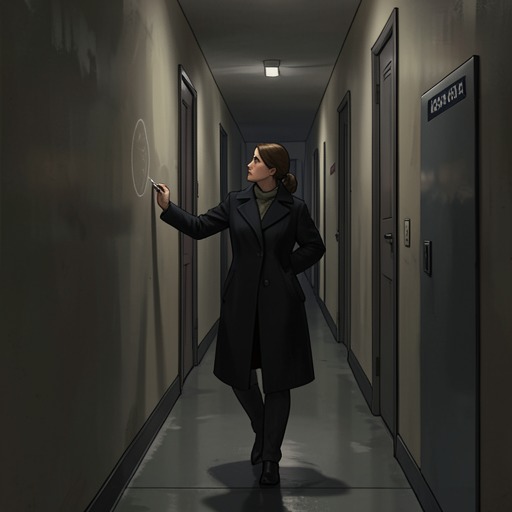
The narrator’s encounter with 16’s earlier trail also shows the care required to preserve route knowledge. He follows her yellow chalk marks from the Sixth North-Western Hall back toward the First Vestibule. The marks sit below his eye level, suggesting that she is shorter, and she has repeated her directions beneath each doorway in case a tide or accident destroys one set. Her systematic marking leaves a recoverable path through a space where signs can disappear. This methodical trace anticipates the larger importance of Sarah’s expertise: what she knows is not merely that a path exists, but how to make it findable again.
Search, Recognition, and Rescue
When the narrator learns that 16 may be approaching the Other, he treats her safety as his most important task. He believes the Other has set a trap, perhaps by promising a meeting and information about how to find Matthew Rose Sorensen. That suspicion creates a painful tactical bind: the narrator thinks the best way to find 16 is to look for the Other, although he wants to avoid him. Remembering the warning that Ketterley will become more dangerous as 16 draws nearer, he hopes to reach her before she reaches Ketterley.
The confrontation turns when a woman’s voice calls Ketterley’s name from among the southern doors and declares that she has come for Matthew Rose Sorensen. The narrator judges that she is concealed in one of those doors, while Ketterley looks around in confusion, unfamiliar with how echoes travel through the halls. Sarah’s command of the space is set against his disorientation: she can use the House’s reverberations and hidden entrances to announce herself on her own terms. The scene makes her purpose explicit, and shifts the immediate question from whether she will find the labyrinth to whether she can reach Matthew before Ketterley can control the encounter.
After the flood, Sarah and the narrator can finally speak. They have spent the crisis intent on saving themselves and one another, with the roar of the waves making conversation impossible. When they turn toward each other, the narrator recognizes her as 16 and as Raphael; she identifies herself as Sarah Raphael and tells him that he is Matthew Rose Sorensen. She frames the name as a statement, not a question, although he reflects that a question might have been easier to answer. The recognition is therefore neither a simple revelation nor an instant restoration: Sarah supplies the name, but the narrator must still confront what it means to have been Matthew before becoming Piranesi.
Sarah explains that she is a police officer, not someone who knew Matthew personally. When he asks why she has come, her answer establishes the basis of their connection as professional duty rather than prior intimacy. Their first exchange is followed by silence. Both are dazed by the flood, and their attention remains caught in its violence, including the moment Ketterley was thrown against a wall of statues. The restraint matters: recognition and rescue do not immediately dissolve the shock of what has happened or produce an effortless bond.
Knowledge, Return, and Continuing Work
In a later conversation, Sarah describes her investigation into Matthew’s disappearance. She wanted to understand what he might have been thinking at the point he vanished, and followed Arne-Sayles’s directions for entering a pre-rational mode of thought. She expected the paths he described to be figurative; the discovery that they led literally to the labyrinth changed her understanding of both his teaching and Matthew’s disappearance. Her account links her search to a chain of knowledge passed from Arne-Sayles, while making clear that Sarah had to interpret and test that knowledge herself.
Matthew’s response clarifies the relation between his former identity and the person formed in the House. He recalls that Matthew was shocked and frightened on arriving, then fell asleep and Piranesi was born. Later, entries in his journal frightened him because he thought they had been written in madness; he now understands them as Matthew’s descriptions of another world. Sarah’s search thus reaches beyond locating a missing person: it helps make legible the gap between the person who entered the House and the identity that took shape within it, without reducing the latter to a mere mistake.
Sarah’s practical knowledge continues after the immediate rescue. She has shown Matthew how to find the path into the labyrinth and how to find the path out, so that he can come and go as he chooses. With that access, he travels to Manchester and seeks out James Ritter, extending the consequences of Sarah’s instruction beyond their escape. In the final departure from the House, Sarah accompanies Matthew toward a corridor-like opening between two statues of Minotaurs. He carries his journals and favourite pens; before they enter, he takes one last look at the House, shivers, and takes Sarah’s hand. Their exit is not an erasure of the House or of the identity he formed there, but a passage undertaken together, with the knowledge that return remains possible.