Maurizio Giussani
PiranesiMaurizio Giussani is a philosophy student from Perugia whose disappearance in the summer of 1987 links Laurence Arne-Sayles’s experimental circle to the thirteen human dead in the House. His fate is never conclusively established in the account: he vanishes after a dinner at Casale del Pino, and years later both Piranesi and Sarah Raphael can only consider it highly probable that he is among the remains Piranesi tends. The gap between the vivid particulars of his last known evening and the nameless bones in the House makes his disappearance a persistent, unresolved mystery.
Identity and Background
Giussani was a philosophy student at the University of Perugia. In the summer of 1987 he was engaged to Elena Marietti, also a postgraduate student. During the summer she worked as a paralegal in her father’s law firm in Perugia. The surviving account gives few details of Giussani’s life before his disappearance; instead, it introduces him through the friendships and suspicions that gathered around him.
His connection to the English researchers began through Stanley Ovenden and Tali Hughes. As tensions grew among the students gathered around Arne-Sayles, Ovenden and Hughes increasingly spent time away from the group and became friendly with Giussani. Their friendship appears to have alarmed Arne-Sayles. Giussani thus enters the story not as a participant in the inner circle’s experiments, but as someone whose presence exposes the strain between its members and the world beyond it.
The Dinner at Casale del Pino
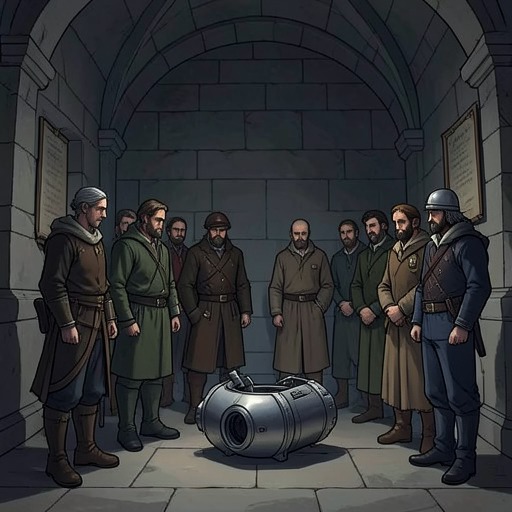
In the summer of 1987, Arne-Sayles rented the farmhouse Casale del Pino, twenty kilometres from Perugia. His favoured students, the group described as his inner circle, accompanied him: Ovenden, Bannerman, Hughes, Valentine Ketterley and Sylvia D’Agostino. Their relations had become increasingly tense. Arne-Sayles reacted fiercely to questions that suggested insufficient commitment to his great experiment, and most of the group responded by keeping diplomatically silent. Ovenden continued to express doubts, while Hughes’s defence of him also drew Arne-Sayles’s anger. Against this increasingly fraught background, Ovenden and Hughes’s new friendship with Giussani became especially consequential.
On the evening of 26 July, Arne-Sayles invited Giussani and Marietti to dinner at the farmhouse. He spoke about the Other World, a place where architecture and oceans were muddled together, and about the possibility of reaching it. Marietti took his account either as metaphor or as a description of a Huxleyan psychedelic experience. The episode leaves open whether she grasped the literal nature of Arne-Sayles’s claims; what it establishes is that he introduced the subject of passage between worlds in front of Giussani and his fiancée shortly before Giussani disappeared.
Marietti had to work the following day. At about eleven that night she said goodnight, drove home and went to bed. The others remained at the farmhouse. The English party had promised that one of them would drive Giussani home, but the surviving accounts diverge in their emphases around what followed. The dinner, which had begun as a meeting between a young couple and Arne-Sayles’s circle, ends in an absence that none of the people present could later resolve.
Disappearance and Conflicting Accounts
Giussani was never seen again. Arne-Sayles said that he went to bed shortly after Marietti left and knew nothing about Giussani’s fate. Ovenden, Bannerman, Hughes, Ketterley and D’Agostino said that Giussani refused an offer of a lift and set off on foot a little after midnight. He lived about three kilometres away. The night was warm and moonlit, details that make the reported walk sound ordinary even as it becomes the last known sighting of him.
The accounts place the missing decision—whether Giussani accepted or rejected the promised ride—at the centre of the uncertainty. Arne-Sayles’s statement that he had retired early separates him from the departure; the others’ account places Giussani walking away alone. The evidence supplied does not settle what happened on the route home, or whether the reported departure took place as described. Rather than supplying a resolution, these statements establish the narrow, consequential boundary of what is known: a dinner, a late hour, a short journey on foot, and no later trace of Giussani.
Ten years later, after Arne-Sayles was convicted of kidnapping another young man, Italian police reopened the case of Giussani’s disappearance. That development ties the old case to later evidence of Arne-Sayles’s capacity for coercion, but the account does not provide a final finding about Giussani or identify what the reopened investigation established. His disappearance remains an unresolved historical fact, not a mystery the narrative claims to have solved.
The Dead in the House
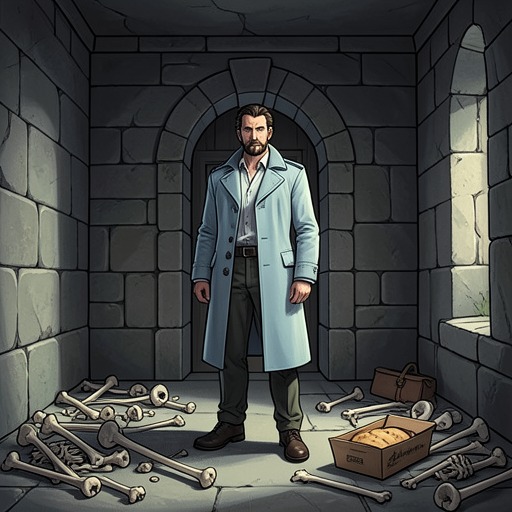
The possibility that Giussani is one of the thirteen dead reaches Piranesi through separate conversations. When Piranesi describes the remains he has found, an elderly visitor recognizes the biscuit box associated with one of the dead as an object that had stood beside the mugs in the corner of his university study. He then connects the dead to people who vanished from Arne-Sayles’s circle: he thinks that one is probably Ovenden, another could be Sylvia D’Agostino, and another is almost certainly the young Italian who had attracted Ovenden’s attention, though he cannot recall Giussani’s name. His recognition is suggestive, but he does not claim to identify the remains directly.
Later, when Sarah Raphael hears that Piranesi cares for thirteen people, she asks whether Ovenden, D’Agostino or Giussani might be among them. Piranesi answers that it is highly probable that one is Ovenden, that another may be D’Agostino and another Giussani, but that he does not know which is which. The exchange preserves the distinction between a strong likelihood and an identification: the House contains evidence of the missing people, yet their individual remains cannot be matched to their names.
At the end of the account, Piranesi records that Valentine Ketterley’s cleaned bones will be placed in an empty niche in the third north-western hall, beside the Biscuit-Box Man, with his long bones tied together using twine and his skull and smaller bones arranged separately. The journal states that Ketterley will lie with his colleagues, naming Stanley Ovenden, Maurizio Giussani and Sylvia D’Agostino. This planned arrangement places Giussani within a community of the dead and shows Piranesi’s continuing care for them, while stopping short of revealing which existing remains are Giussani’s.
Narrative Significance
Giussani’s story is constructed from a small number of precise, incomplete records: an evening dated 26 July, a farmhouse twenty kilometres from Perugia, a reported walk of roughly three kilometres, and accounts that cannot be reconciled into a known fate. This documentary narrowness matters. Arne-Sayles’s dinner conversation about reaching another world sits immediately beside Giussani’s disappearance, but the evidence does not turn that sequence into proof of what happened to him. Suspicion accumulates without becoming certainty.
His disappearance also connects two different ways of knowing the past. In the world outside the House, the case is reopened after Arne-Sayles’s kidnapping conviction, and a list of his missing associates remains a compelling mystery. In the House, Piranesi encounters the dead as people to be cared for, but his knowledge cannot assign each set of bones to a name. Giussani is consequently present both as a question the investigation has not answered and as a probable member of the dead whose remains Piranesi promises to lay beside his colleagues. The ending offers companionship and care, not forensic closure.