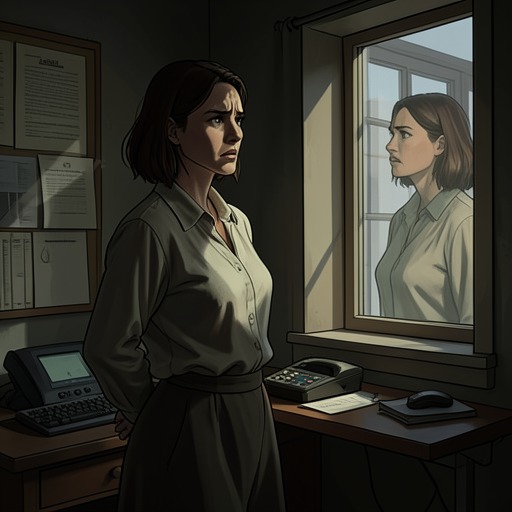
Clarissa Dole
REClarissa Dole is the Springton High classmate responsible for stealing Tabitha Moore’s personal binder while Tabitha was distracted and throwing it into the trash in a nearby ladies’ room. Initially connected to the rumor-driven hostility surrounding Tabitha, Clarissa later appears in person, admits what she did, and apologizes. Her encounter with Tabitha becomes more than a confession: it tests whether accountability can interrupt the social machinery of bullying and whether forgiveness can create the possibility of an ordinary friendship.
Identity and Introduction
Clarissa is first identified through the investigation into Tabitha’s stolen work. Mrs. Cribb explains that Clarissa took the binder while asking for a bathroom break and discarded it in the restroom trash. The act is not presented as an isolated prank. Clarissa belongs to a wider group of students disciplined in connection with the harassment surrounding Tabitha: she is suspended pending an expulsion hearing after Halloween, alongside Chris Thompson, Kaylee Mendolson, Brittney Taylor, and Erica Taylor. Clarissa’s specific offense is the theft, while Kaylee is identified as the student who spread the malicious rumor involving Tabitha and Mr. Simmons.
When Clarissa later appears at the Halloween gathering, Tabitha does not immediately recognize her. The disguise contributes to the uncertainty: Clarissa is wearing a very brief, brightly colored dress modeled on the British flag, while her strawberry-blonde hair has been teased for a costume. Her sudden recognition is followed almost at once by an unprompted confession. The movement from an unfamiliar costumed teenager to the classmate who stole the binder gives the scene a small but decisive reversal: the anonymous harm at school acquires a face and a voice.
The Theft and Its Meaning
Clarissa says that she took the notebook because she had accepted what other students were saying about Tabitha, even though she did not actually know her. Her explanation places the theft within the group psychology of the school rather than treating it as a purely private act of malice. She participated in a rumor environment that converted distance and repetition into apparent truth. The stolen binder therefore represents both a physical violation and the consequence of a social story told about Tabitha by people who had not taken the trouble to understand her.
Tabitha explains that everything in the binder mattered to her. It was a personal project on which she had spent substantial effort, so its removal made her feel that she was no longer safe at school. Her departure from school was not, in her account, an exaggerated response to a single object being misplaced. The theft came on top of other pressures, including the assault that had left her with a fractured wrist, and transformed the school from a place where she hoped to have a normal teenage life into another source of danger and exposure. Clarissa’s action thus helps clarify why Tabitha’s withdrawal carries such emotional and practical weight.
Confession and Apology
Clarissa approaches Tabitha at the gathering and says plainly that she took the notebook. She is visibly distressed, repeatedly apologizing for having believed the rumors and acknowledging that she should not have acted without knowing anything about Tabitha’s actual circumstances. Her apology is not framed as a defense of the theft. Instead, she asks Tabitha not to hate her and recognizes that collective opinion had influenced her judgment without excusing it.
Clarissa also reacts defensively and uncertainly when the binder’s contents are discussed. She appears to have believed that the work was somehow false or illegitimate, while Alicia Brooks objects to the implication that the drawings are fake and notes that she had drawn on the binder herself. Clarissa quickly concedes that the altered binder looks beautiful. This exchange exposes the fragile basis of the accusation: the object was not simply stolen for its material value, but judged through assumptions about Tabitha and the authenticity of her creative work.
Tabitha answers with unusual precision. She tells Clarissa that she appreciates the apology and is not angry, but remains hurt. Forgiveness does not erase the injury, and Tabitha does not pretend that it does. By distinguishing anger from hurt, she preserves the seriousness of what happened while refusing to make punishment the only possible conclusion. Clarissa’s apology is therefore accepted without being allowed to rewrite the event.
Friendship and Reconciliation
The most important question Tabitha asks is whether Clarissa actually thinks the two of them could become friends. Clarissa freezes and appears afraid that the question is sarcastic or punitive. Tabitha clarifies that she is asking sincerely. She has always wanted a normal high-school life with many friends, and she does not want Clarissa to be held back for a year and come to resent her because of the disciplinary consequences. The proposed friendship is consequently neither sentimental nor automatic. It is a tentative alternative to the cycle in which harm produces punishment, punishment produces resentment, and resentment produces further hostility.
Tabitha ultimately forgives Clarissa and gives her a comforting squeeze before letting go. She internally confirms that the forgiveness is genuine and asks that they put the incident behind them. The gesture does not restore the lost work or undo the fear that drove Tabitha away from school, but it gives the encounter a different ending from retaliation. Clarissa is allowed to become more than the act she committed, while Tabitha retains control over the terms on which reconciliation might proceed.
Narrative Role and Significance
Clarissa functions as a compact embodiment of how school bullying spreads through bystanders and borrowed beliefs. She is not shown as the originator of every rumor or every attack; instead, she demonstrates how a student who does not know the target can still participate in damaging conduct by accepting the group’s version of events. Her later confession makes that mechanism visible and gives the novel a concrete instance of social accountability.
Her encounter with Tabitha also marks a change in Tabitha’s response to hostility. Tabitha reflects that the possibility of forgiveness feels better than fantasies of getting even or making her enemies pay. Clarissa’s presence therefore becomes part of Tabitha’s movement away from revenge and toward a more complicated understanding of herself and others. The scene does not declare the school safe again, nor does it guarantee that friendship will follow. Its significance lies in the narrower, harder achievement: Clarissa names the harm, Tabitha acknowledges its continuing pain, and forgiveness becomes a choice rather than a denial.