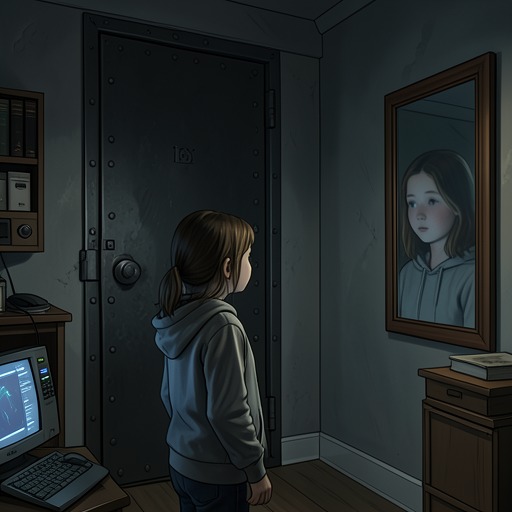
Tabitha Moore
RETabitha Moore is the novel’s central time-displaced protagonist, a woman whose second life begins when a prototype MRI accident in 2045 sends her mind back forty-seven years into her thirteen-year-old body. The return gives her an apparent opportunity to prevent old tragedies, but it also forces her to inhabit the body, social position, and family circumstances she once experienced as unbearable. Her decisive struggle is therefore not simply to alter history: it is to discover whether a person formed by regret can live again without being consumed by the life she remembers.
Identity and Return
In 2045, Tabitha is sixty years old, petite and frail, with short gray hair, weathered skin, and the physical marks of a hard life. She encounters the enormous old-fashioned MRI inside the University of Louisville Hospital complex and recognizes it as strangely familiar. The machine, nearly half a century old, is being used because its scans are unusually comprehensive despite its age. When it malfunctions, the medical crisis becomes a temporal rupture rather than an ordinary diagnostic procedure.
The first shock of her return is bodily. Tabitha realizes that she is not merely confused or suffering from memory loss: she is young again, with small hands and chubby fingers, in the body she remembers as “Tubby Tabby.” The date confirms the impossible displacement: May 7, 1998. She understands that the 2045 MRI has somehow connected with the earlier MRI incident at the Emsie St. Juarez Children’s Hospital, returning her consciousness to the period when her parents were still alive and she was in junior high school. The discovery is both miraculous and horrifying because it restores possibilities she had lost while also restoring the self-loathing attached to her childhood body.
Her initial response is rejection. She fears that the apparent time travel may instead be a fatal seizure or brain injury, and she begs for death rather than face her old life again. The prospect of becoming the overweight, powerless girl she once hated is almost as frightening as the temporal impossibility itself. Yet a single pushup changes the emotional direction of the scene: the young body is weak, but it is capable of possibilities unavailable to her sixty-year-old self. That physical discovery allows a new idea to take shape. She does not have to remain fat, she knows how to cook, she can run, and she has months before high school begins. The body she initially experiences as a prison becomes the first instrument of her planned reconstruction.
Rebuilding a Life
Tabitha approaches the past with the accumulated skills and regrets of adulthood. She intends to rewrite Goblina and Goblin Princess using the structural and pacing techniques she learned later in life, and she hopes to publish before the market becomes oversaturated. Writing is not merely a career plan. It is the means by which she converts experience into a new narrative and attempts to make the past legible to the people around her.
Her plans extend beyond creative ambition. She wants to save Julie from taking her own life and protect her parents from the destructive patterns that shaped the family. The language of repair dominates her early second life: she imagines that future knowledge can correct failures, prevent deaths, and make her family become what she had always wanted. The hope is expansive, almost intoxicating, but it contains a dangerous assumption—that knowing what happened once will make it possible to control what happens next.
Her first day at Springton High demonstrates how quickly the revised life departs from the remembered one. In her previous life, she had been ignored; this time, her carefully arranged hair, subdued eyeliner, expressive hazel eyes, and changed bearing draw immediate attention when she boards the bus. The altered reception confirms that her body and presentation can change the social script, but it also exposes her to a different form of scrutiny. Later, rumors falsely connect her to Matthew Williams and to the rescue of Officer Darren MacIntire, while classmates accuse her of exploiting the shooting for attention because she lives in a trailer park. The new life is not a clean escape from humiliation. It transforms invisibility into public suspicion.
When injury and harassment make school untenable, Tabitha handles withdrawal with unusually formal precision. She acknowledges that she left school while distraught, recognizes that she failed to obtain the necessary paperwork, and asks for help withdrawing legally while securing accreditation for homeschooling before she can be declared truant. Her composed language reveals the divide between her chronological age and her apparent age: she is a thirteen-year-old negotiating with adults, but she speaks with the procedural awareness of someone who has already lived through the consequences of institutional failure.
Time, Memory, and Instability
Tabitha’s knowledge of the future is powerful but increasingly unreliable. She knows the broad outline of the life she once lived, yet each intervention creates new circumstances that were absent from her memory. Rumors about Matthew Williams are one early example: she remembers that he never asked her out or drove her to Louisville, and she suspects that other people are confusing Officer Darren MacIntire with Officer Williams. The discrepancy establishes that remembered history is not a fixed map but a vulnerable source of partial information.
The second major rupture occurs when the prototype MRI is used again. In the Emsie St. Juarez Pediatrics ward, the machine emits a painful shriek, blows the electrical breaker, and contributes to a power outage across Jefferson County. Thirteen-year-old Tabitha lies motionless inside it as black smoke fills the room. The event returns her to the beginning once more, abruptly stripping away the relationships and achievements of the intervening timeline. She experiences the restart as theft: the people she had come to love and the life she had painstakingly built seem to have been taken from her.
The temporal logic becomes still more unstable when an older Tabitha reaches toward a falling Dream F-22 Fighter Jet in a dark void. A small hand catches hers while the sixty-year-old body within the MRI goes still and the aircraft disappears into the darkness. This impossible image places rescue, death, and transition in the same scene, refusing to separate literal event from metaphysical or dreamlike experience. Later, Tabitha explains to Alicia Brooks and Elena Seelbaugh that she believes Erica Taylor killed her at the lake house, after which she woke again in May 1998. She cannot reconstruct the lost moments, but she understands that the timeline has restarted a second time. The result is not mastery over time but a succession of lives whose memories remain emotionally real even when their circumstances can no longer be reproduced.
Relationships and Family Conflict
Tabitha’s relationships are shaped by her double position as an adult mind and a daughter still trapped within her childhood family. She longs to be an ordinary teenage daughter with a loving family, yet her knowledge of the future makes ordinary dependence almost impossible. Her mother, Shannon Moore, and father, Alan Moore, are not simply parents in the present tense; they are also figures from a remembered life marked by poverty, passivity, and pain. Tabitha wants to save them from themselves, but she cannot stop reacting to them as the people who failed her before.
Her disclosure to Elena Seelbaugh marks a different kind of intimacy. Tabitha tells Elena that she has already lived a life beyond 1998 and that this new passage through the year is different because of what she has tried to change. Alicia Brooks blurts out the simpler formulation that Tabitha is from the future, but Tabitha carefully corrects her: she is from “a future,” not necessarily the future that now governs their world. The correction matters because it acknowledges divergent timelines and the collapse of her authority as an all-knowing guide. Her friendship with Elena therefore becomes a test of whether truth can create trust without making Tabitha appear insane or turning her friends into spectators of her impossible condition.
The deepest immediate conflict concerns Lisa Moore. Tabitha knows that Lisa’s presence threatens the household, yet she doubts that she can persuade either Lisa or her parents to recognize the danger. Her frustration is intensified by her own emotional volatility: she can reason through the problem eventually, but in direct confrontation her temper rises before rational thought can intervene. While recovering from surgery, unable to run, power-walk, or work in the garden, she feels physically trapped in the bedroom while Lisa sleeps in the living room. The limitation makes her anger more difficult to discharge and reveals how closely her mental stability is tied to physical movement.
At Thanksgiving, Lisa backhands eight-year-old Joshua Moore after he clings to her. Tabitha reacts before she can deliberate, rushing across the room in a surge of white-hot rage and carrying the roughly sixty-pound child away despite the pain of her cast and the strain on her injured body. The action is protective, but it also exposes the danger of her accumulated trauma: she does not know whether she is rescuing Joshua or attacking Lisa. Her body moves before her adult reasoning can organize the response.
Later, Tabitha confronts Alan over the family’s continuing tolerance of Lisa and over his earlier failure to stop the damage caused by Shannon’s condition and the family’s poverty. Her grief is not a simple accusation. She admits that Alan has a large heart, that his blindness to other people’s badness is part of what she loves about him, and that she cannot place every burden on him. At the same time, she insists that he kept allowing the family’s suffering to continue. The scene turns her time-travel project inward: changing events has not eliminated the need to name the old injuries or to demand responsibility from the people she still loves.
Change, Flight, and Narrative Role
By the later Thanksgiving timeline, Tabitha is visibly unlike the girl she once was. She is slender enough to appear frail but carries herself with confidence and poise, while Shannon has also lost weight and overcome the agoraphobia that once confined her to the mobile home. The family gathering is deliberately rearranged: the Moores celebrate a day early so they can spend actual Thanksgiving with the MacIntires, and Lisa has returned to the lives of her four sons. Tabitha sees no subtle continuity between this gathering and the Thanksgiving she remembers. The actors, relationships, date, and emotional structure have all changed.
The contrast between the two Thanksgivings captures Tabitha’s achievement and her peril. She has altered bodies, routines, family participation, and emotional possibilities, but she has not escaped conflict. Lisa’s violence proves that the second life still contains the old family’s capacity to injure its children. Tabitha’s response is more protective than passive, yet it is also more volatile, showing that recovery has not removed the reflexes created by earlier abuse.
Her decision to leave home follows the failed confrontation. Carrying an overstuffed jean schoolbag, Tabitha tells Alan that she is going to stay somewhere else for a while. He immediately refuses and orders her back to her room, but she repeats that she is going and apologizes. The departure is both an act of self-preservation and a rejection of the family’s demand that loyalty excuse harm. It also continues her movement toward chosen relationships, especially the protection associated with the MacIntire and Williams families.
Tabitha’s narrative significance lies in the tension between heroic purpose and unstable knowledge. She resembles a second-chance hero who crosses a threshold, returns with knowledge, and tries to rescue others, but the structure repeatedly inverts that pattern. Her first return does not restore an ideal self; it restores the body she despised. Her knowledge does not guarantee control; it becomes less reliable as the butterfly effect spreads. Her repeated timeline restart does not produce a clean resurrection; it creates grief for lives that remain inaccessible. Even her physical transformation carries ambivalence, because the slender body she builds is associated with confidence and agency while also becoming frail during recovery.
As a character, Tabitha is defined by the conflict between narrative authorship and embodied vulnerability. She believes she can write her story again, yet her body, trauma, family, and changing timeline continually interrupt the script. She is intellectually capable of analyzing causality, institutional rules, and long-term consequences, but she is also a girl who sobs, rages, panics, and reaches for a younger cousin before understanding what she is doing. The novel’s central question through her is not whether the past can be rewritten in the abstract. It is whether a person who remembers every reason to hate her former life can build a different one without denying the wounded child who had to survive it.