Laurie Moore
RELaurie Moore, often called Grandma Laurie, is Tabitha Moore’s grandmother and a central figure in the fragile network of care surrounding the Moore family. Her importance is not based on authority or dramatic power, but on repeated acts of welcome, feeding, listening, transportation, and concern. In a story where children are frequently left uninformed or forced to carry adult burdens, Laurie offers Tabitha a rare relationship in which vulnerability is noticed and answered.
Identity and Household
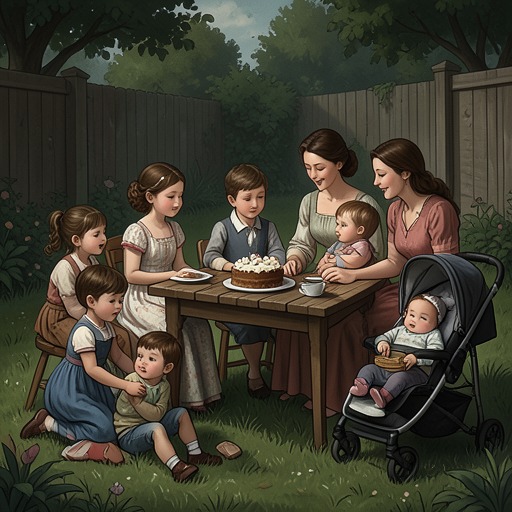
Laurie is presented as an older woman who is still energetic and active, though Tabitha notices that she is surprisingly young by the standards of Tabitha’s remembered future. She has a slight, almost frail build, short brown hair, and crow’s-feet at the corners of her eyes. She lives in an apartment with a porch and a garden, a domestic setting that contrasts with the disorder and deprivation elsewhere in the family. Her household also contains considerable noise and disruption: Sam, Aiden, Nick, and Joshua race about with identical buzz-cuts, one carrying a driveway marker and the others wielding sticks. Laurie watches them from her chair, maintaining at least the appearance of supervision while the boys turn her home and garden into an unruly playground.
Her care is practical rather than sentimentalized. When Tabitha arrives needing food compatible with her determination to become healthier, Laurie initially worries that she has little to offer beyond cucumbers. Once Tabitha says she can eat them, Laurie leads her to the garden and has the children gather cucumbers and tomatoes. She also gives Tabitha lettuce from the refrigerator and several cans of sweet peas. The tomatoes are still yellow and orange, but Tabitha knows they will ripen if stored in a dry, partially enclosed place, and the visit prompts her to consider starting a garden at the trailer. Laurie’s support therefore reaches beyond the immediate meal: it helps Tabitha imagine a modest form of future self-sufficiency.
Care for Tabitha
Laurie becomes increasingly important as Tabitha attempts to remake a life whose dangers she remembers from another timeline. At first, Tabitha’s frequent visits are conspicuous. Laurie points out that Tabitha has been coming by every other day, despite having said she wanted to see her more often, and asks whether everything is all right. Tabitha has arrived after another argument with Shannon Moore, exhausted enough to collapse on the porch steps. Laurie does not dismiss the conflict or demand that Tabitha return home immediately; she moves from her chair to sit beside her and asks what happened.
The porch consequently functions as more than a physical setting. It is a threshold between the family’s pressures and a temporary space for disclosure. Tabitha can admit that she is in trouble, ask for help, and acknowledge the emotional damage caused by her confrontations with her mother. Laurie’s response is not shown as a complete solution, but as dependable presence. That distinction matters because Tabitha often believes that no one will listen to her, while Laurie repeatedly makes listening available.
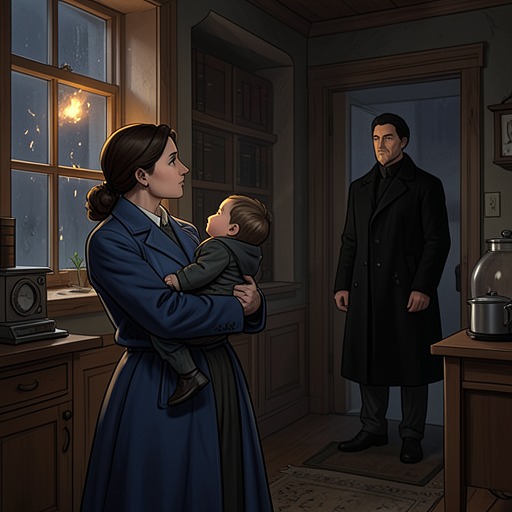
Laurie also acts when Tabitha is physically and emotionally overwhelmed. After Tabitha’s school crisis, Laurie picks her up in a borrowed Jeep belonging to her friend Nancy’s daughter. She anxiously inspects Tabitha and asks whether she is all right. Tabitha answers that she is not: she is exhausted, close to giving up, and unsure whether she can remain in school, even though she now has friends and wants to try. Laurie’s intervention provides immediate safety at a moment when Tabitha’s connection to school and home is becoming unstable. It also shows the limits of the family’s resources: the vehicle is borrowed, and the better transportation is explicitly contrasted with Danny’s old, unreliable car.
Information, Secrecy, and Family Conflict
Laurie is also an important channel of information in a family where Alan Moore and Shannon Moore fail to tell Tabitha what she needs to know. After the South Main shooting, Laurie calls as soon as Tabitha returns from school to ask whether she is safe and whether she has heard anything about the police officer. Her concern links emotional reassurance with awareness of public danger. Tabitha, who has difficulty sleeping after the violence, relaxes when she hears Laurie’s voice and slumps across the kitchen counter while trying to calm herself.
During the same period, Laurie reveals that Danny Moore was arrested about a week and a half earlier. He had been caught on surveillance cameras stealing roughly thirty thousand dollars’ worth of IBM, Compaq, and Toshiba personal computers from a pallet behind a Service Merchandise department store at Sandboro Mall. Tabitha is furious that her parents never told her, particularly because she remembers that the arrest was supposed to have been discussed in her previous life. Laurie’s account exposes both the practical instability of the wider family and the emotional distance between Tabitha and her parents. Laurie cannot repair that silence, but she becomes the person through whom Tabitha learns what has been withheld.
Her role is therefore protective without being omniscient. Laurie recognizes that something is wrong, asks direct questions, and supplies information, yet the evidence does not portray her as able to control the family’s larger failures. The children remain exposed to harsh discipline, adults continue to argue, and Tabitha’s decisions eventually place her in open conflict with Alan Moore. When Tabitha announces that she is going to stay somewhere else for a while, Laurie is not present in the immediate confrontation, but the contrast is clear: Laurie’s home has become one of the places Tabitha can imagine turning to when the Moore residence no longer feels tenable.
Generational Witness and Narrative Role
Laurie’s relationship with Tabitha gains additional weight from the temporal structure of Tabitha’s life. Tabitha remembers Laurie from the future, yet encounters her at an age and vitality that make the remembered family history feel strange and unstable. The grandmother is not merely an inherited figure from Tabitha’s past; she is a living person encountered before the consequences Tabitha knows have fully unfolded. Tabitha’s shocked recognition that Laurie is younger than she is in the future turns the visit into a confrontation with time itself.
This temporal dislocation also sharpens Laurie’s function as a witness. Tabitha carries knowledge of Jeremy Redford’s death, Danny’s arrest, the South Main shooting, the abuse of Ashlee Taylor, and the future consequences of family decisions, but she cannot always remember every face or act clearly. Her guilt over abandoning Ashlee and her distress over failing to intervene in the earlier timeline show how unreliable memory and moral responsibility overlap. Laurie does not possess Tabitha’s future knowledge, yet her ordinary questions create a stable human counterpoint to Tabitha’s overloaded awareness.
Laurie’s importance is ultimately cumulative. She feeds Tabitha when the girl is trying to change her body and habits, listens after conflict with Shannon, calls after public violence, discloses family news, and retrieves Tabitha when school becomes unbearable. These acts do not erase poverty, abuse, secrecy, or estrangement, but they form an alternative family pattern inside them. Laurie represents care that is concrete enough to be trusted: a garden opened to a hungry child, a chair left for someone in distress, a phone call made promptly, and a borrowed Jeep used to bring her home.