Hannah MacIntire
REHannah MacIntire is the seven-year-old daughter of Darren MacIntire and Sandra MacIntire, and one of the book’s most vivid child characters. She enters the story through an adult crisis—the shooting that leaves her father critically injured—but she is not reduced to a symbol of innocence. Small, observant, talkative, and emotionally direct, Hannah becomes an active presence in Tabitha Moore’s recovery and eventual decision to leave her parents’ home. Her scenes repeatedly place adult secrecy, institutional authority, and family distress beside a child’s urgent demand to know, help, and belong.
Identity and Introduction
Hannah is introduced as a first-grader whose parents are away in Louisville while Darren receives treatment. Matthew Williams explains to Tabitha that the Williams family has been caring for Hannah and that he is relieved not to have to give her bad news about her father. Sandra MacIntire and Karen Williams deliberately limit what Hannah is told: she knows only that her father has been hurt and that the family will go to see him. This protection also leaves her positioned at the edge of the adult conversation, physically waiting in the car while others discuss the seriousness of the situation.
When Tabitha first sees her, Hannah is small for seven and appears especially tiny inside what seems to be Matthew Williams’s blue-and-white varsity jacket, marked with the Springton S. Her large green eyes, round cheeks, and dark wispy hair gathered into a long ponytail make her immediately recognizable as young, but her cautious observation from the back seat also establishes that she understands more than the adults are saying. Tabitha greets her and admits nervousness about meeting Darren again, since the only previous encounter occurred when he was injured. The exchange gives Hannah a limited but meaningful role in the event: she is not told the whole truth, yet she is present at its human center.
Relationship with Tabitha Moore
Hannah’s relationship with Tabitha develops through repeated contact rather than through a single formal introduction. At the MacIntire home, she calls out an enthusiastic greeting, stops at the porch, and beckons Tabitha toward the others. Her excitement contrasts with the guarded adult handling of Darren’s injury and helps turn the house from a place of medical anxiety into a social space where Tabitha can participate.
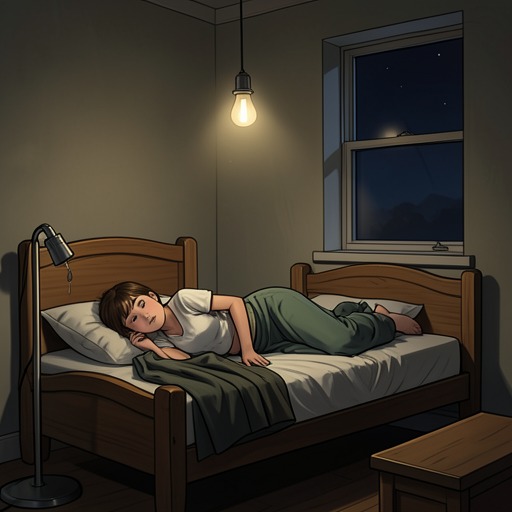
The bond becomes more intimate when Hannah finds Tabitha experiencing a nightmare. She calls for her mother, insists that Tabitha is having a bad dream, and protests that Sandra had promised there would be no nightmares. When the adults initially do not respond quickly enough, Hannah stamps her foot and repeats the warning. She then squeezes Tabitha’s hand, gently shakes her, and pleads for her to wake up. The scene reverses the expected direction of care: the seven-year-old is the one who notices distress, summons protection, and offers physical reassurance. Hannah cannot explain the nightmare or cure it, but she can refuse to leave Tabitha alone in it.
By the time Tabitha is preparing to leave the hospital, Hannah has become part of the daily emotional landscape. Darren’s exaggerated pout while his daughter is present strikes Tabitha as endearing, revealing a softer and more playful aspect of him. Sandra and Hannah are visiting during Tabitha’s goodbye, and Tabitha’s parents remain near the door while she enters the crowded room. Tabitha is eager to leave the hospital but recognizes that she will miss seeing Hannah every day. Hannah’s importance therefore extends beyond comic energy: her regular presence has made an otherwise painful institutional setting feel inhabited and relational.
Childlike Agency and Family Boundaries
Hannah’s speech and behavior are exuberant, but they are not merely decorative. She wants to guide visitors, control the flow of information, and take part in decisions that adults frame as theirs alone. At the MacIntire home she hurries back after seeing Tabitha awake, then returns carrying a can of Dr Pepper. She explains with solemn intensity that the children are allowed to drink as much pop as they want until six o’clock, listing Dr Pepper and root beer as though reporting an important household rule. The detail gives her a distinct domestic authority: within the children’s world, she is a confident witness and self-appointed interpreter.
Her desire to participate also appears in her insistence that she is nearly old enough for greater privileges. When adults tease her about maturity, Hannah argues that she will turn thirteen in only a few years and is almost old enough. The claim is comic because the distance between seven and thirteen remains substantial, but it echoes Tabitha’s own insistence that thirteen makes her a young woman rather than a child. Their parallel language creates an understated connection between them: both resist being defined solely by adult judgments about age, even though Tabitha possesses knowledge and responsibilities far beyond Hannah’s experience.
At the same time, the adults repeatedly negotiate Hannah’s access to difficult realities. Karen Williams keeps her away from the initial discussion of Darren’s condition, and Sandra must decide how to explain what happened. Later, when Tabitha considers staying elsewhere, the adults reassure her that she is not a bother and that Hannah has always been treated in the same spirit of welcome. Hannah is consequently part of a family system that protects children while also asking them to absorb emotional consequences they do not fully understand. Her presence makes visible the tension between safety through shielding and respect for a child’s capacity to perceive.
Presence During Tabitha’s Departure and Recovery
Hannah’s attachment to Tabitha continues after Tabitha decides to leave her parents’ home. Tabitha tells Alan Moore that she will stay somewhere else for a while and seeks permission to remain with the MacIntire family for as long as necessary. Karen Williams assures the family that Hannah talks about Tabitha all the time and wants to come over to “babysit” with her. The proposed role reversal is characteristic of Hannah’s relationship with Tabitha: Hannah imagines herself as a helper and companion, even though the adults are the ones responsible for safeguarding both girls.
Hannah also appears during the later period in which Tabitha is awake and recovering. She bursts into the bedroom, sees Tabitha awake, and immediately runs back down the hall before Tabitha can greet her. Her retreat is followed by an indignant attempt to defend herself: she insists that she did not wake Tabitha because Tabitha was already awake, then loudly assures her mother that she is using her inside voice. The scene preserves Hannah’s mixture of affection, impulsiveness, and theatrical self-justification. She brings energy into a room organized around illness and convalescence, making recovery feel like a shared household event rather than a solitary medical milestone.
Sandra’s reassurance that Tabitha was allowed to rest, followed by Hannah’s report about the freely available soft drinks, further places Hannah in the role of an eager host. She wants Tabitha to understand the rules and pleasures of the house. When Sandra tells Tabitha that the family is happy to have her and that Hannah is treated the same way, the MacIntire home becomes an alternative to the instability of the Moore household: not perfect or free of adult problems, but capable of making room for a distressed child without treating her as an inconvenience.
Narrative Role and Significance
Hannah functions as an emotional witness to the consequences of violence without possessing the adult vocabulary for them. Her father’s injury is filtered through partial explanations; her nightmare scene shows how trauma reaches her indirectly; and her visits to Tabitha make care reciprocal rather than one-directional. She is protected from explicit knowledge, yet she recognizes fear, exhaustion, absence, and the need for reassurance. The narrative uses that gap to show that concealment can postpone information but cannot prevent children from sensing a crisis.
Her connection with Tabitha also complicates the book’s recurring conflict over age and authority. Tabitha, despite insisting that she is a young woman, is repeatedly treated as a child by schools, parents, hospitals, and officials. Hannah is genuinely seven, but she is still allowed moments of initiative: she greets visitors, reports household customs, challenges adult teasing, notices Tabitha’s nightmare, and tries to help. Their contrast suggests that maturity in the story is measured less by chronological age than by whether a person is permitted to act, speak, and be believed.
Hannah’s final significance lies in the kind of belonging she offers. Tabitha leaves her parents’ home amid conflict and seeks refuge with the MacIntire family, where Hannah’s affection is already established. The child’s repeated welcome does not solve the adults’ legal, medical, or family problems, but it supplies evidence that Tabitha is wanted. Hannah therefore embodies the smallest and most persuasive form of chosen-family recognition: not a declaration, but a child who remembers someone, asks when she can visit, reaches for her hand during a nightmare, and assumes that there will be room for her in the house.