Pamela Cribb
REPamela Cribb is a forty-nine-year-old member of the Springton school board whose decisive intervention brings official force to the crisis surrounding Tabitha Moore’s harassment at Springton High. Although she is ostensibly only a board member, the small district relies on her for extensive inter-school oversight in place of an assistant superintendent. She arrives after the school administration has treated the conflict as something that can be smoothed over, and her anger, investigation, and direct contact with Tabitha reveal how badly the institution has failed to respond.
Identity and Institutional Role
Pamela Cribb enters the school-board office already convinced that the situation is far from resolved. Principal Edwards’s satisfaction irritates her because Karen Williams had called her late the previous night, angry and nearly in tears. Pamela and Karen are longtime friends, fellow members of the Springton United Methodist Church, and participants in the Women’s Fellowship Choir; Karen’s social connections also make clear how quickly the school’s failure can become a wider community scandal. Pamela therefore approaches the case not as an abstract disciplinary dispute but as an emergency that is spreading through families, the school, the police, and the courts.
Her appearance and behavior reinforce the contrast between official composure and private alarm. Wearing a pumpkin-patch sweater over a button-up blouse with suit pants, she searches impatiently through Halloween candy behind the front desk while demanding that Principal Edwards understand the severity of the matter. The ordinary candy dish becomes part of the institutional absurdity: a school crisis involving threats, harassment, and possible litigation is being managed from an office whose personnel still behave as though the problem were a minor disagreement.
The Harassment Investigation
Pamela orders Erica Taylor, Brittney Taylor, and Kaylee Mendolson removed from class and placed under suspension. When Principal Edwards objects that the evidence is merely one student’s word against another’s, Pamela invokes the school board’s immediate harassment investigation rather than allowing procedural hesitation to protect the accused students. She reports that the Springton police have a county lawyer preparing charges, that the parent-teacher association is already receiving angry calls, and that Seelbaugh and Straub has issued a second notice of claim.
Pamela also rejects the principal’s attempt to reduce the matter to the conduct of Chris Thompson. She insists that the school board is being threatened with lawsuits based on information it has not yet collected and warns that the consequences may extend beyond a few expulsions. Her fear of a legal battle is not presented as a purely self-protective concern: she understands that a failure to investigate promptly has allowed the conflict to snowball, placing both the students and the district in danger.
Her meeting with Clarissa Dole shows the same firmness. Clarissa protests that she cannot be suspended, but Pamela explains that suspension is a temporary measure keeping her away from school grounds until an expulsion hearing. The one-on-one meeting is an effort to make the gravity of the case unmistakable to a student who continues to bully Tabitha Moore. Pamela’s authority is disciplinary, but it is also corrective: she is trying to restore the school’s capacity to recognize conduct that its administration previously minimized.
Discovery of Tabitha’s Manuscript
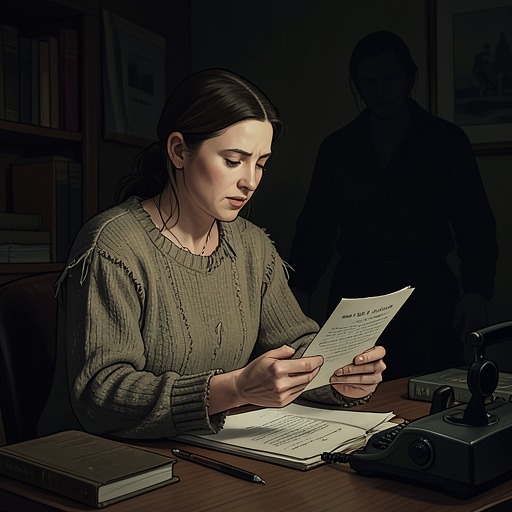
Pamela’s investigation changes when she examines Tabitha’s blue plastic binder. It is plainly marked as Tabitha Moore’s property and is nearly overfilled with orderly pages, leaving almost no blank space. At first Pamela assumes that the material must be classwork, perhaps an unusually demanding assignment from an advanced-placement course. The absence of ordinary class or assignment headings makes her curious, and she begins reading from the front.
What she finds is an extremely detailed outline for a fiction novel titled Goblina. The binder records elaborate story structure and sustained literary analysis at a level Pamela considers comparable to university work, far beyond what she expects from a thirteen-year-old freshman. The discovery forces her to revise her understanding of Tabitha: the student is not merely a victim whose complaint must be processed, but a highly capable writer whose intellectual life has been developing outside the categories the school uses to measure her.
Pamela also recognizes that the manuscript is not interchangeable school property. After Clarissa Dole steals it during a bathroom break and throws it into the trash in a nearby ladies’ room, its recovery becomes an important part of Pamela’s visit to the Moore household. When she returns the binder, Tabitha grips it tightly and explains that the book is more than a coping mechanism and that she cannot explain how important it is. Pamela’s earlier curiosity becomes remorse when she realizes that she had viewed the narrative from the wrong perspective and had failed to understand its personal stakes.
Protection, Apology, and Leave
At the Moore residence, Pamela introduces herself to Tabitha as a representative of the school board and speaks with Tabitha and Shannon Moore in the kitchen. She explains that Clarissa admitted stealing the notebook, while Kaylee Mendolson was responsible for spreading the malicious rumor involving Tabitha and Mr. Simmons. She further states that the rumor could have cost Mr. Simmons his job and that Kaylee will face expulsion in light of the broader circumstances. The school’s response thus reaches beyond the direct theft of the manuscript to the reputational danger created by the rumor.
Pamela offers Tabitha an institutional apology as well as concrete protection. She acknowledges that Springton High’s administration acted too little, too late, or not at all when it should have given the harassment its full attention. She tells Tabitha that several teachers have recommended advancing her a grade because the freshman curriculum does not challenge her, and she says that the board wants her to continue at Springton High in a completely safe learning environment. Yet she does not treat academic advancement as a substitute for safety.
When Tabitha refuses the description of herself as brilliant and begins to resist returning immediately, Pamela does not force the issue. Instead, she proposes a leave of absence until after the expulsion hearings, allowing Tabitha to rest and recover before deciding what she wants to do. Tabitha agrees to this arrangement. Pamela’s response marks a shift from the school’s earlier pressure to contain the dispute toward an acknowledgment that Tabitha’s recovery and agency must determine the next step.
Continuing Connection and Narrative Function
Pamela’s final recorded role is not limited to the school investigation. Later, she offers by telephone to drive Ashlee Taylor to visit Tabitha, who is receiving too few visitors. Her cheerful expectation that Tabitha will be delighted to see Ashlee contrasts sharply with Ashlee’s awareness that fading marks are not the same as erased trauma. Pamela cannot fully comprehend the lasting pain carried by Ashlee’s abuse, but her willingness to arrange the visit helps reconnect two girls whose experiences have made Tabitha one of the few people Ashlee believes might truly understand her.
Pamela functions as a late but necessary institutional witness. She cannot undo the bullying, the stolen manuscript, the rumor, or the damage already inflicted, and her investigation begins only after the crisis has become impossible to ignore. Nevertheless, she identifies the failures that allowed the harassment to continue, disciplines several responsible students, recognizes the intellectual and emotional importance of Goblina, and creates room for Tabitha to recover outside the immediate reach of Springton High. Her significance lies in that belated transformation of authority: the school board becomes protective only when Pamela insists on seeing the student, the evidence, and the consequences together.