Moore cousins
REThe Moore cousins—Joshua, Nicholas, Aiden, and Samuel—are the four young boys in the Moore family whose behavior supplies both comic disorder and one of the clearest small-scale signs of change in Tabitha Moore’s family world. Their movement from foul-mouthed, restless children to a coordinated group capable of listening, practicing, and standing still gives their appearances a modest but meaningful arc: discipline does not erase their childhood energy, but it makes that energy usable within a family that is repeatedly trying to rebuild itself.
Identity and Introduction
The cousins are elementary-school-aged boys who arrive together as a characteristically difficult group. On one Halloween visit, Grandma Laurie orders them to sit on the sofa and warns that one more foul word from any of them will cost them trick-or-treating. Their silence and stiff expressions suggest that the warning comes after trouble rather than before it. The scene presents them collectively first: they are a boisterous unit, more easily recognized by their shared reputation and behavior than by individual distinctions.
Their costumes briefly give them separate visual identities while preserving their comic togetherness. They dress as the brightly colored winterwear-clad main cast of South Park. Tabitha can identify Joshua with certainty because he wears the orange hoodie associated with Kenny, the character who dies in every episode. The detail places the boys inside the popular culture of their period while also emphasizing Tabitha’s partial distance from ordinary childhood knowledge; she recognizes one cousin through an especially conspicuous costume, while the group remains a shifting cluster of names, clothes, and noise.
Family Scenes and Collective Behavior
The cousins’ presence turns the Moore trailer into an unusually crowded household. When Elena Seelbaugh arrives to help with trick-or-treating, she greets Joshua, Nicholas, Aiden, and Samuel by name and immediately takes charge of the expedition. She announces a strategy meeting, spreads a black-and-white photocopy of a Springton map across the coffee table, and marks routes with pink, blue, and yellow highlighters while asking the boys to identify where they live. Her authority changes the atmosphere: the children who had required Grandma Laurie’s threat become an obedient huddle capable of participating in a plan.
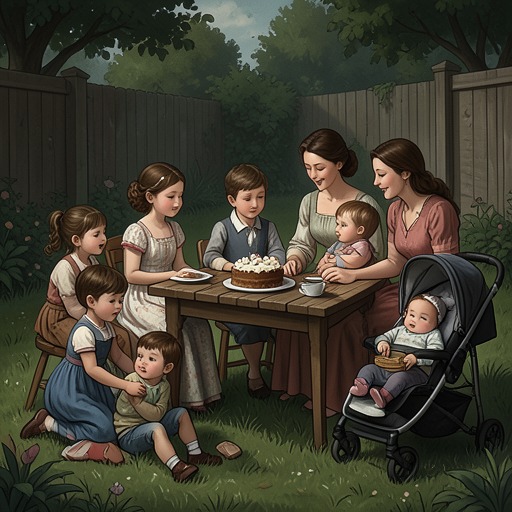
The family’s Halloween arrangement also reveals that their behavior is not treated as a private inconvenience but as a shared responsibility. Grandma Laurie manages the household, Elena organizes the outing, and Tabitha watches from the kitchen while having her hair prepared. The cousins’ presence makes the Moore home feel like a madhouse, yet it also draws relatives and friends into practical cooperation. Their disorder creates the immediate problem; the adults and older girls answer it through supervision, humor, and collective care rather than by excluding the boys from the celebration.
A second family gathering shows the same energy after Tabitha returns home. Grandma Laurie and all four cousins welcome her, and the trailer again fills with raised voices as the boys struggle to contain their excitement. They would crowd Tabitha with questions if Mrs. Moore did not hover protectively over her. Joshua asks whether she really died, while Aiden tells her that they missed her. Their questions are childish and blunt, but their emotional meaning is direct: Tabitha’s absence has been registered as a frightening disruption, and her return is greeted as a family event rather than a quiet medical recovery.
Discipline, Cooperation, and Change
The cousins’ most important development appears in a later playground scene. On the frigid November mulch, all four stand in a line with one fist extended in a punch and the other drawn low against the body. Their identical stance makes them look briefly like a trained formation rather than four distracted children. Tabitha feels unexpectedly proud and emotional because the boys, once restless fidgets unable to contain their energy, are now standing still together.
This change is especially significant because Tabitha has experience helping to manage young children at Lee’s Martial Arts. She knows how difficult it is to corral them, and she has taught the Moore cousins only about a dozen practice sessions. Their improvement therefore exceeds the immediate duration of her instruction. Even during her absence in the hospital, they have continued practicing and appear to have grown more disciplined. The narrative makes their progress a quiet counterpart to Tabitha’s own interrupted life: while she was physically removed from the family, habits she helped establish continued in her place.
Tabitha praises them while walking down the line as if inspecting troops, and the cousins’ discipline becomes a shared accomplishment rather than a punishment imposed from above. Their stillness does not make them less childlike; it gives form to their enthusiasm and makes listening possible. Earlier, Elena’s map exercise converted their energy into a trick-or-treating strategy. Later, martial-arts practice converts the same energy into coordinated bodies. Across both scenes, the boys learn through repetition, attention, and relationships with older figures who treat them as capable of improvement.
Narrative Role and Significance
The Moore cousins function as a recurring barometer of domestic order. At first, Grandma Laurie’s threat to cancel Halloween establishes them as a source of noise and misbehavior. Their enormous piles of candy later become a collective object when Sam pushes his share into the middle and the other three add theirs, accepting a proposal to pool the candy while Alicia Brooks insists that Tabitha take at least one piece. The mound of candy turns individual accumulation into a shared family arrangement, mirroring the cousins’ broader movement from four competing impulses toward a cooperative group.
Their reactions also make Tabitha’s medical ordeal legible at a child’s emotional scale. Joshua’s question about whether she really died and Aiden’s declaration that the boys missed her compress the terrifying uncertainty surrounding her condition into simple speech. The cousins do not explain the hospital events, but their confusion and affection reveal what those events cost the household. When they later stand in disciplined formation, their achievement marks more than improved behavior: it demonstrates continuity during Tabitha’s absence and gives her a concrete sign that her influence has survived.
The boys therefore occupy an important supporting position in the story’s family-rebuilding pattern. They are comic, unruly, and sometimes difficult to control, but they are also responsive to care and capable of change. Their arc does not depend on a dramatic revelation or a solitary triumph. It is measured in smaller acts—sitting quietly, listening to Elena, sharing candy, practicing, and holding a stance. Through those acts, the Moore cousins embody the book’s recurring suggestion that recovery becomes visible not only in hospitals or major confrontations, but also in the altered behavior of children who are waiting at home.