Joshua
REJoshua is one of Sam, Aiden, Nick, and Joshua, the four cousins who fill Grandma Laurie’s apartment and surrounding play spaces with noisy, improvised adventures. The boys are only a year apart, wear identical buzz-cuts, and are initially difficult for Tabitha Moore to distinguish from one another. Joshua’s importance lies less in a separate subplot than in the way his responses register Tabitha’s transformation: he moves from playful challenger to loyal relative, recognizing her strength and objecting when she is treated unfairly.
Identity and Family Setting
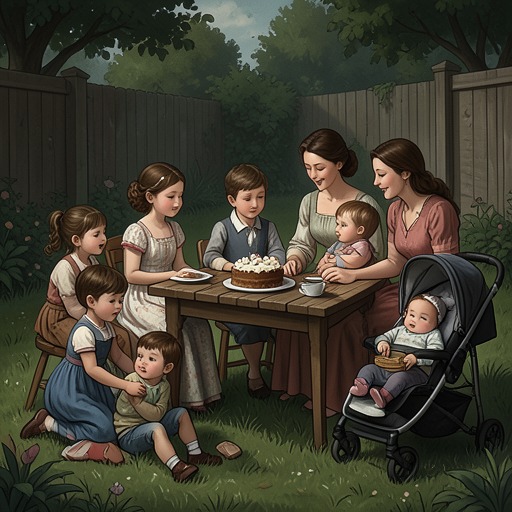
Joshua belongs to the Moore family’s tightly packed younger generation and spends much of the summer with Tabitha at Grandma Laurie’s apartment. When Tabitha arrives, the boys are running amok; one carries a driveway marker and the others wield sticks, creating the impression of a small, unruly mob. Grandma Laurie supervises them from her porch, suggesting a household in which energetic, loosely controlled play is ordinary rather than exceptional. Joshua is therefore introduced as part of a collective, but the narrative gradually gives him an individual moral and emotional position within that group.
His childhood perspective also produces comic misunderstandings. When Tabitha explains that acute trauma has supposedly unlocked the higher portions of her brain and made her extremely intelligent, Joshua’s younger companions mistake the phrase for “a cute drama.” Grandma Laurie clarifies that Tabitha means she became very smart after hitting her head, “Like a superhero.” Joshua’s world is still organized around games, dares, and literal interpretations, yet his later conduct shows that childishness does not prevent him from recognizing loyalty and injustice.
Summer Conflict and Changing Respect
The cousins test Tabitha’s claim to extraordinary intelligence by challenging her to calculate a thousand times a million. She answers that the result is one billion, shrugging off the boy who yanks at her arm. The exchange places Joshua and the others in the role of skeptical witnesses: they treat Tabitha’s changed mind as something to verify, while she treats their challenge as another exercise in managing the family’s expectations.
The more decisive change comes after Sam provokes Tabitha and she loses her temper. Days later, Tabitha apologizes for the outburst but warns Sam never to strike or mistreat her, or any other girl, again. She threatens to hit him just as hard if he repeats the behavior. Joshua sides with Tabitha because he believes she was in the right and had a sufficient reason for what she did. Nick and Joshua quickly persuade one another, and then both agree with Aiden, while Sam dismisses them as “wussies.” Joshua’s choice alters the cousins’ internal balance: Sam remains defiant, but he no longer tests Tabitha’s limits.
The change is reinforced by Tabitha’s physical transformation. Over the summer, the “tubby Tabby” the boys once mocked loses roughly a third of her body weight and develops startling athletic ability, including jumps, kicks from playground equipment, dive-rolls, and even a handspring. Her play leaves all four cousins exhausted. The boys come to regard her with fear and awe, imagining not a swan but a hawk or eagle with beautiful wings and powerful talons. Joshua’s support is thus not merely admiration for a stronger playmate; it marks his recognition that the old hierarchy, in which Tabitha could be ridiculed without consequence, has ended.
Family Loyalty and Emotional Care
Joshua later gives the clearest verbal expression of his attachment to Tabitha. When she explains that her changed appearance has made people notice her, even though such attention is shallow and based on appearances, Joshua tells her that he thinks she is really cool because she can perform flips and wall-walks and because she always plays with the boys. He asks whether they are her friends. Tabitha rejects the label in favor of family, telling him that they are cousins and therefore friends she cannot get rid of. The exchange defines their bond as more durable than ordinary friendship: it is teasing, involuntary, and permanent, but also dependable.
That dependability becomes physical and unmistakable when the cousins encounter Tabitha after their parents’ absence has caused them pain. Elena Seelbaugh sees Tabitha gently scold the filthy boys, dusting dirt and dead plant debris from them, then drop to her knees and pull all four into a giant hug despite her custom-designed clothing. Joshua and the others do not resist; they return the embrace, even though the oldest-looking boy offers Elena an embarrassed glance. Tabitha apologizes for what happened to their parents and wishes she had done something. Joshua’s participation in the hug makes him part of a shared grief that the boys cannot yet fully explain, while their willingness to accept Tabitha’s embrace shows the trust built beneath the earlier roughhousing.
Response to Tabitha’s Crisis
Joshua’s loyalty is most visible when Tabitha is overwhelmed at school. Grandma Laurie explains that someone has stolen one of Tabitha’s books, that Tabitha has left class, and that she is now sleeping on the sofa after a terrible day and week. The boys react with collective fury and disbelief because the theft confirms that other high school students are harming Tabitha without facing consequences. Joshua spits out that it is not fair, while Sam immediately tells him to be quiet for Tabitha’s sake and Nick points out that they are outside and she cannot hear them.
Joshua’s protest is small but significant. He cannot recover the stolen book or correct the school’s response, yet he names the moral injury plainly. Earlier, he recognized Tabitha’s right to defend herself against Sam; here, he recognizes her right to protection from a wider system of harassment. His childhood vocabulary reduces the situation to fairness, but that directness gives his response force. He does not treat Tabitha’s suffering as the price of her transformation or as entertainment in the way the cousins once treated their challenges. He treats it as an injury done to family.
Narrative Role and Development
Joshua remains a supporting character, but his development is legible through repeated acts of recognition. He first appears as one indistinguishable member of a noisy group, then becomes one of the cousins who accepts Tabitha’s authority after Sam’s aggression. He identifies with her when she is mocked, calls her impressive when her abilities and appearance change, accepts her definition of their connection as family, returns her embrace during a moment of parental loss, and protests when classmates steal from her. These moments give him a consistent ethical trajectory without removing his childishness.
His role also complicates the book’s transformation motif. Tabitha’s changed body and adult knowledge disrupt the family’s old image of her, but Joshua demonstrates that intimacy can be revised without being abandoned. He does not become an adult ally or acquire independent power; instead, he remains a child whose loyalty is expressed through play, agreement, physical closeness, and anger at unfairness. Through Joshua, the cousins’ relationship with Tabitha shifts from casual mockery toward respect and protection, showing how family can witness a person’s change and still claim her as one of its own.