Alicia Brooks
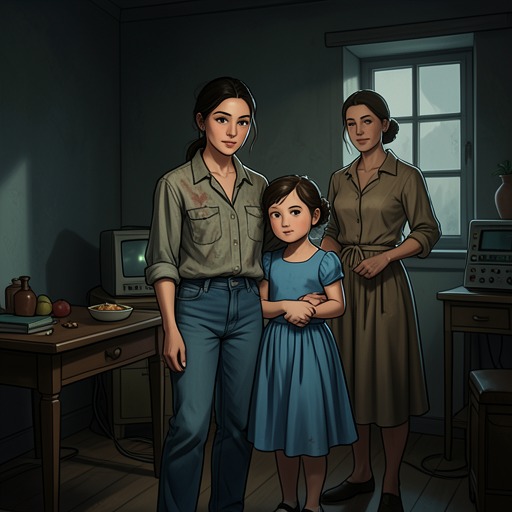
REAlicia Brooks is the artist and school friend whose wary intelligence turns Tabitha Moore’s return to 1998 from a private impossibility into a shared human problem. Initially isolated at Springton High, Alicia protects herself through drawing and self-effacement; after meeting Tabitha, she becomes the person most willing to question Tabitha’s secrets, accompany her through danger, and accept the practical burden of a future she does not fully believe. Her importance lies not only in loyalty but in witness: Alicia sees the shooting, tests Tabitha’s claims, recognizes the cost of her silence, and remains present when time itself proves unstable.
Identity and Introduction
Alicia enters the story through the artwork displayed beside military heroes. Her portrait presents her as a softly smiling African American woman in oversized glasses, while the accompanying drawings show sorrowful faces and the detailed naked back of a woman. The display identifies her as an accomplished artist whose work has appeared in Sports Illustrated, People magazine, and Playboy, establishing a contrast between public recognition and the private insecurity that defines her school life.
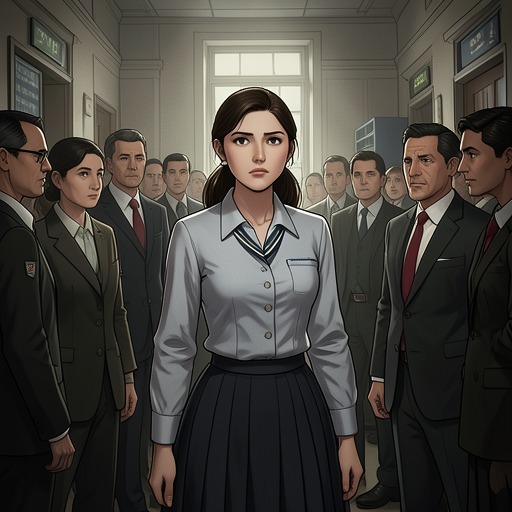
At Springton High, Alicia hates the experience of starting over. She knows few people from Fairfield Middle, receives little attention from those who do, and resents her parents’ assumption that a mostly white school must be better than Fairfield High. She understands that assumption as fundamentally racist rather than benevolent. She had planned to construct an eccentric, artsy persona, but rejects the look as contrived when she sees herself in the mirror. Instead, she wears her hair in a tight bun with glasses, a polo shirt, and jeans, imagining herself as an invisible Black extra without a speaking part.
Her sketchbook is both artistic instrument and defensive shelter. Alicia keeps it open on her desk to avoid meeting classmates, but anxiety and frustration leave her with only cross-hatching, floating eyes, and cube shapes. Tabitha’s approach breaks through that retreat. Seeing the sketchbook, Tabitha introduces herself and asks whether Alicia draws. Alicia responds cautiously, sitting straighter and becoming alert, while also noticing that Tabitha is the conspicuously popular red-haired girl attracting the attention of every boy in the classroom. Their friendship begins at the intersection of Alicia’s guardedness and Tabitha’s deliberate act of recognition.
Friendship and Shared Danger
Alicia soon becomes Tabitha’s most attentive friend at Springton High. She notices that Tabitha grows more high-strung and visibly distressed in class and at lunch, even though Tabitha refuses to explain the cause. In the library, Alicia interrupts Tabitha’s preoccupation and asks whether she is all right, then wonders whether the harassment at school is beginning to affect her. The question is significant because Alicia does not treat Tabitha’s unease as mere moodiness; she watches for patterns and presses against the silence surrounding them.
That attentiveness places Alicia beside Tabitha during the shooting of Officer Darren MacIntire. A thunderous crack, louder than any gunshot Alicia has heard on television, makes her flinch and search for its source. She sees the police officer collapse on the median, watches the fleeing driver escape, and initially remains frozen while trying to understand what has happened. The scene becomes real only when Tabitha runs toward the fallen officer. Alicia then helps respond to the emergency, stammers through communication with the dispatcher, and stands by while Tabitha and another officer struggle to control the bleeding.
The shooting changes the terms of their friendship. Alicia is shaken not only by the violence but by the possibility that Tabitha knew it was coming. She tells Tabitha that if they are going to be friends, Tabitha must explain what is happening. This demand is neither casual curiosity nor simple suspicion: Alicia has endured the scene physically and emotionally, and she understands that withheld knowledge may have placed her inside a danger she could not name. Her friendship therefore includes an insistence on accountability.
Alicia also experiences the distortions that follow Tabitha’s public reputation. At school, she hears claims that Matthew Williams asked Tabitha out, took her to Louisville, and kissed her because his father was one of the officers involved in the shooting. Alicia knows this does not match her own understanding of events and reacts with jealousy, irritation, and uncertainty. She wonders whether students are confusing Officer MacIntire with Officer Williams and hears others dismiss Tabitha’s rescue as fabricated publicity because she lives in the trailer park. These rumors show Alicia navigating both her private feelings and the school’s class contempt, while recognizing that Tabitha’s genuine actions are being converted into a spectacle.
Time Travel and Complicity
Tabitha’s future identity turns Alicia from friend into reluctant collaborator. During Halloween, Tabitha explains that Alphabet Corporation, remembered by Alicia as the company behind an internet search engine, may be an investment opportunity. Tabitha hopes Alicia will invest in Google, and Alicia agrees to help despite the distance between the present and the imagined future. Her support is practical rather than credulous: she says she would have gone in because they are friends even if she had not believed Tabitha.
Alicia then clarifies the limits of that belief. She had not actually accepted Tabitha’s story at first and says she would never have believed it until Tabitha described Alicia’s future artwork. That artwork becomes a private test no ordinary explanation can survive. Alicia’s skepticism is therefore not abandoned but revised by evidence specific to her own identity. She does not surrender judgment to Tabitha; she finds a fact that makes disbelief harder than belief.
When Tabitha finally tells Elena Seelbaugh that she has already lived through a different life beyond 1998, Alicia immediately blurts out that Tabitha is from the future. She recalls Tabitha’s advance knowledge of the shooting and supplies the emotional force that Tabitha’s careful language lacks. At the same time, Alicia understands that this is not a single stable future. Tabitha explains that the current passage through 1998 is different because of the changes she has attempted, and Alicia becomes one of the few people able to hold both versions of reality in mind.
The temporal crisis is not abstract for Alicia. Tabitha remembers that, in 2045, a prototype MRI accident sent her mind back forty-seven years, to the 1998 accident at the children’s hospital. Later, the MRI emits a painful shriek, blows the electrical breaker, and causes a power failure across Jefferson County while thirteen-year-old Tabitha lies inside it. Alicia is not the person inside the machine, but her friendship is shaped by the consequences of its failures: Tabitha’s knowledge comes from a life Alicia cannot see, and every attempt to alter events risks producing another version of the world.
Emotional Recognition and Limits
After Tabitha is attacked, Alicia suppresses information from Elena because Elena has become emotionally absent, attending school physically while grieving in a vacant, withdrawn state. Alicia recognizes that Elena’s grief is understandable, but her own connection with Tabitha has become more complicated than she can safely disclose. The crisis forces Alicia to admit that she may have a major crush on Tabitha, or at least an attraction and affection she cannot comfortably classify. She insists to herself that the feeling is probably not sexual, then recognizes that there is much more to it than mere interest in a possible time traveler.
Tabitha’s extraordinary status intensifies Alicia’s fixation, but it does not wholly explain it. Alicia studies Tabitha’s smallest slips because they may reveal the future, yet the text also distinguishes that investigative attention from the sense that Tabitha is irreplaceable to her. This doubleness keeps Alicia from becoming merely a sidekick fascinated by science fiction. She is simultaneously analyzing evidence, protecting a friend, confronting jealousy, and discovering an attachment that exceeds the explanations she first gives herself.
Alicia’s role is especially important because she combines skepticism with commitment. She does not believe Tabitha simply because Tabitha asks for trust, but she does not withdraw when the truth becomes frightening. Her demand for disclosure after the shooting and her willingness to consider investing in Google show two sides of the same ethic: intimacy requires honesty, while loyalty may require action before certainty is complete.
Narrative Role and Significance
Alicia functions as Tabitha’s ally and reality-check within a story organized by recursive time. She begins as someone who feels erased by the social world, describing herself through the language of a background extra, but becomes a central witness to events that others misunderstand or deny. Her artistic identity gives her a way to observe and record experience, while her skepticism prevents Tabitha’s future knowledge from becoming unquestioned authority.
Her Halloween costume crystallizes this development. Alicia arrives in an orange Star Wars rebel-pilot uniform with black boots and gloves, harness straps, air tubes, a toy lightsaber, and a pilot’s helmet. When Tabitha asks whether she is from Star Wars, Alicia answers that she is Luke Skywalker and has come to rescue her. The joke is playful, but it also reverses Alicia’s earlier self-image: the girl who once imagined herself without a speaking part now enters the scene visibly, theatrically, and with the language of rescue.
The image becomes more complicated when Tabitha’s second timeline collapses. During the MRI disaster, Tabitha reaches toward the machine as another blood vessel ruptures; in the ensuing void, a small delicate hand catches hers while the dreamlike F-22 falls away. Alicia is not explicitly identified as the unseen savior, so the scene should not be reduced to a literal confirmation that she rescues Tabitha across time. Yet its image resonates with Alicia’s earlier costume and with her established function in the narrative: she is the friend who reaches toward Tabitha when ordinary explanations fail.
Alicia therefore represents friendship as both rescue and witness. She cannot prevent every catastrophe, prove every version of reality, or eliminate Tabitha’s losses. She can insist on the truth, remain beside the injured, challenge the school’s malicious story, and accept that love may be present inside feelings she cannot yet name. In a novel where lives restart but consequences do not disappear, Alicia supplies continuity not through control of time but through the repeated act of showing up.