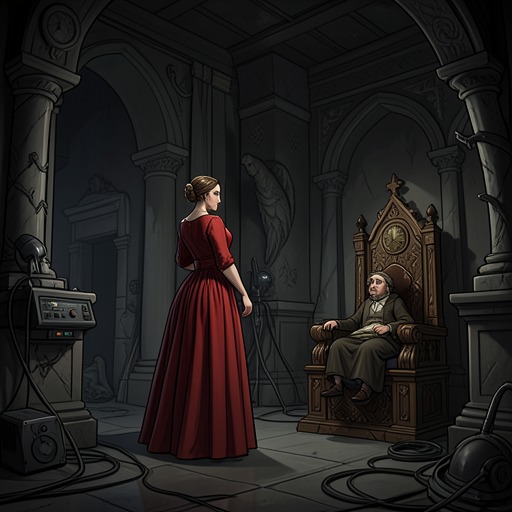
Beon
REBeon is a captive mage who serves as the group’s unwilling expert when Censede, the nameless girl, and their prisoner reach the Silk Road across the Ostskala. His decisive narrative function is to identify the white strand before them not as a merely difficult road, but as part of the web of a female Chimeric Dreadweaver. Beon’s knowledge gives the landscape its true scale and makes the proposed crossing appear less like an adventurous shortcut than a possible journey into a predator’s maw.
Identity and Introduction
Beon first appears through alarm rather than authority. On seeing the immense strand of webbing stretched from the cliff edge toward a distant, unseen height, he whispers that Censede and the girl are fools and demands to know whether they understand what they are facing. His horror distinguishes him from the others: where Censede recognizes a route and the girl sees a strange path, Beon immediately sees an ecological and military threat whose dimensions exceed ordinary experience.
His identity is specifically that of a mage, not a wizard. When Censede calls him a wizard, Beon corrects the title with a sneer, preserving the distinction even while held captive and surrounded by people who reject his warnings. The correction is small but revealing. Beon is exacting about professional language, and that precision accompanies the technical explanations on which the group’s survival may depend.
Knowledge of the Chimeric Dreadweaver
Beon explains that the Great Weaver is female and that the males are comparatively small, growing no more than two or three meters tall. Against a male, he says, a company of Mages might prevail; the females are an entirely different prospect. He further reports that male Dreadweavers are commonly eaten by female Chimeric Dreadweavers, turning the creature’s reproductive difference into another sign of its brutality and scale.
The information changes the meaning of the web. Beon recognizes the strand as a radial, part of the web’s frame, and explains that it is not sticky. The trapping lines would be constructed upon it in a capture spiral. This knowledge briefly answers the girl’s practical fear that the travelers will be immediately glued to the path, but it does not make the crossing safe. For Beon, the distinction between a nonsticky radial and a trapping line is a technical detail within a larger catastrophe, not reassurance.
He estimates that the web may stretch for entire leagues and perhaps across the sky over Ostsea. The group is therefore not approaching an isolated thread that can be crossed and forgotten; it is nearing a vast structure whose full extent lies beyond the girl’s sight. Beon’s language makes the unseen portion of the web more frightening than the visible strand. The danger is not confined to what the travelers can inspect, and the creature itself remains absent from view while dominating the scene.
Conflict over the Silk Road
Beon’s immediate objective is escape. He begs to be released so that he can return and warn the capital, at least of the presence of a Chimeric Dreadweaver so close to the border. His proposed warning would aid the enemy, which is precisely why Censede refuses it. Censede dismisses the request and insists that they will walk the Silk Road rather than provide information to the opposing side.
The disagreement is not simply courage against cowardice. Beon argues from specialized knowledge and visible probability: the route will lead to death, the web is too vast, and the creature is too powerful. Censede argues from precedent, reverence, and the necessity of the mission. He maintains that the Silk Road can be traveled by those who respect it, especially travelers small enough that their footsteps will not disturb the web. Beon rejects this spiritual logic as madness and suicide.
When Censede praises his wisdom but questions his courage, Beon’s response again protects his professional identity rather than softening the conflict. He is a mage, he insists, not a wizard. He then reconstructs Censede’s intended route: from the anchoring line to a bridging thread along the outer edge, down to the ground on the far side of Ostersjon, bypassing the outposts and checkpoints of the Northern Magi. His ability to infer the plan demonstrates that his objections are informed, not panicked ignorance. He understands exactly what Censede hopes to accomplish and considers the entire plan fatal.
Past Experience and Narrative Role
Censede’s claim that he has crossed the Silk Road before gives Beon’s disbelief a second function. The elder says he once made the journey with his Master and three other Goblin apprentices. Beon calls this impossible, refusing to accept that “some ignorant gobs” could have crossed leagues of web and survived. His contempt for the Goblin travelers exposes both his prejudice and his fear: the survival story threatens the certainty of his own prediction that the route cannot be crossed.
The history is darker than a simple success story. Censede reveals that the other three apprentices fell from the web, leaving only him. Their deaths confirm Beon’s warning that the route is traversable only at terrible cost. At the same time, they validate Censede’s claim that the Silk Road can be crossed. Beon is therefore not proven wholly right or wholly wrong. The road is possible, but its precedent is a record of attrition rather than safety.
Beon functions as a threshold voice at the moment the travelers leave ordinary ground. He names the concealed predator, translates the web’s physical structure, identifies the military consequences of delay, and insists on the danger that Censede’s faith cannot erase. His role resembles that of a reluctant threshold guardian in an adventure narrative, except that he is not guarding the passage by choice: his captivity forces him to accompany the people he believes are walking toward disaster.
Characterization and Significance
The available scene presents Beon as a sharply defined, survival-oriented character. His speech moves between precise instruction and exasperated insult: he can explain radial lines and capture spirals, then dismiss the proposed journey as a path leading directly into the Chimeric Dreadweaver’s maw. That combination makes him more than a source of exposition. His expertise is inseparable from his emotional response, because understanding the web’s design allows him to imagine the danger in greater detail than the others can.
His fear also supplies the scene’s gradated horror. First comes the unexplained white strand, then the revelation that it belongs to a Great Weaver’s web, and finally the recognition that the Weaver is a colossal female Chimeric Dreadweaver whose web may span the sky. Beon articulates each escalation. The threat remains partly unseen, but his technical explanation makes the unseen creature more concrete, not less.
Beon’s lasting significance in this episode lies in the tension he creates between knowledge and faith. Censede has experience, reverence, and a willingness to proceed; Beon has classification, calculation, and an urgent desire to retreat. The nameless girl stands between them, asking practical questions while absorbing the scale of the danger. Through Beon, the Silk Road becomes both a physical route and a test of whether survival depends on courage, belief, or the humility to heed expert warning.