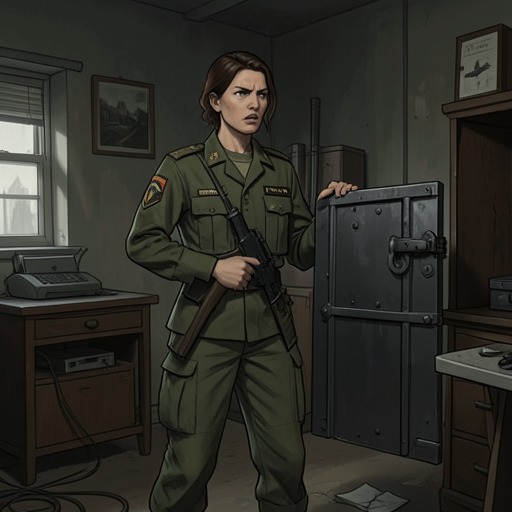
Colonel Pike
StrikeColonel Pike is a senior United States Air Force officer who rejects the government’s colonization of the past as an excuse for genocide. She helps lead a resistance plan built around destroying the Bridge, first acknowledging that her allies lack the forces to secure the past-side dome and then identifying SYLO as the necessary partner. At the future dome, she refuses to leave the nuclear device unattended: convinced that her past actions will bring execution or imprisonment in either era, she chooses to remain and see the device armed.
Identity and Position
Pike enters the account with the authority of a commander under pressure. When a suspicious leader questions her because she is not in uniform, she answers that her team is about to deploy and that the interruption is wasting her time. The exchange establishes both her operational urgency and the friction between her command presence and the circumstances around her. The leader identifies her as Colonel Pike, confirming the rank behind the curt reply.
Her later explanation places that authority within a broader military dissent. Pike says that she and her associates are career officers of the United States Air Force who love their country and took an oath to protect its flag. They have nevertheless concluded that the government’s direction, and the military’s role in carrying it out, cannot be accepted. Her objection is not framed as a disagreement over tactics: she condemns genocide as barbaric and immoral, and insists that it must stop.
Pike also knows the machinery of the colonization mission from inside. She acknowledges that the group has been fulfilling its duties in support of colonizing the past and understands every facet of the operation. She knows Colonel Feit from their time together at the Academy, and dismisses him as a tool. That personal history sharpens the contrast between shared institutional training and their opposed uses of military authority: Pike turns her experience against the mission, while Colonel Feit remains associated with its enforcement.
The Resistance Plan
When Tori Sleeper asks how a force without sufficient numbers can stop the United States Air Force, Pike first checks the room for the others’ willingness to continue. After receiving their nods and shrugs, she describes the plan as a rudimentary military tactic used since warfare began. Kenny Sokol gives its direct objective: destroy the Bridge. Pike’s brief pause before the disclosure suggests that the proposal is consequential even among the people preparing to carry it out; the plan is not presented as a routine operation.
The proposed method depends on nuclear devices housed in a heavily guarded building outside the dome. The resistance intends to smuggle one into the dome, seal the entrance, and detonate it inside. According to Pike, the physicists believe the resulting explosion has a strong chance of sealing the Bridge. If it fails to do so, radiation within the dome could still delay the invasion and colonization. Pike therefore presents the operation as a choice between two possible strategic effects: destroy the route to the past, or buy SYLO time to regroup and mount a better defense. The plan’s danger is explicit, but so is its logic: even an incomplete success could obstruct the invasion.
The proposal cannot work unless the resistance also secures the dome in the past. Pike accepts that her own side lacks the strength and numbers to capture it; when Kent Berringer points out that this makes the plan worthless unless they can find a way to do so, she confirms that they have devised one. The answer is SYLO. Tucker Pierce recognizes the force as the intended partner, and Pike’s small smile confirms his inference. This makes the strategy dependent on a broader alliance: the resistance must ask SYLO to confront ground troops and airborne machines, then hold the area around the dome so the Retros cannot stop the device from being detonated in the future.
Command at the Dome
At the dome, Pike remains involved as the operation moves from planning to immediate danger. After Olivia and another member of the group float the nuclear device to the center and lower it to the deck, an alarm raises the possibility that the false orders used in the operation have been exposed. Pike calmly identifies that risk, then turns to Liger and orders him to arm the device by six o’clock. Her composure contrasts with Kenny Sokol’s urgent reaction, as he orders his men to clear the dome. Two commandos carry unconscious soldiers outside and leave them at the door.
The incident shows Pike continuing to exercise command even as the operation’s concealment begins to fail. Her response is practical rather than reassuring: she names the likely cause of the alarm, sets the arming deadline, and keeps the mission moving. The countdown converts the plan’s abstract alternatives into an immediate decision. The nuclear device must be made ready while the dome is still vulnerable and the invasion force remains poised to pass through the Bridge.
Choice and Narrative Significance
Pike refuses Olivia’s implied appeal for her to leave. She explains that, after what she has done, the United States Air Force would not let her live in either era: she expects execution in the past or imprisonment for the rest of her life. Rather than flee toward either prospect, she says, “I’d rather go out in a flash of glory than be executed in the past, or spend the rest of my life in a cell. Please go. This is my decision and I’m okay with it.” The statement makes her continued presence at the device a conscious choice, not a failure to recognize the danger.
Olivia and the others move slowly toward the open door, where the Sounders are concealed behind armored vehicles and ready for another attack. Yet no soldiers charge the dome, and no counteroffensive begins; the immediate view is instead of the first giant attack plane waiting its turn to float into the past. Against that looming invasion, Pike’s refusal to abandon the device gives the resistance plan its most personal cost. Her opposition to genocide has led her from institutional service through complicity in the colonization mission to an act intended to halt it, even if the act leaves her to face death or imprisonment. The account leaves her at that threshold, resolved to stay and ensure the device is armed.