SYLO
StrikeSYLO is a secret military defense organization formed to stop the Retros from invading the past through the Bridge. Created in response to a hidden conflict between the governments of the present and future, it built a network of arks intended to preserve people and expertise through an attack and enable reconstruction afterward. Its campaign exposes both the necessity and the cost of that purpose: SYLO resisted an invasion that threatened society, yet compromised defenses and ruthless efforts to identify infiltrators left civilians caught in the fighting.
Identity and Founding
SYLO is identified with the Navy and led in the field by officers including Captain Granger. Its purpose was not initially obvious even to people living under its protection. On Pemberwick Island, SYLO soldiers established a base and imposed a quarantine on the island, publicly associating it with a virus that did not exist. The quarantine and military presence formed part of a larger effort to defend the island and other prepared sites from the Retros, whose attacks had devastated the world. The organization’s name and its guardian imagery acquire a bitter irony as the story reveals that the threat came not from an epidemic but from a future military force.
The plan to create SYLO grew from long-running tension between governments in the present and the future. For years, the future government pressed to reveal its existence, while the present government resisted disclosure out of concern for the consequences to society. The Bridge’s isolation helped keep the truth contained; speculation about an unusual military installation near Area 51 came close to the secret without identifying it. Meanwhile, a small group of scientists in the present was allowed to study the future. Their knowledge helped prompt efforts such as developing renewable energy, reducing greenhouse gases, and recycling, but those efforts could not readily overcome commercial and political resistance. The future’s environmental crisis therefore informed SYLO’s preparations even as the institution could not ensure that society would change course in time.
The Ark Strategy
SYLO’s answer to the possibility of invasion was to create smaller communities that could be defended and could preserve the capacity to rebuild. Captain Granger described these communities as arks. Over roughly ten years, hundreds of volunteers agreed to leave their established lives and relocate. Selection emphasized a broad range of abilities and backgrounds: doctors, engineers, architects, and musicians were among those whose skills were to be kept available, alongside people of different races and religions. Tucker Pierce’s family illustrates the practical logic of this policy: his father was a civil engineer, his mother an accountant, and Quinn Carr’s parents were doctors.
The arks were designed as a reserve for a future reconstruction, not as proof that SYLO could prevent the invasion. The organization intended to protect its population and preserve the knowledge needed to rebuild if the Retros were turned back. But the plan was compromised from within. Olivia explained that the future’s Air Force had sent spies through time to blend into communities and learn about SYLO and its bases. There were dozens on Pemberwick Island, and Captain Granger knew infiltrators were present without knowing exactly who they were. When SYLO activated the arks, it was already responding to an invasion underway: the forces had fought for more than a week around the Bridge, and the wrecked aircraft surrounding the dome marked an unsuccessful effort to stop Retro planes from crossing. SYLO then landed at Pemberwick Island, Catalina, Fort Knox, and other locations to make its last stand. The discovery that Retro spies had infiltrated the very sites meant to preserve society exposed the central weakness of the ark strategy.
Military Limits and the Pemberwick Defense
SYLO’s military position was markedly weaker than that of the Retros. During the flight back toward Pemberwick Island, Captain Granger rode in a Skyhawk while Cutter piloted and helped evade attack. The transport aircraft carried no weapons; as Captain Granger explained, offensive firepower belonged to the Cobras. The Retros, by contrast, used weapons that delivered powerful, nearly invisible energy bursts. Although the opposing forces belonged to branches of the United States military, the future Air Force had a serious technological advantage over SYLO’s Navy. SYLO could maneuver and resist, but its aircraft could not answer every attack in kind.
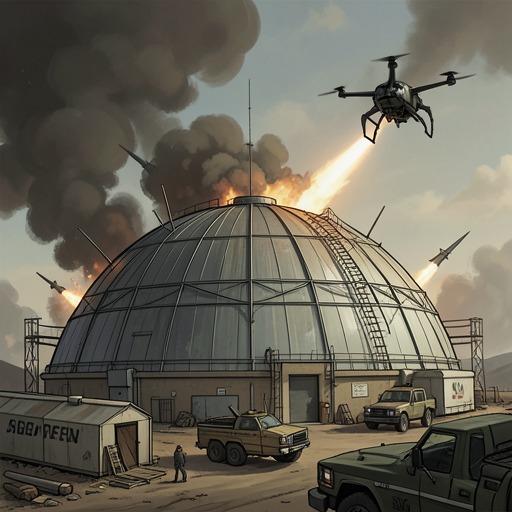
At the prisoner camp on Pemberwick Island, SYLO’s arrival did not initially mean rescue for those held there. Its aircraft appeared during an attack on the base, and the prisoners, uncertain where to take cover, were left in the line of fire. Retro fighters rose vertically around the dome to form a defensive perimeter, while SYLO jets launched missiles at the structure. Their immediate target was the gate to the Bridge, not the prisoners. The scene distinguishes SYLO’s strategic objective from the needs of those caught beneath the battle: the organization was attacking an access point central to the invasion, while the camp population faced the danger created by the clash around it.
SYLO’s counter-infiltration measures also make its defense morally complicated. Captain Granger acknowledged that his methods on Pemberwick Island had been ruthless, explaining that he had been trying to protect the ark after learning that infiltrators had entered it. Olivia said those who had been shot or arrested were Retro spies rather than innocent islanders attempting to escape, but Tori Sleeper objected that this did not describe everyone. Olivia conceded that Tori’s father had been caught in the crossfire, as Kent Berringer had lost his own father. The distinction between identifying an enemy and harming people in the midst of that effort remains consequential: even a defensive operation against real infiltrators could impose losses on families who were not part of the conspiracy.
Alliance and the Fight for the Bridge
SYLO’s campaign eventually depended on the Sounders, the resistance operating within the future’s military system. Olivia revealed that the Air Force had recruited her to support her family, then assigned her to espionage when it became clear that she was not suited to fighting with a Pulser. She and other infiltrators learned about SYLO’s defenses from inside the bases. Yet the Sounders’ role reversed that pattern: they resisted the Retro invasion and helped make a SYLO ground offensive possible by taking the drones out of play. Captain Granger said that SYLO had planned an attack on the test site for years but had been unable to carry it out while the drones remained an overwhelming obstacle.
The alliance transformed an operation that had seemed impossible into a coordinated attempt to protect the Bridge dome. The Sounders planned to detonate an atomic device in the dome at six o’clock, but success depended on the dome on SYLO’s side being secured. When Richard E. Neff thanked Tucker Pierce and authorized the mission, Captain Granger received the order he had been waiting for and moved to act. The plan linked several forms of resistance: the Sounders’ work against the drones, SYLO’s ability to mount a ground attack, and the defense of the structure needed for the detonation. SYLO could not win by technological parity; it had to exploit cooperation and a change in the conditions of battle.
The struggle at the dome shows how quickly that balance could change. Sounders and commandos came under pressure as the Retros threatened to retake the facility, while other commandos had to defend the drone command center where Sokol and the pilots controlled the aircraft. Losing that center would have returned the drones to Retro control. SYLO helicopters arrived as the defenders were being pressed, and armed commandos descended by zip lines before moving toward the dome entrance. The arrival provided reinforcements at the point where the defense risked collapsing. It also made SYLO’s contribution visible as one part of a wider effort rather than a solitary victory: the organization’s forces needed the Sounders to disrupt the enemy’s advantage, and the Sounders needed the dome defended for their plan to succeed.
Victory, Costs, and Legacy
Olivia’s account defines SYLO’s result in deliberately limited terms. The organization stopped the invasion and preserved society, but it did not reverse what the Retros had already done. People in the twenty-first century where Tucker and his friends had lived still had to confront the destruction and rebuild from what remained. Tori emphasized the Sounders’ contribution, and Kent added that he and his companions had also taken part. The outcome is therefore collective: SYLO fulfilled its purpose, but neither its own forces nor its ark plan alone explains the survival of society.
That victory does not erase the costs of SYLO’s methods or the failures of its preparations. Its bases were penetrated; the arks it had assembled as safeguards became sites of espionage and battle. On Pemberwick Island, the search for infiltrators and the defense of the base intersected with civilian lives, including those of people whose relatives were killed. At the same time, the organization’s strategic restraint had real limits: SYLO aircraft were outmatched, the drones could prevent a ground offensive, and its mission required help from resistance members inside the enemy’s ranks. The story presents SYLO as necessary to stopping the invasion, but not as an all-powerful or unambiguously protective institution.
The novel’s final image gives SYLO’s guardian identity a personal and generational dimension. A business card bears the organization’s name and the motto Today. Tomorrow. Forever. Tucker Pierce studies it as though it were a rare treasure. The closing declaration identifies the speaker and companions with the guardians and with SYLO, turning the institution from a distant military secret into an identity inherited and affirmed by those who fought alongside it. The name’s significance rests not only on the organization’s founding or its survival, but on the people who carry its purpose forward after the invasion has been stopped.