Tucker
StrikeTucker is the first-person narrator at the center of a chain of reversals in which survival does not amount to victory. Trapped with friends and family in an attacked helicopter, he survives its crash only to recognize that the Retros’ plans remain in motion. A woman then identifies him as “Zero Three One One,” a designation he rejects. His defining choices in these scenes are acts of recognition: he refuses the number, confirms that Kent is alive, calls out to the unexpectedly surviving Tori, and finally separates from his companions to pursue the truth at the dome.
Identity and the Number
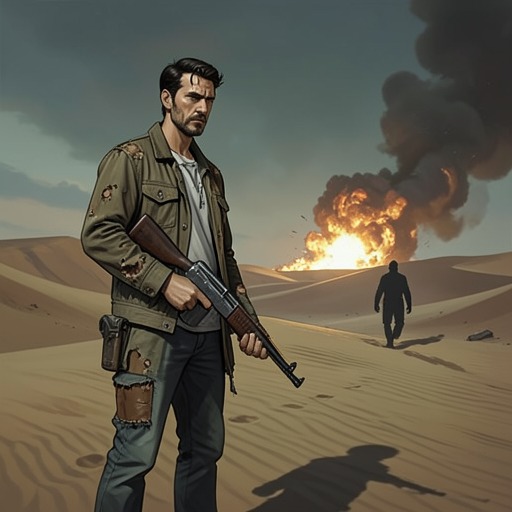
Tucker’s identity is placed under pressure immediately after the crash. The helicopter has gone down in the desert, and his first assessment of the aftermath is not relief but despair: destroying the Retros’ fleet of planes has not stopped their plans to reset society. He sees the apparent victory as short-lived and concludes that the group has failed. That judgment gives the next encounter its force. A woman standing at the foot of his bed calls him “Zero Three One One.” Tucker turns before thinking, realizes that the quick movement proves he is awake, and answers, “I’m not a number.”
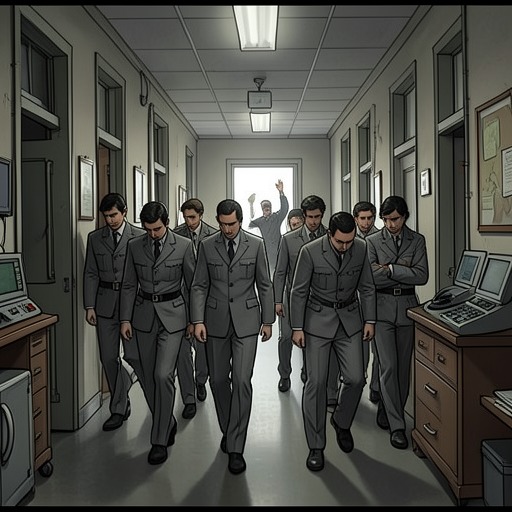
The exchange presents a sharp contrast between imposed classification and personal identity. The number is spoken as though it were sufficient to name him; Tucker’s defiant reply refuses that reduction. The scene does not explain the woman’s role or the circumstances represented by the designation, so the significance rests on the encounter itself: after a crash that has left him despairing and disoriented, he still asserts that he is a person rather than a label.
The Crash and Its Human Cost
Before the crash, Tucker is one of six people trapped in a military helicopter under attack, spinning out of control and dropping toward the ground. The darkness outside prevents them from judging their altitude or knowing when impact will come. He sits shoulder to shoulder with Tori on one side; Kent and Tucker’s mother, Stacy Pierce, sit opposite them. Tori has been shot in one leg, and Tucker reaches for her uninjured leg while she clutches his arm. Their physical closeness is a response to helplessness: none of them can control the aircraft or see the moment of impact coming, so they huddle together and brace for it.
The crash turns that shared fear into a reckoning. Tucker survives, but survival cannot be mistaken for the defeat of the Retros. In his assessment, the destruction of their planes has not put them out of business, and the larger objective of stopping their plan to reset society remains unmet. His sense of failure is therefore tied to consequence, not merely personal danger: the immediate disaster has not ended the threat. The short-lived victory makes the crash a reversal, in which surviving the impact leaves the central struggle unresolved.
Survival and Recognition
Tucker’s response to Kent’s apparent injury is practical but wary. After a fight, he sees Kent lying several feet away and crawls toward him while keeping hold of a pipe in case danger has not passed. Kent is face down. Tucker reaches for his shoulder, then hesitates, afraid of what turning him over might reveal and wondering whether his windpipe has been crushed. When he does turn Kent, Kent’s eyes are open and searching. He is dazed, but alive.
The moment narrows the larger disaster to a single uncertain question: whether a friend has survived. Tucker does not know at first; he has to approach, pause, and look. The pipe remains in his grasp even as he checks on Kent, a detail that keeps immediate danger and concern for his companion in the same scene. Kent’s survival does not erase the threat, but it changes what Tucker can know about the people beside him: at least one person he feared dead is still alive.
Tori’s survival brings a different kind of shock. Tucker sees her alive and well, calls, “Tori!” and immediately regrets speaking before thinking. His surprise has exposed him: Tori freezes and looks back to discover who has called her name. The brief exchange is consequential because the recognition is mutual in its tension—Tucker has revealed himself, and Tori has turned toward the voice. After the earlier image of her injured in the helicopter, her appearance alive is a reversal of the fear established before the crash.
The Choice at the Dome
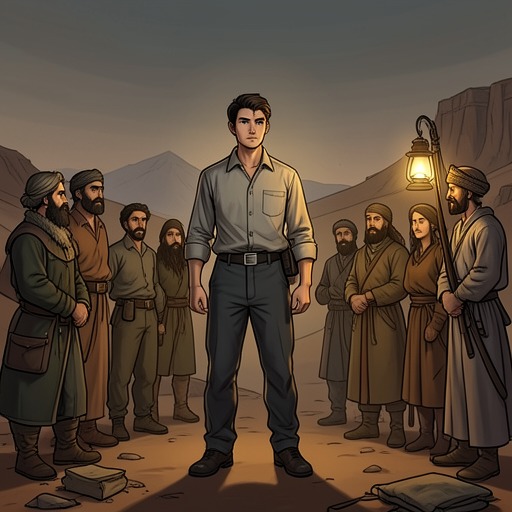
Tori proposes a route away from immediate danger: the group could escape, find SYLO, and bring help back. Tucker agrees that the others should disappear into the desert and try to reach SYLO, but he does not join them. He says that he has to stay and tells them that he loves them. Then he runs toward the dome before he can change his mind. His destination is also a declared purpose: he keeps his attention on the dome and on the truth he expects to find there.
The departure is deliberate, not a casual parting. Tucker hates leaving his companions and forces himself not to look back, concentrating instead on what lies ahead. The contrast between the two courses is plain: his friends are to seek SYLO beyond the immediate danger, while he turns toward the dome. The evidence does not establish what he will find there, but it does establish the choice’s cost and direction. He is alone again, moving toward an unresolved truth while those he loves take the alternative route.
Narrative Role
These scenes define Tucker through a sequence of decisions made under uncertainty. He cannot prevent the helicopter’s fall, and he initially misreads the destruction of the aircraft fleet as a victory that has already failed. Yet he resists being reduced to a number, checks whether Kent is alive, and calls out when he sees Tori. At the dome, his attachment to his friends is explicit, but it does not settle the question of what he must do; he leaves them because he believes he has to stay.
The narration’s first-person perspective keeps those reversals close to Tucker’s immediate understanding: the fear of impact, despair after the crash, hesitation before turning Kent over, and regret after calling Tori. The sequence does not offer an easy triumph. It ends instead with a divided group and Tucker running toward the dome, carrying both his attachment to the others and the unresolved demand for truth.